
You're closing month-end, but the evidence is scattered. A manager approved a purchase by email, someone's still looking for a card slip, and an overseas supplier says the amount received doesn't match the invoice. Your spreadsheet shows what left the bank account, not why the payment cost that much or who should explain the difference.
Spend management software should fix that operating problem, not give you another dashboard to maintain. For a South African exporter, the test extends beyond tidy approvals: can finance trace a purchase from request to ledger and explain the rand cost of delivering the agreed amount to the beneficiary?
Why South African Businesses Are Adopting Spend Management Software
The month-end scramble usually starts before month-end. A team leader authorises a subscription without naming a budget owner. A supplier sends an invoice to an employee rather than accounts payable. Finance discovers both commitments after the money has already moved.
Those aren't just missing-document problems. They're gaps between the person committing the business, the person approving expenditure and the person recording it. Buying software without deciding who owns those hand-offs moves the confusion onto a screen.
Start with the operating problem
Before evaluating products, write down the purchase journeys your team follows. Include employee purchases, supplier invoices, recurring subscriptions and international payments. Mark where finance loses visibility and where employees work around the current process.
For example, an overseas advertising purchase and a supplier invoice might belong to the same department, but they need different controls. The former may need a restricted card and receipt capture. The latter may require purchase approval, invoice matching and confirmation that the supplier received the agreed amount.
Practical rule: Buy against the transactions your team struggles to control, not the longest feature list in a sales presentation.
The right starting point is a written requirements list, not a vendor ranking. Your requirements should distinguish essential controls from optional conveniences:
- Commitment visibility: Can finance see approved purchases before they become bank transactions?
- Named ownership: Does each request have a requester, budget owner and accountable approver?
- Complete evidence: Can a reviewer follow the supporting documents without searching email?
- Payment accountability: Who investigates deductions, failed transfers and beneficiary shortfalls?
Set the implementation boundary
Decide what stays in your accounting system, what the new tool will control and who maintains the connection. Otherwise, finance can end up approving in one place, paying in another and manually rebuilding the transaction history elsewhere.
For a smaller team, a focused implementation is preferable to an ambitious rollout nobody can administer. Start with the expenditure causing the clearest control failure. Expand only when the team can operate the process reliably.
The objective isn't maximum digitisation. It's a process in which employees know how to buy, managers know what they're authorising and finance can explain the result.
What Spend Management Software Actually Does
Spend management software connects purchasing rules, authorisation, payment records and accounting evidence. Evaluate it against the jobs you need it to perform, rather than assuming every product covers the whole process.
The functional map below provides a useful starting point for a demonstration.
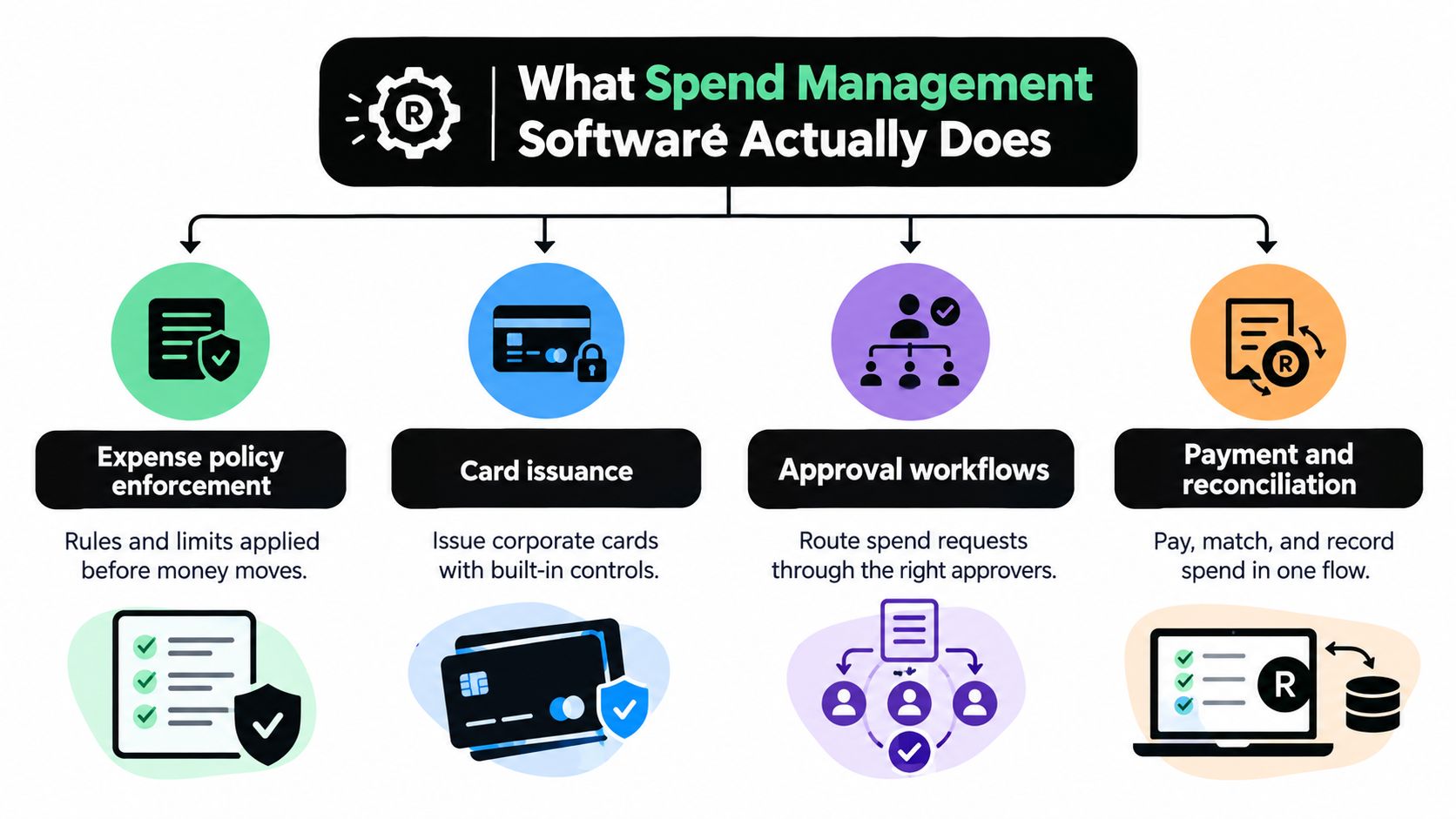
Control before purchase
Policy enforcement means applying rules when an employee requests or initiates expenditure. Ask the vendor to demonstrate an out-of-policy purchase. Does the system block it, route it for an exception or merely flag it afterwards? Those outcomes aren't interchangeable.
Card issuance and controls connect employee payment access to company policy. Where cards are included, verify whether physical and virtual cards support the restrictions you need. Don't assume that a spending limit also provides merchant restrictions or department-level budget enforcement.
Capture, authorise and reconcile
Approval automation should send requests to the correct decision-maker, retain supporting evidence and distinguish routine purchases from exceptions. Receipt capture is useful, but the demonstration should also cover missing receipts, duplicate submissions and an approver who's unavailable.
Reconciliation goes further than exporting a transaction list. Finance should be able to associate the payment with its invoice or receipt, assign the correct accounting treatment and identify unresolved differences before posting.
Use these practical tests:
- Missing evidence: Submit a transaction without its supporting document and inspect the follow-up process.
- Changed purchase: Alter an approved request and check whether reapproval is required.
- Accounting correction: Recode a transaction and confirm that the change remains traceable.
The local case for structured records is substantial. A South African procurement survey of 222 professionals found 43% hadn't begun their digital-procurement journey and 38% mainly used Excel; among organisations that had digitised procurement, 80% reported improvements including visibility, cycle times and cost control. These are survey findings, not guaranteed software outcomes.
Accounting software remains your financial record. Procurement software addresses sourcing and supplier purchasing processes. Spend management should connect operational controls to those systems, not create a competing ledger.
Category-specific investigation still matters. For cloud expenditure, Server Scheduler's cloud waste benchmarks and optimization tactics offer a separate resource for examining infrastructure costs. Treat that exercise as complementary: approving a cloud bill doesn't establish that the underlying resources are necessary.
Comparing Spend Management Platforms and Pricing Models
Choose the platform category before requesting quotations. An accounting extension, a card platform and a broader suite can all appear in a spend management shortlist, but they aren't equivalent purchases.
Spend Management Platform Types at a Glance
| Platform Type | Core Strength | Typical Pricing Model | Best Fit For |
|---|---|---|---|
| All-in-one spend suites | Connecting requests, approvals, invoices and reporting | Platform subscription, with possible user, module or usage charges | Businesses needing coordinated purchasing across departments |
| Card-led fintech platforms | Employee payment access and point-of-purchase controls | Account or platform fees, potentially combined with card, transaction or FX charges | Teams whose immediate problem is employee purchasing or international card expenditure |
| Accounting add-ons | Extending capture and approval around an existing ledger | Subscription by organisation, user or document volume | Businesses retaining their accounting system as the operational centre |
Use these as quotation categories, not universal pricing promises. Require each vendor to identify its actual charging basis and exclusions in writing.
Compare the bill your business will actually pay
A per-user subscription can become unattractive if occasional requesters, contractors and read-only approvers all require paid access. Ask what counts as an active user and whether someone who only approves purchases needs a full licence.
Transaction-based pricing needs different scrutiny. Establish whether the charge applies to an invoice, payment attempt, successful settlement or document processed. Clarify how credits, retries and rejected payments are treated.
A flat platform fee isn't automatically simpler. Check whether integrations, additional entities, implementation, support and data exports sit outside it.
Ask vendors to price your current operating pattern and your expected growth using the same assumptions. Don't compare a subscription-only quote with another provider's fully loaded proposal.
Test integration depth, not the logo wall
An accounting logo on a website isn't proof of usable integration. Request a demonstration using your chart of accounts, departments, projects and currency requirements.
Have the vendor process a purchase, post it, correct it and show what happens when synchronisation fails. Verify who resolves errors and whether finance can see an exception queue without involving a developer.
- Mapping: Confirm support for the accounting dimensions your management reports require.
- Attachments: Check whether invoices and receipts remain accessible from the posted entry.
- Duplicates: Inspect how repeated imports and retried syncs are handled.
- Ownership: Establish who maintains the connector when either system changes.
A CSV export is a fallback, not proof of integration. If staff must repeatedly clean files and rebuild coding, include that work in the operating cost.
Demand useful automation
Deloitte procurement research covered by CFO South Africa identified analytics as a leading influence for more than 65% of chief procurement officers, while 62% reported a moderate-to-large analytics skills gap. The purchasing implication is straightforward: don't buy analytical potential that your team lacks the capacity to realise.
Give the vendor imperfect descriptions and unfamiliar supplier names. Ask it to demonstrate classification, exception detection and management reporting without preparing a bespoke dashboard beforehand.
Finally, test approval configuration yourself. Your finance administrator should be able to change a routing rule, delegate authority and inspect the result. A flexible product that requires paid consulting for routine policy changes may be the wrong fit for an SMB.
Spend Management Use Cases for South African SMEs
Different businesses need different starting points. The scenarios below are illustrative operating situations, not customer case studies.
The exporter managing overseas suppliers
An exporter needs to connect supplier obligations with payment execution. The relevant record should show the invoice currency, approved amount, funding source, settlement status and any unresolved beneficiary shortfall.
In the demo, use an overseas supplier invoice rather than a domestic expense claim. Ask the vendor to distinguish an invoice awaiting approval from a payment awaiting settlement. Finance shouldn't have to contact the requester to discover which stage has stalled.
For this business, a polished employee-expense app may be secondary. Prioritise supplier records, payment evidence and a clear route for resolving discrepancies.
The BPO paying international contractors
A BPO finance team may need to coordinate contractor invoices across client accounts and distributed managers. The central question is who can prepare, approve, amend and release each payment.
Ask the vendor to demonstrate a contractor changing bank details after an invoice has been authorised. The software should make the change visible and support the review process your business requires. Also test how finance pauses an individual payment without rebuilding an entire recurring run.
Match permissions to responsibilities. Giving everyone broad access because it's easier to administer defeats the purpose of introducing controls.
The services firm formalising purchasing
For a growing services business, the immediate requirement may be less elaborate: replace informal email sign-off with a consistent request, an accountable approver and accessible evidence.
Choose a process employees can follow without finance translating every screen. Before paying for a broader suite, use AccountShare's small business expense software pricing comparisons as a supplementary budgeting resource, then validate the shortlisted products against South African availability and your actual requirements.
The underlying adoption gap remains relevant. A 2025 study of 186 South African SME owners and managers found more than 60% lagged in basic digital tools and e-commerce, and reported that e-procurement implementation practices were statistically significant predictors of procurement performance. That finding describes the study sample, not every South African SME.
The recommendation isn't to adopt the most advanced product. It's to introduce a manageable process that gives the business a reliable purchasing record.
The Hidden Cost of Cross-Border Business Spend
A lower transfer fee doesn't prove a lower payment cost. Compare what your business gives up with what the beneficiary receives, using the same currency pair, timing and required settlement amount.
Separate the cost layers before accepting a savings claim.
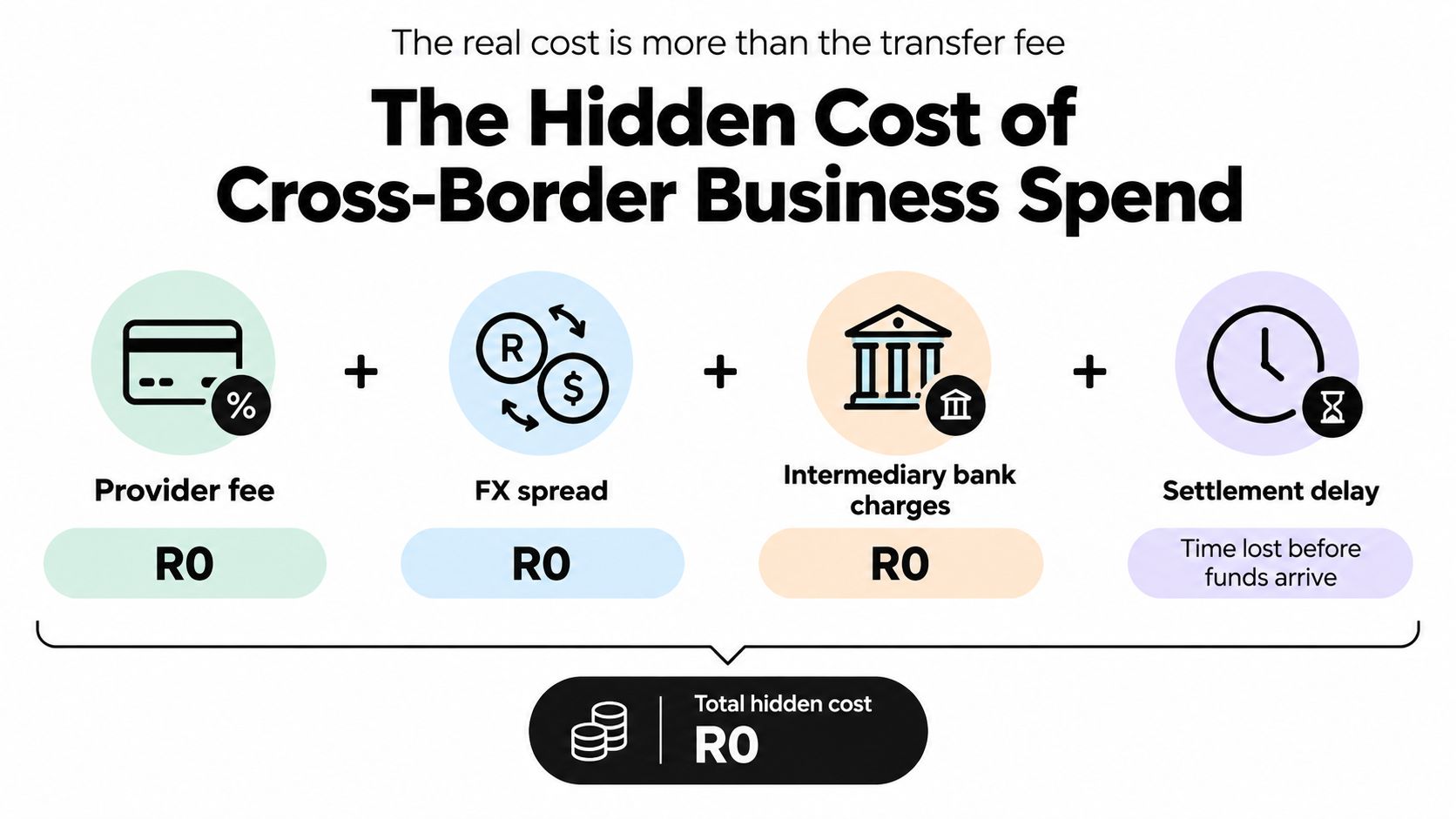
Build a corridor-level landed-cost calculation
For this evaluation, landed payment cost means the full economic cost of delivering the required funds, not customs duties or the landed cost of imported goods.
Capture the following separately:
- Provider fee: The explicit payment or conversion charge.
- FX markup: The difference between the quoted conversion and a documented, time-matched reference rate.
- Intermediary deductions: SWIFT or correspondent charges affecting the debit or beneficiary receipt.
- Exceptions: Charges and staff work associated with rejected, returned or corrected payments.
- Timing and administration: Actual reconciliation time and any demonstrable cost caused by settlement delays.
A useful worksheet ends with total rand outflow, net beneficiary receipt and rand cost per unit delivered. Add internal staff cost separately so you don't confuse payment charges with your own administration.
Zaro's cross-border cost analysis cites SARB-related reporting of 7.97% average sub-Saharan African cross-border payment costs in Q1 2025, South Africa–Zimbabwe costs of 12.7% in Q1 2024, and an 8.1% average for a USD200 SADC transfer against the 3% UN benchmark. These figures provide context, not a quotation for your commercial invoice or proof that every transaction size carries the same cost.
Spend governance fails when finance records that a payment was approved but cannot establish what the beneficiary received.
Compare like with like
Percentage savings can mislead when providers combine fixed and variable charges. Test your actual invoice sizes and recurring payment patterns, rather than applying a small-transfer benchmark to larger supplier settlements.
For additional reading on payment-route considerations, consult the overseas payment insights from Everglow Prosperity. Keep your decision grounded in written quotes and completed-payment evidence.
The accompanying video provides another resource to review alongside your payment worksheet.
Don't accept “sent” as the final control status. Require a process for confirming receipt and investigating any difference against the supplier obligation.
Where Corporate Cards Fit in Your Spend Stack
Corporate cards belong in the payment and point-of-spend control layer. They're useful when employees need authorised purchasing access, but issuing a card doesn't establish the business justification for the purchase.
Place the card within the surrounding control process, rather than treating it as the entire system.
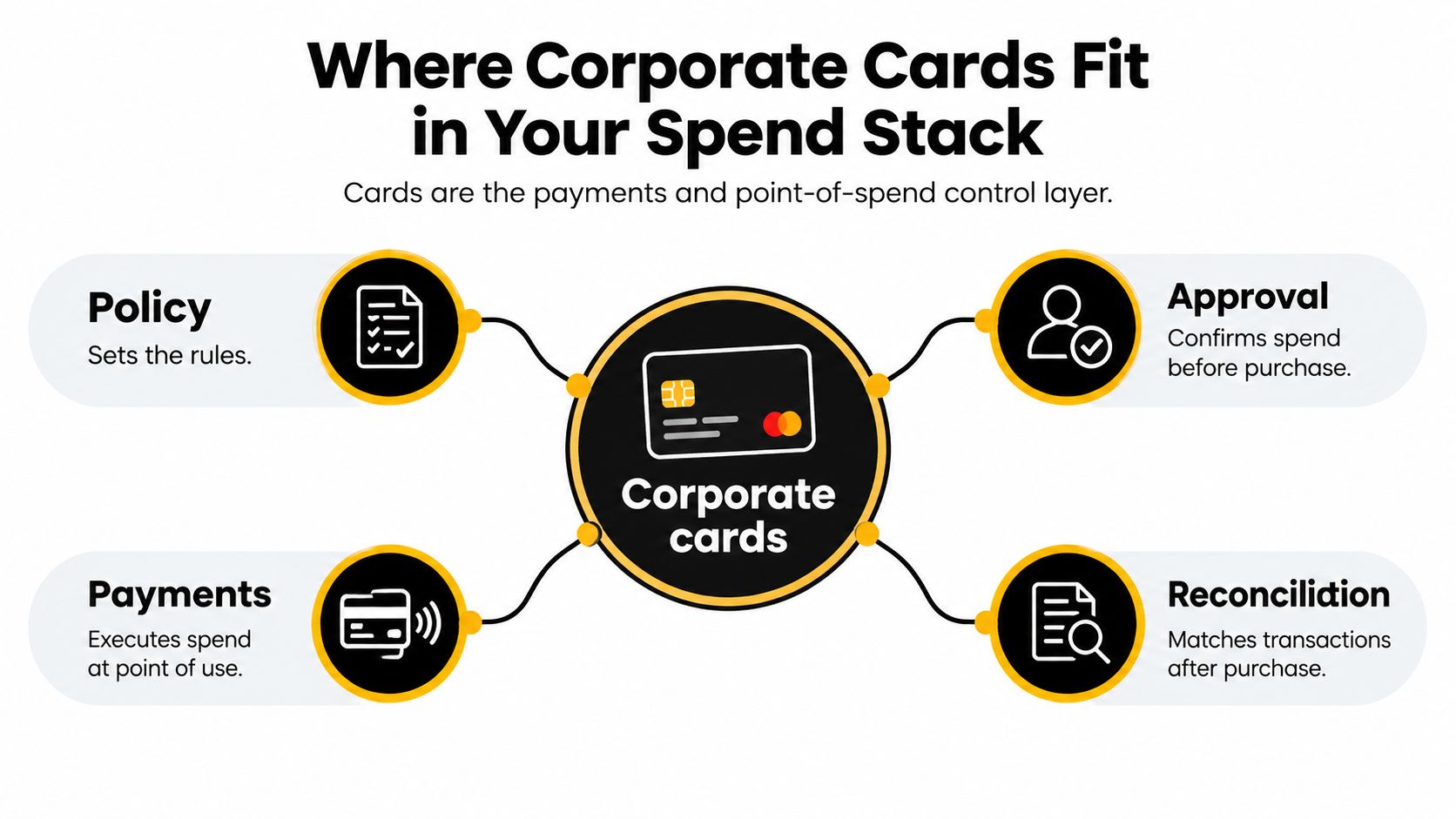
Test the point-of-purchase controls
A card-led proposal should demonstrate issuance, suspension, spending limits, available merchant restrictions and transaction visibility. Verify each capability on the offered product and account tier. Don't treat a feature mentioned in a presentation as a contractual commitment.
Use a software subscription as the demonstration transaction. Ask who owns the card, what happens when that employee leaves and how finance identifies the subscription at renewal. Then test a declined purchase and inspect what both the employee and finance can see.
For international expenditure, ask the provider to explain the conversion basis, applicable charges and treatment of reversals. A purchase and its later refund need a traceable accounting explanation, even where the final rand amounts differ.
Keep supplier purchasing in scope
A card platform doesn't automatically replace supplier onboarding, invoice matching, contract records or budget hierarchies. Those functions may sit in a broader suite or remain in existing systems.
For a South African ZAR and USD account-and-card proposition, verify the operating mechanics directly:
- Onboarding and funding: Confirm KYB requirements, account funding instructions and when money becomes available.
- Access: Establish which users can view balances, administer cards and initiate payments.
- Foreign exchange: Obtain the applicable rate basis and full fee schedule in writing.
- Accounting hand-off: Inspect the transaction data and supporting evidence finance can retrieve.
The architectural choice is practical. If employee purchasing is the immediate problem, a card-led tool may be the sensible starting point. If supplier commitments are poorly controlled, adding cards won't solve the missing purchasing process.
Choose a payment layer that fits the wider records and responsibilities you've established. Avoid rebuilding the whole finance stack merely to obtain a different card.
How to Choose the Right Spend Management Software
Run a working session, not a feature tour. Give shortlisted vendors an anonymised purchase request, supplier invoice, international payment record and accounting correction. Ask your own finance administrator to operate the proposed process.
Use a demo-ready acceptance checklist
- Approval governance: Demonstrate configurable routing, delegated authority and segregation of duties. Broader suites deserve scrutiny here; don't assume a card product covers supplier approvals.
- Spend visibility: Show commitments and unresolved items, not just completed transactions.
- Audit evidence: Export the approval history, supporting documents and changes without vendor assistance.
- Accounting compatibility: Prove the required sync or document the manual hand-off. An add-on deserves consideration where keeping the ledger central is the priority.
- Commercial transparency: Identify chargeable users, usage, implementation, support and payment costs.
- Cross-border accountability: Reconcile the quoted debit with the completed beneficiary receipt.
Make usability a purchasing requirement
A 2023 University of the Witwatersrand study of 102 South African manufacturing procurement professionals identified absent digital strategy, poor observability of benefits and low technology competence as prominent adoption barriers. Treat those as implementation warnings, not reasons to postpone action.
Your team should be able to find an exception, understand its cause and assign responsibility without specialist analytical support. Ask who will administer the system internally and include that person in selection.
Before shortlisting, cost a real payment corridor. Retrieve the bank debit, conversion details, charges and beneficiary confirmation for an actual transaction, then record the reconciliation effort separately. Use that completed example as the baseline every vendor must explain.
For the payments layer, Zaro offers ZAR and USD business accounts and debit cards, multi-user access and customisable team permissions, with spot-rate foreign exchange, zero spread and no SWIFT fees. Visit Zaro to discuss your supplier or contractor payment corridor and request a cost breakdown you can compare with your existing route.