
Your Cape Town export business has just been paid. A client in Texas settled a USD 50,000 invoice, the dollars are sitting in your account, and you need rand in the operating account by Friday to cover payroll and a packaging supplier. You open your banking app, look at the USD/ZAR figure on the screen, and tap accept. That one tap decides what the invoice is really worth in rand, and the gap between a good and a poor outcome usually has nothing to do with the number you saw.
The spot rate is the exchange-rate component of that decision. It isn't the price of the payment. Between the mid-market figure on a rate screen and the amount your supplier or your own rand account finally receives, there are spreads, fees, correspondent deductions and timing. Understand the mechanics and you can put a number on each of those layers, which is the only way to compare one provider against another without guessing.
What a Spot Rate Means in Plain Terms
A spot rate is the price of one currency in another for exchange now. Your exporter asks the bank for the USD/ZAR rate, the dealer quotes a number, and the deal is struck on that number for settlement in the next couple of days.
That timing is the definition, not a detail. The South African Reserve Bank describes a spot foreign-exchange transaction as a single outright exchange of two currencies at an agreed rate, with settlement or delivery normally occurring within two business days. So the spot rate is the market price that applies immediately, not a price fixed for some future date.
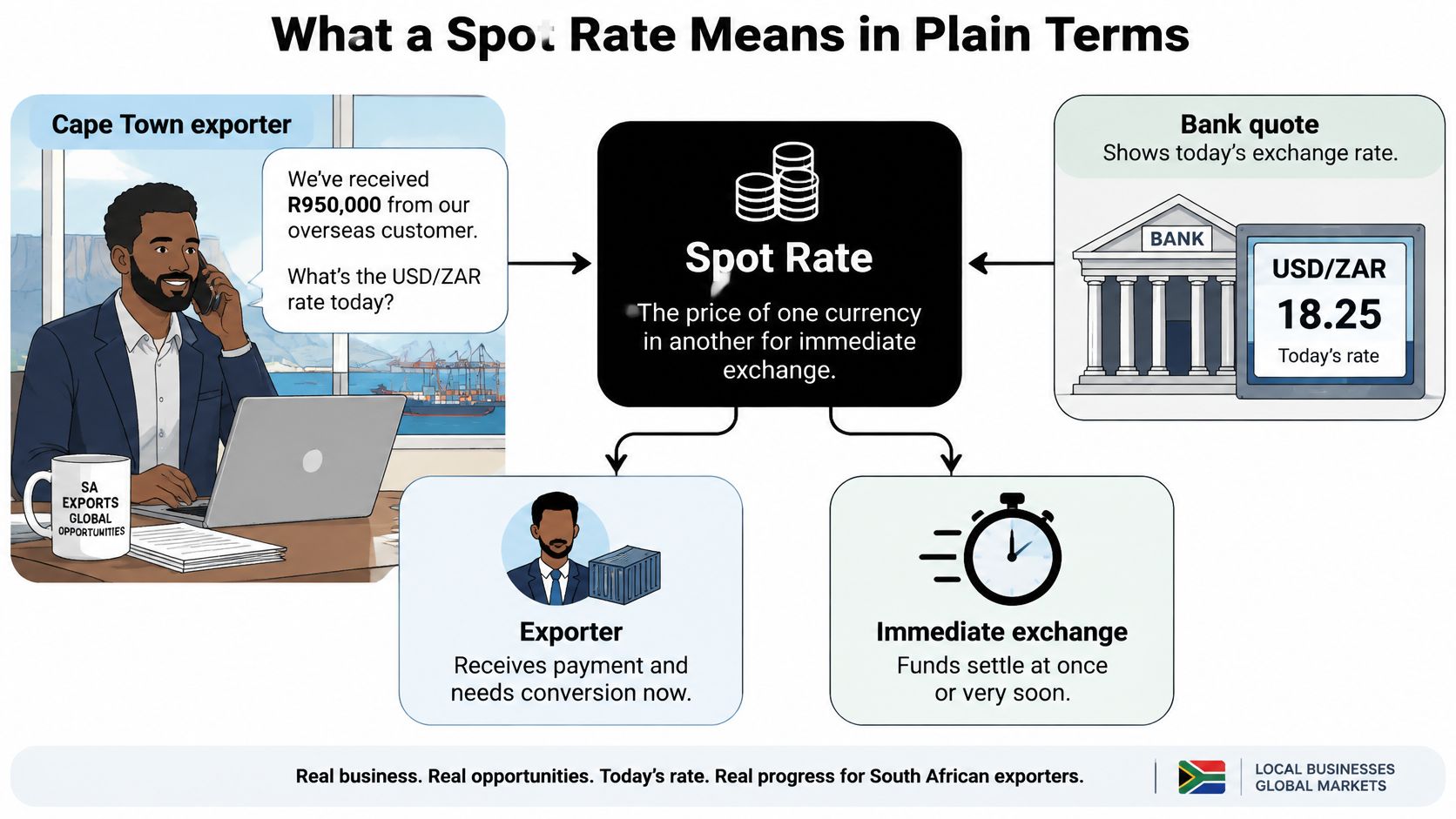
Spot versus forward, in one line each
Spot converts money at the market price prevailing now, with funds moving within about two business days. A forward fixes a price today for settlement on a date you choose later, which is a different instrument with a different purpose.
The SARB's turnover work shows how the market splits. Spot transactions made up an average 23% of domestic South African foreign-exchange turnover from 2000 onward, while FX swaps dominated at 71% and outright forwards accounted for 6%. Spot is a large, liquid slice of a market built mostly for short-dated funding.
Why every quote needs a timestamp and a pair
The rand floats. Its value is set by market forces through the trading day, so "the spot rate" without a currency pair and a time is not a rate at all. USD/ZAR, GBP/ZAR and EUR/ZAR are three different prices, and USD/ZAR moves minute by minute.
For South African businesses, one pair matters more than the rest. The same SARB analysis found that roughly 95% of rand turnover since 2000 was against the US dollar, against 2% against the euro. That's why a USD/ZAR quote is the one your bank, your customer and your accounting system all argue about.
The mid-market number is a reference, not a price
Banks buy and sell currency around a mid-market rate, the midpoint between the bid and the offer. The figure on a free converter is usually that midpoint. You cannot transact at it, because the institution taking the other side needs a margin for handling the trade.
Practical rule: treat the mid-market rate as your benchmark, never as your cost. The moment a provider applies its own rate, you're paying a spread.
That spread is only the first layer. Fees and deductions sit on top of the exchange rate itself, and they're where a payment that looked cheap becomes expensive.
How a Small USD/ZAR Move Changes Your Rand Cost
Percentages hide the thing you feel. A 1% move in USD/ZAR sounds trivial until you apply it to a real invoice and see the rand figure.
Take an illustrative mid-market reference of R17.55 per US dollar. It's a working number for the arithmetic here, not a live quote. At R17.55, a USD 20,000 payment costs R351,000. Move the rate 1% higher to R17.73, a difference of 18 cents, and the same payment costs R354,600. That's R3,600 more for one transaction you did nothing different on.
Scale it and the number stops being trivial. A USD 50,000 invoice goes from R877,500 to R886,500, an extra R9,000. Five such payments in a month and the same small move has cost you R45,000 in rand, which is a salary or a shipment.
| USD amount | ZAR at R17.55/USD | ZAR at R17.73/USD (1% move) | Extra ZAR cost |
|---|---|---|---|
| USD 20,000 | R351,000 | R354,600 | R3,600 |
| USD 50,000 | R877,500 | R886,500 | R9,000 |
Which rate, and at what time
The South African Reserve Bank states plainly that the nominal exchange rate is determined by market forces, and it publishes separate current and historical ZAR/USD, ZAR/GBP, ZAR/EUR and ZAR/JPY rates. Those published rates are useful for pricing a quote, setting a budget rate and valuing balances at month end. They are not executable rates, and no dealer is obliged to trade at them.
The rand also moves in both directions fast enough to embarrass anyone who dates a rate loosely. SARB data show the rand's nominal effective exchange rate rose 3.7% in the fourth quarter of 2025, then fell 4.1% between the end of February and 13 March 2026. A spot rate quoted without a date can therefore describe a market that no longer exists.
Write the rate down with the date, the time, the pair and the source. A rate you can't reconstruct six weeks later is a rate you can't defend to your auditor or your board.
That's the discipline: quote in rand, timestamp it, and reprice whenever the underlying rate has moved enough to matter on your payment size.
Why the Rate You Are Quoted Is Not the Rate You Get
A supplier asks for USD 20,000 by Friday. The quote looks sharp because the provider shows a rate close to mid-market. Then the beneficiary receives less than expected, and the rand cost on your side is higher than the headline suggested. The quoted rate is only one part of the landed cost of the payment.
Work through the arithmetic. At an illustrative mid-market reference of R17.55, a USD 20,000 payment is worth R351,000. If the provider applies R17.20 instead, the same payment delivers the rand equivalent of R344,000. The difference is R7,000, sitting inside the exchange rate before any transfer fee appears on the statement. Nothing is labelled as a charge. The customer gets less foreign currency for the rand spent.
Think of the exchange rate as the price tag and the full quote as the till slip. The till slip is what matters.
Three layers between mid-market and the final amount
The spread. The provider's markup is built into the applied rate, so the rate you receive sits away from the mid-market figure. Zaro charges a transparent spread on the exchange rate, based on volume and corridor, with no SWIFT fees and a clear quote provided on sign-up or by speaking with the team.
Explicit fees. Transfer charges and SWIFT messages may appear as separate line items. These are the visible costs, so they are easy to compare. They are still only part of the total.
Deductions in transit. Correspondent banks in the payment chain can take charges before the beneficiary is credited. The beneficiary then receives less than the amount on your instruction, and the quote may not have prepared you for that outcome. Zaro discloses applicable fees before a transaction is confirmed, with fees and spreads applying as set out in the agreement or as quoted when using the service.
| Cost layer | How it appears | Usually disclosed upfront? | Fixed or variable |
|---|---|---|---|
| Exchange-rate spread or markup | Applied rate sits away from mid-market | Sometimes, often buried | Variable |
| Transfer fee | Separate line item | Yes | Fixed per transfer |
| SWIFT or correspondent charge | Deducted in transit | Rarely | Variable |
| Third-party bank deduction | Beneficiary receives less | No | Variable |
| Timing risk | Rate moves before funds arrive | No | Variable |
| KYB or compliance delay | Payment held for review | Partly | Variable |
The one number that settles the argument
Divide the beneficiary's final amount by your total rand outlay, both measured at the same timestamp. Lower is cheaper. That single ratio strips out the marketing, the "zero fee" claim and the flattering rate screen. Comparing the beneficiary's final amount against total rand outlay is the clearest way to assess FX payment cost.
A useful landed-cost test is simple:
Beneficiary amount received / total rand paid = rand cost per unit received
Use the same test on every quote. A slightly better rate loses its appeal if fees, correspondent deductions or settlement timing reduce what arrives. A slightly higher rand outlay can be cheaper if more foreign currency lands in the beneficiary's account.
The US dollar concentration in this market makes the check urgent rather than optional. The SARB Financial Stability Review reports that USD accounts for 96% of South African FX transactions and 93% to 97% of turnover in the domestic FX market. If your exposure is rand against dollar, this is the quote you check first. The same landed-cost discipline applies in compare vehicle export pricing breakdowns, where the final cost matters more than the headline.
The question to ask: how much will actually arrive, and when? A competitive rate paired with an uncertain settlement date is an expensive payment for a business with a supplier deadline.
When Spot Applies and When a Forward Is Needed
Spot is the right reference for a specific set of jobs: paying an overseas contractor this week, settling a supplier invoice that's already due, repatriating export proceeds, or converting a rand balance into dollars for a purchase happening now. In each case you need the exchange done, and you need it done at the market price of the moment.
The market supports that use comfortably. The SARB's analysis of global over-the-counter turnover reported average daily spot turnover in South Africa rising from US$2.0 billion in April 2019 to US$3.0 billion in April 2022, growth of 50% even as total over-the-counter turnover fell from US$20.4 billion to US$15.8 billion over the same period. Billions of dollars a day passing through the spot market is what makes price discovery on USD/ZAR credible.
Where spot runs out
Spot doesn't remove risk. It executes at the current price and closes the trade. If you invoice a client in dollars today and receive the money in eight weeks while paying your staff in rand every month, the spot rate at settlement tells you what the money is worth then, not what it will be worth when you budgeted for it.
That gap is where a forward earns its place. You fix a rate today for a known future settlement date, and you accept that you won't benefit if the rand strengthens in the meantime. You're buying certainty, and certainty has a price.
- Choose spot when the payment is due now, timing is uncertain, or you're converting a balance you already hold.
- Choose a forward when the invoice date, the amount and the rand cost are all known and the gap to settlement is long enough for the rand to move against you.
A spot rate is a market reference with a timestamp attached. It's not a guarantee, and it's never the final cost of a transfer.
The forward decision belongs in the cash-flow plan, next to the invoice schedule. Deciding it at the moment of payment is deciding too late.
How to Execute a Spot Payment Step by Step
A spot payment fails in predictable places: the wrong amount lands, the wrong rate gets applied, or the money arrives a day late. Each step below exists because skipping it causes one specific, expensive failure.
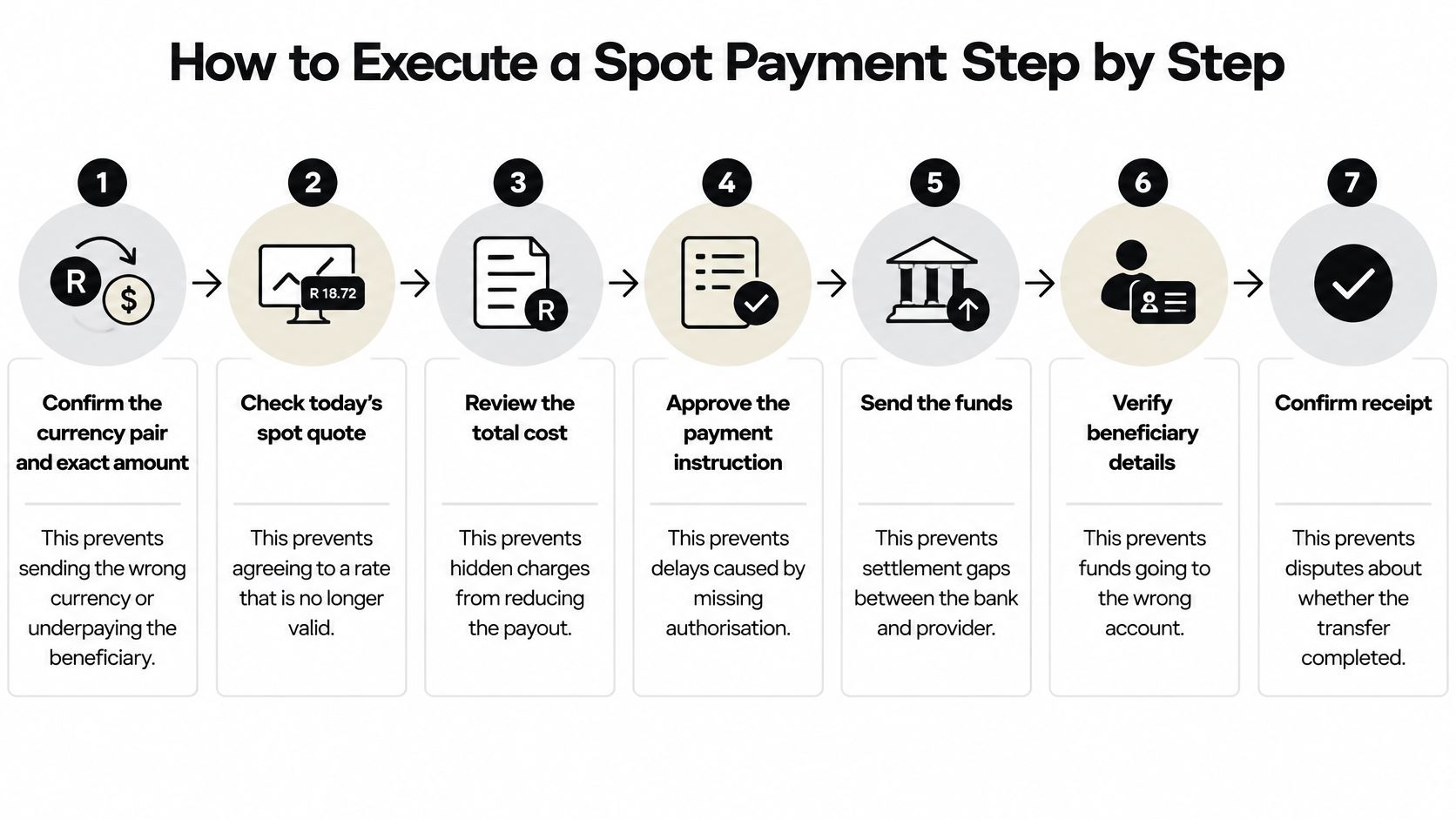
Confirm the currency pair and the exact amount the beneficiary must receive. Write it as "USD 20,000 must land in the supplier's account", not "pay the invoice". This prevents a payment that's short by a correspondent charge or converted into the wrong currency.
Request a quote and record the timestamp, the applied rate and every fee in writing. A verbal rate is worth nothing at month end. This prevents a dispute about which rate applied when the confirmation arrives with a different number.
Calculate the landed cost. Take your total rand outlay, divide it by the amount the beneficiary receives, and compare quotes on that ratio. If R385,000 leaves your account and USD 20,000 lands, your landed cost is R19.25 per dollar. If a second quote delivers only USD 19,700 for the same R385,000, the ratio is R19.54 per dollar, and the cheaper-looking headline rate just cost you more. This prevents comparing a headline rate against an all-in cost.
Check the settlement date against the two-business-day spot convention and your own cash-flow date. Count business days, not calendar days, and allow for public holidays in both countries. A payment instructed on a Thursday before a South African public holiday can settle the following Tuesday. This prevents a payment that lands after your supplier's cut-off.
Complete KYB and compliance checks before you commit, not after. Have your incorporation documents, proof of address and transaction rationale ready. A first-time payment to a new beneficiary often triggers review, and review takes time you don't control. This prevents a payment held for checks while the rate moves against you.
Fund the payment and keep the execution confirmation. Record the timestamp, currency pair, quoted mid-market rate, execution rate and total rand amount for every transaction, so the realised FX cost can be reconciled against the benchmark later. This prevents a reconciliation gap nobody can explain.
At month end, record the realised gain or loss against your benchmark rate. Compare the rate you got with the mid-market rate at the same time on the same day. In the example above, if mid-market sat at R18.80 when you dealt at R19.25 landed, the difference of R0.45 per dollar is your true cost of execution, and on USD 20,000 that is R9,000. This prevents an FX cost that grows and never gets audited.
Who is responsible for what
Split the problem cleanly. The spot rate handles the exchange-rate component. Settlement timing and compliance decide whether the payment behaves. A finance team that controls both gets a predictable outcome; one that only watches the rate is managing half the risk.
The steps take minutes once the documents are in order. The discipline is in the recording, because the reconciliation at month end is only as good as what you wrote down at execution.
Compare Providers and Test Your Next Quote
Compare providers using the total cost of your actual payment, with quotes taken at the same timestamp. An advertised rate is only one part of the price. These six checks connect it to the rand leaving your account and the dollars reaching your supplier.
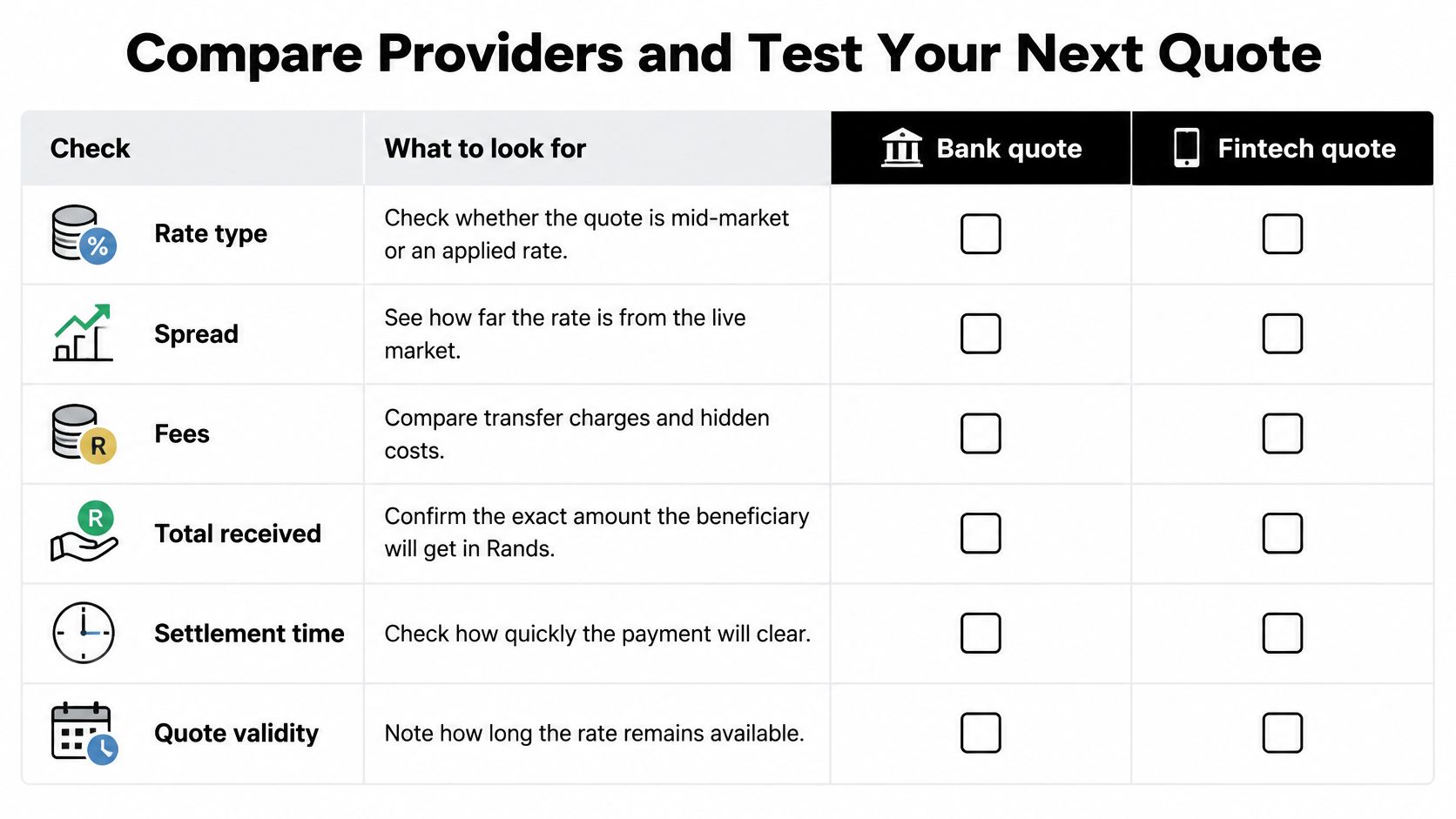
| Check | Bank quote | Provider quote |
|---|---|---|
| Mid-market reference and applied rate | Ask for both, with the currency pair and timestamp | Ask for both; mid-market is a benchmark, not necessarily your price |
| Spread in rand on your payment size | For ZAR per USD, subtract mid-market from the applied rate and multiply by the USD purchased | Use the same calculation and timestamp |
| Explicit fees including SWIFT and correspondent charges | Request all applicable charges, not just the headline fee | Confirm charges and any deductions before the beneficiary is credited |
| Final USD received by the beneficiary | Get the amount in writing | Get the amount in writing |
| Total ZAR outlay at the same timestamp | Include every charge debited from your account | Include every charge debited from your account |
| Settlement time and KYB status | Confirm the value date and outstanding review requirements | Confirm the value date and outstanding review requirements |
Run the one-number test
Divide your total rand outlay by the USD the beneficiary receives. The result is your landed cost in rand per dollar delivered. Lower is cheaper, provided both quotes meet your settlement deadline.
Keep the denominator consistent. Dollars purchased and dollars received can differ if charges are deducted along the way. Using the beneficiary's final receipt captures those deductions rather than letting an attractive exchange rate hide them.
Timing belongs beside that calculation. A cheaper payment that misses a supplier deadline may not meet your needs, so get the settlement date confirmed before committing.
Do this today: request two quotes for your next real payment, run the ratio on both, and commit only when the settlement date and the total rand outlay are both confirmed in writing.
Zaro's free USD to ZAR converter shows the live mid-market rate and compares what a bank may take in FX spread and SWIFT fees. Use it as a benchmark for the table, then assess the actual quote, including Zaro's, against the final beneficiary amount.
Zaro offers a transparent exchange-rate spread, no SWIFT fees and fast settlement, with KYB handled up front. Pricing depends on volume and corridor, with a clear quote available upon sign-up or from the team. Applicable fees and spreads are disclosed before you confirm a transaction. Open an account with Zaro, request a quote for your next supplier invoice, and compare the dollars delivered against the full rand cost.