
The popular advice is simple: send the money through your bank because it's safer. That advice is incomplete. A Standard Bank transfer money overseas instruction can be secure and compliant while still costing your business far more than necessary.
The visible commission is only one line in the payment. Your real cost may also include the exchange-rate margin, intermediary-bank deductions, receiving-bank charges and delays caused by cut-off times or compliance checks. South African SMEs should compare the amount that leaves the business with the amount the beneficiary receives, not just the fee displayed on the payment screen.
Why Your Standard Bank Transfer May Cost More Than You Think
The bank's quoted fee is often the least interesting number in an overseas payment. The biggest cost usually sits in the exchange-rate margin and charges deducted by intermediary banks before funds reach your supplier. A transfer can therefore look reasonable on screen while delivering poor value for a South African SME.
The bank channel remains the default partly because South Africa's exchange-control history made compliance central to international payments. Outward transfers were controlled from 1939, with the current framework rooted in regulations formalised in 1961. A major liberalisation followed in March 1995, and current-account controls were removed by the late 1990s. The South African regulatory review of money transfers provides the relevant historical context.
The quote you receive isn't the whole bill
Before authorising a payment, demand four figures from the bank:
- The ZAR amount debited: Record the total rand cost leaving the business account.
- The foreign currency delivered: Confirm whether the supplier receives the full invoice amount or absorbs deductions.
- The exchange rate used: Compare the bank's rate with a genuine mid-market reference at the same time. The difference is the FX spread, and it can outweigh the displayed commission.
- All third-party charges: Ask whether correspondent or beneficiary-bank fees may be taken from the payment.
The review notes that bank telegraphic transfers can take two to three working days, while minimum bank fees can approach R200 per transaction. It also highlights the need to assess commissions, SWIFT and intermediary charges, and the exchange-rate margin together. For smaller invoices, a fixed fee plus a weak exchange rate can consume a disproportionate share of the payment.
CFO rule: Approve an overseas payment only after you know the all-in ZAR cost and the expected beneficiary credit. The headline fee is not a decision metric.
For a significant supplier payment, obtain a competing quote from a specialist FX provider or fintech built for business transfers. A bank may still win on a particular currency corridor, urgency or compliance requirement, but it must win on the final amount delivered, not familiarity. “Standard” describes the bank's process. It does not guarantee competitive pricing.
Transfer Methods Available From a Standard Bank Account
A Standard Bank business customer has several practical routes, and each suits a different payment pattern. The right choice depends on urgency, currency, documentation and whether the obligation is known in advance.
Choose the rail that matches the payment
Branch-based SWIFT or telegraphic transfer suits an irregular corporate payment where staff need direct bank assistance or the payment has unusual documentation. It gives the bank an opportunity to review beneficiary details and supporting paperwork before release, but branch processing can be less convenient and may involve additional cut-off constraints.
Online International Payments are more suitable for routine supplier invoices, recurring service payments and familiar beneficiaries. The online route is efficient when your business already has the beneficiary information, payment purpose and compliance records organised. Don't treat the digital interface as proof that the underlying payment is cheaper. It may just make the same bank rail easier to access.
A Forward Exchange Contract, or FEC, can help when your business knows it will need foreign currency later and wants greater budget certainty. It doesn't remove exchange-control or compliance obligations, and it creates a commitment that treasury staff must understand before signing. Use it for a defined commercial exposure, not as a casual prediction about where the rand may move.
A fourth route is a specialist FX provider or fintech. These businesses may separate payment execution from traditional correspondent-bank processes and can make the rate easier to compare. For teams evaluating newer cross-border infrastructure, this overview of top crypto payment solutions provides useful context, although a business must assess regulatory status, settlement mechanics and accounting treatment before using any alternative rail.
| Method | Best use case | Typical speed | Rate type |
|---|---|---|---|
| Branch SWIFT transfer | Irregular or documentation-heavy corporate payments | Bank and correspondent processing applies | Bank-set exchange rate |
| Online International Payments | Routine supplier and operating payments | Dependent on cut-off and beneficiary processing | Bank-set exchange rate |
| Forward Exchange Contract | Known future foreign-currency obligations | Settlement on agreed future date | Contracted rate |
| Specialist FX provider | Regular or higher-value cross-border payments | Provider and local payout rail dependent | Provider quote, often separately displayed |
The practical decision is straightforward. Use the bank when control, familiarity or a specific compliance requirement matters most. Benchmark a specialist provider whenever the payment is recurring, the amount is material or the exchange rate is doing most of the financial damage.
The Full Cost Stack Behind a Bank Overseas Transfer
An overseas payment is not priced by the visible bank fee alone. Standard Bank's commission is only the first line. Add the exchange-rate spread, possible correspondent-bank deductions and charges applied by the receiving bank, then compare the delivered foreign-currency amount with the rand debited.
The FX spread usually deserves the closest scrutiny. A fixed commission can look reasonable on a large payment, while a small disadvantage in the exchange rate applies to the full conversion. A bank quote with a modest commission can therefore deliver less value than a fintech or specialist FX provider quoting closer to the mid-market rate. South African SMEs should benchmark both quotes, not just the displayed fee.
Build your own reconciliation
Use this calculation for every quote:
All-in cost = ZAR debited minus the ZAR value of the foreign currency received, plus any separate charges.
For a hypothetical R1,000,000 payment, do not rely on assumptions from a sales representative. Ask the bank to identify every line and classify it as a sending-bank cost, intermediary deduction, beneficiary-bank charge or FX difference. The Cenfri review of South African money transfers supports checking commission, SWIFT or intermediary fees and the exchange-rate margin together.
| Cost line | Typical amount in ZAR | Visibility |
|---|---|---|
| Sending-bank commission | Quote required | Usually visible |
| SWIFT or payment-processing charge | Quote required | Often visible |
| Correspondent-bank deduction | Depends on route | May be unclear before settlement |
| Beneficiary-bank charge | Depends on recipient bank | Often paid or deducted at destination |
| Exchange-rate margin | Scales with payment value | Frequently embedded in the rate |
| Urgent or special handling | If applicable | Should be confirmed before release |
| Total economic cost | Calculate from delivered value | Rarely shown as one figure |
The cost can be material on South African outbound payments. Transfers to the rest of SADC grew from ZAR6 billion in 2016 to ZAR19 billion in 2024, while high-cost corridors can lose more than 15% of transfer value to fees and foreign-exchange effects, according to Cenfri. That does not make banks unsuitable. It makes route-level measurement mandatory.
A fee-free transfer can still be expensive if the exchange rate is poor.
Save the bank quote, applied rate, debit confirmation and beneficiary credit advice for every payment. Reconcile the difference after settlement. This record gives the finance team evidence to negotiate bank pricing and decide whether a fintech alternative offers a lower delivered cost. Shortcuts based on the visible fee alone are how businesses overpay.
Documentation and Compliance for South African Businesses
The cheapest route is useless if the bank can't release the payment. South African businesses should prepare the commercial explanation and source-of-funds trail before submitting an overseas instruction, especially where the transaction is large, unusual or linked to a new beneficiary.
The practical allowance depends on the individual or entity, the purpose of the payment and the applicable exchange-control rules. Standard Bank states that its Single Discretionary Allowance is up to R2 million per calendar year, while Nedbank states that South African residents over 18 can make international payments of up to R1 million without supporting documents, as described on its international payments information page. Those are not interchangeable corporate permissions. Confirm the rule that applies to your business and payment purpose.
Prepare a defensible payment file
Your file should normally make five questions easy to answer:
- Who is being paid: Keep the beneficiary's legal name, account information and bank identifiers consistent across the invoice and payment instruction.
- Why is the payment being made: Retain the supplier invoice, contract, dividend resolution, service agreement or other commercial basis.
- Where did the money come from: Be ready to evidence the source of funds and the business purpose.
- Who controls the company: Maintain current registration information, beneficial-ownership declarations and authorised signatory records.
- Which allowance or approval applies: Record the relevant exchange-control basis and any SARS or Financial Surveillance documentation requested.
FICA checks can include certified identity documents, proof of business registration, ownership information and verification of authorised representatives. The bank may ask for additional information where the payment doesn't fit the company's profile or where the destination, beneficiary or purpose triggers further review.
A specialist FX provider doesn't remove these responsibilities. It will still need to complete its own customer and business verification, and it may request invoices, ownership details and source-of-funds evidence. The difference is operational: one provider may process the payment through its platform, while the underlying compliance obligation remains with the business and the regulated payment participants.
Keep a payment checklist in the accounting workflow. Missing documents create more delay than most businesses expect, particularly when an instruction is submitted close to a cut-off time.
How Long a Standard Bank Transfer Actually Takes
The transfer may leave your Standard Bank account before the beneficiary can use it. Those are separate events. Your banking app can show the payment as processed or completed while the receiving bank is still screening, reconciling or waiting for local clearing.
SWIFT's network performance data gives finance teams a useful distinction. In Africa, 75% of transactions on the network reach beneficiary banks within 10 minutes, but crediting the final account is slower in many cases. Globally, 46% of cross-border payments are credited within 60 minutes, compared with 29% in sub-Saharan Africa, and Swift notes that crediting can take more than a day depending on the receiving country. The South African Reserve Bank paper on payment performance makes the last-mile distinction clear.
Where the clock gets lost
A payment can slow down at several points:
- Instruction submission: Incorrect beneficiary details or a missed bank cut-off can push processing to the next available cycle.
- Bank review: Standard Bank may pause an instruction while staff request an invoice, purpose or source-of-funds evidence.
- Correspondent routing: One or more intermediary banks may handle the payment and apply their own checks.
- Beneficiary screening: The receiving bank may review the payment before crediting the account.
- Local clearing: The final currency conversion or domestic settlement process may add time after the international message has arrived.
| Method | Typical settlement | Common delays |
|---|---|---|
| Branch SWIFT instruction | Often several working days | Cut-offs, manual review and correspondent routing |
| Online bank payment | Dependent on currency and destination | Incorrect data, compliance queries and beneficiary processing |
| Specialist FX provider | Provider and payout route dependent | Verification, funding and local-bank crediting |
| Multi-currency wallet | Fast internal movement may be possible | Final withdrawal or bank payout leg |
Don't promise a supplier that “the money has arrived” because the sending bank shows a completed status. Confirm the beneficiary credit, especially for payroll, shipment release or a payment tied to a contractual deadline.
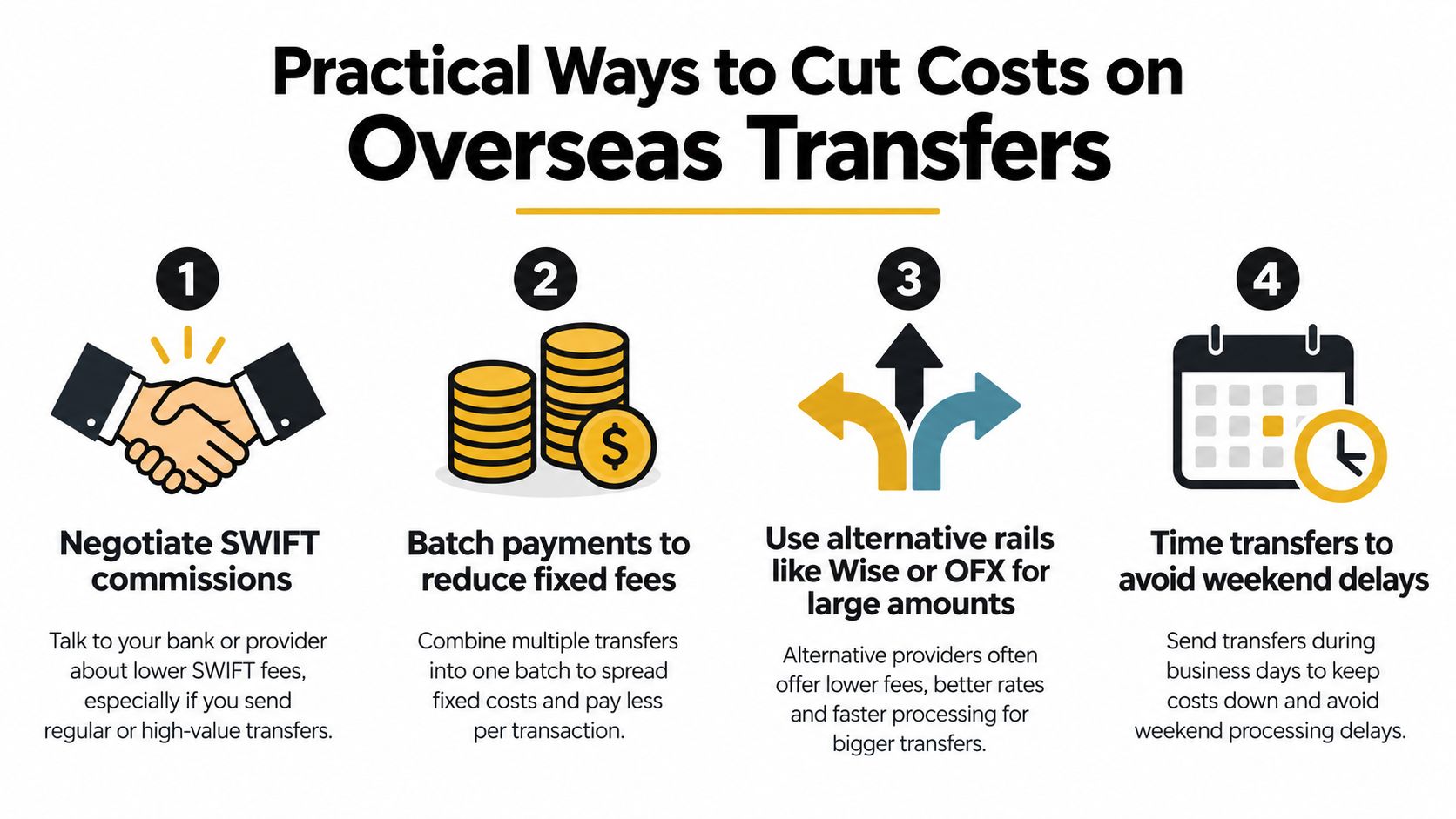
Practical Ways to Cut Costs on Overseas Transfers
The advertised transfer fee is rarely the full cost. For a South African SME, the larger leak is often Standard Bank's FX spread, followed by charges deducted by intermediary banks before the beneficiary receives the money. Compare the amount delivered, not the fee shown on the payment screen.
Ask Standard Bank for a written quote that separates the sending commission, exchange rate, beneficiary charges and intermediary costs. Then obtain a quote from a fintech provider that shows its rate and margin clearly. A lower visible commission means little if the bank delivers fewer dollars, pounds or euros for the same rand debit.
Four levers that work
- Negotiate the bank's visible charges: Ask whether your transaction volume or payment profile qualifies for a lower commission. Request the full cost in writing, including charges outside Standard Bank's control.
- Benchmark the FX rate: Compare the final ZAR debit with the foreign-currency amount delivered by a specialist provider. Use the same invoice value, funding date and delivery instruction for a fair comparison.
- Check intermediary deductions: For EUR supplier payments, confirm whether the route uses a correspondent bank and whether the supplier will receive the invoiced amount in full. A short payment can create reconciliation work and damage a supplier relationship.
- Batch suitable payments: Combining compatible invoices can reduce repeated fixed charges. Do this only where the supplier, working-capital and fraud risks remain controlled.
Apply the comparison to the currency you use. For a USD contractor invoice, compare the provider's delivered dollars for the same rand spend. For GBP export proceeds, calculate the conversion and repatriation cost rather than reviewing only the incoming-payment fee. For EUR suppliers, check the beneficiary receipt after all routing charges.
Finance discipline: Record FX cost on the P&L as a controllable expense. Recurring payments deserve a proper review because a small rate difference repeats every month.
Use rate alerts or an agreed treasury window where they fit your cash policy. Do not speculate with money needed for payroll, stock or operating expenses. The practical objective is a documented all-in cost and a route that beats the bank on total value, not a clever currency call.
Making the Right Choice for Your Next Transfer
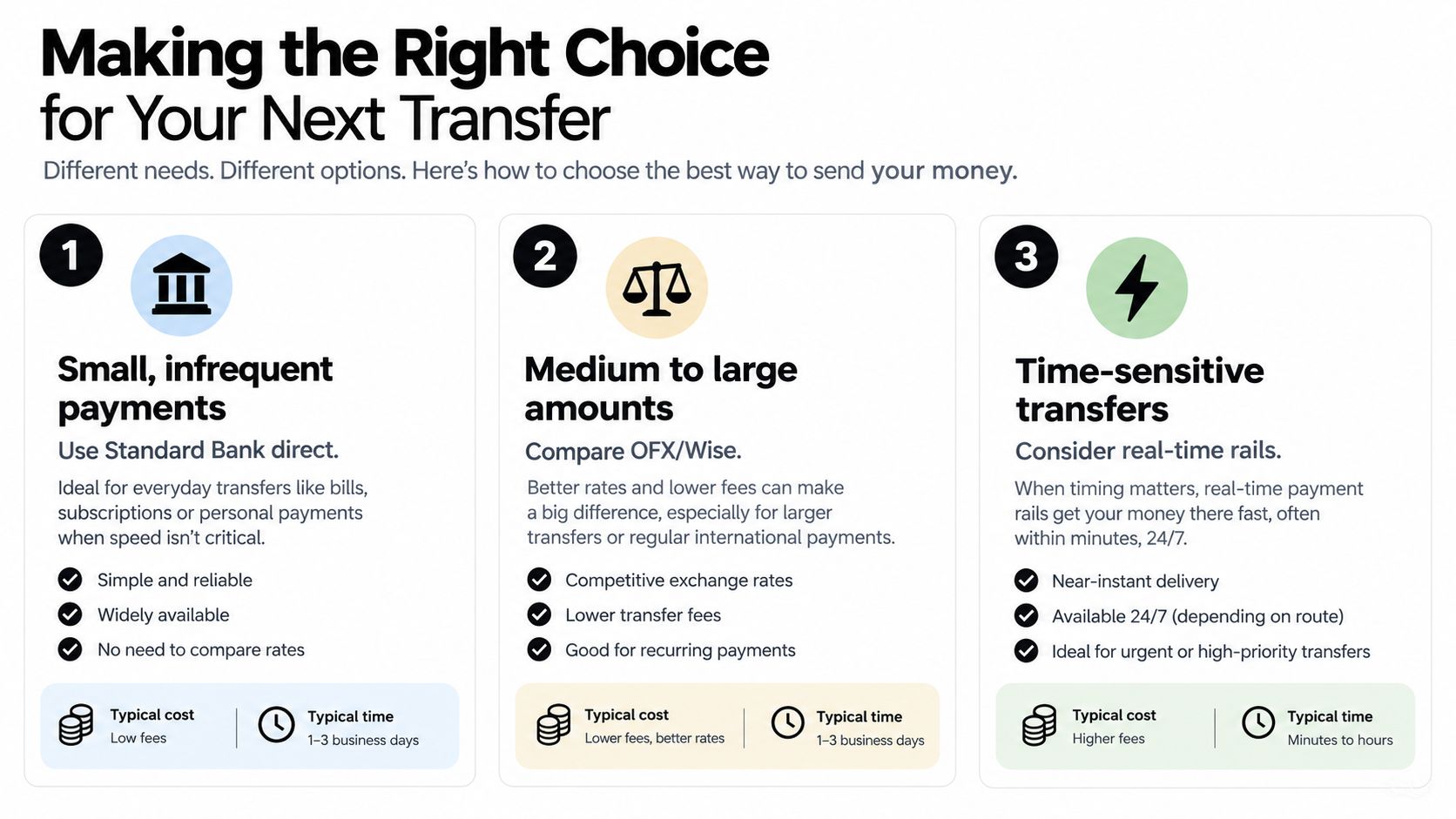
The right payment rail depends on three questions: how much you're sending, how quickly it must arrive and how difficult the currency corridor is. A small, infrequent payment to a known beneficiary may justify the convenience of Standard Bank's direct process. A recurring supplier, payroll or contractor flow deserves a formal comparison because a small rate difference repeats across every payment.
Urgency changes the answer. Pay a premium when a same-day outcome protects a shipment, contract or critical supplier relationship. For routine monthly obligations, submit earlier and choose the route that provides the clearest all-in cost. Exotic currencies and thinly traded corridors deserve extra scrutiny because the rate and routing can be less competitive.
Use a simple approval test
Before releasing the next payment, ask:
- Amount: Is this a one-off payment, or part of a recurring flow that should be priced as a portfolio?
- Speed: Does the beneficiary need funds immediately, or can finance plan around normal settlement?
- Cost: What will the business spend in total after FX and third-party charges?
- Compliance: Are the invoice, beneficiary details, ownership records and required approvals current?
- Control: Has someone independently reconfirmed the beneficiary account before a large release?
Retain the invoice and payment evidence in line with your company's recordkeeping policy, log every transfer reference and separate the person who creates a beneficiary from the person who approves a payment. Phone verification should use a trusted contact already held in your records, not a telephone number copied from a last-minute email.
Your next three actions are practical. Request a full all-in quote from Standard Bank, benchmark the same payment against one alternative provider, and record the saving or extra cost in your treasury file. After several payments, you'll have evidence for a policy decision instead of relying on habit.
Zaro lets South African businesses fund ZAR and USD balances through a standard bank transfer, then send and receive global payments using the actual spot exchange rate without SWIFT fees or an exchange-rate spread. Review your next overseas payment against the available alternatives and visit Zaro to assess whether its controls and cross-border account structure fit your finance process.