
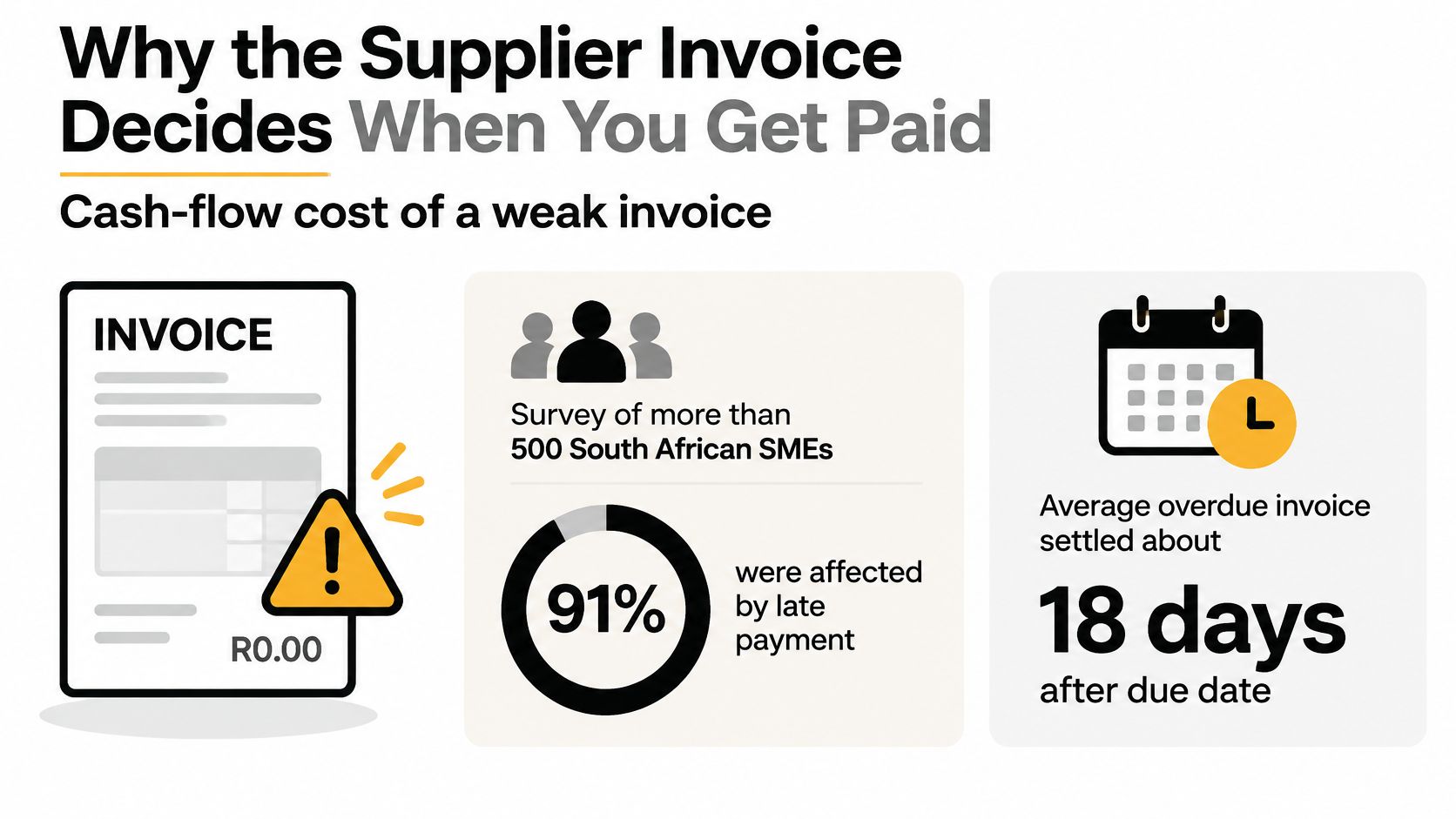
91% of South African SMEs surveyed were affected by late payment, and the average overdue invoice was settled approximately 18 days after its agreed payment date, according to a survey of more than 500 businesses reported by News24. A supplier invoice isn't just proof that you've done the work. It's the document your customer uses to approve, schedule and identify your payment.
Why the Supplier Invoice Decides When You Get Paid
Say your Cape Town business has packed an export order and handed it over for transport. Your staff and local suppliers still need paying, but the overseas customer's finance team can't release the money because the invoice doesn't identify the payment currency.
You've completed the commercial work. You haven't yet given the buyer a usable payment instruction.
A supplier invoice is the seller's request for payment for goods or services supplied. Think of it as a bridge: the completed job is on one bank of the river, and the customer's money is on the other. Missing information leaves a gap that someone must resolve before payment can cross.
The cash-flow stakes are illustrated below.
Keep the documents distinct
The buyer's finance team needs documents that answer different questions:
- Purchase order: What did the buyer authorise, at what price and on what terms?
- Delivery note or receipt evidence: What was delivered or accepted?
- Supplier invoice: What amount is now payable, to whom and by when?
The invoice shouldn't force the buyer to reconstruct those answers from an email chain. It should identify the order and give the accounts-payable clerk enough information to match the charge.
For an exporter or business process outsourcing firm, that includes VAT treatment, settlement currency and usable overseas payment details. A neat logo won't compensate for a missing beneficiary name.
Practical rule: Build the invoice for the person who must approve and pay it, not only for the person who ordered the work.
For broader working-capital planning, Wistec's guidance on how to improve invoicing and cash reserves is a useful companion to maintaining your invoice register. Treat the supplier invoice example below as a working document: replace the fictional details, verify the tax treatment and retain the fields your buyer needs.
A Supplier Invoice You Can Copy Field by Field
The following is a fictional worked example, not a live invoice or usable bank instruction. It assumes a VAT-registered Cape Town exporter has confirmed that the particular export qualifies for zero-rating, including the treatment of packing, and will retain the necessary supporting evidence.
Don't apply a zero rate just because the customer has an overseas address. The actual supply and export arrangements need to support that treatment.
Worked supplier invoice example, March 2026
| Field | Example on the invoice | What it does |
|---|---|---|
| Supplier legal name and address | Cape Kelp Exports (Pty) Ltd, 14 Dock Road, Cape Town, 8001 | Names who is owed |
| Supplier VAT number | 4123456789, fictional specimen only | Supports the buyer's tax record |
| Document title | Tax Invoice | Shows this is the tax document, not a quote |
| Invoice number | CKE-2026-0142 | Unique serial for matching and audit |
| Issue date | 4 March 2026 | Identifies when the invoice was issued |
| Buyer name and address | North Sea Foods Ltd, Hull, United Kingdom. Insert its complete billing street address and postcode before issue | Names who must pay |
| Buyer VAT or tax number | Only if the buyer holds one. None assumed in this export example | Identifies a foreign taxable buyer where they have one |
| Currency | USD | Fixes the settlement currency |
| Line 1 | Dried kelp flakes, 500 kg × USD 8.40 = USD 4,200.00 | Builds the goods value |
| Line 2 | Export packing, one charge × USD 180.00 = USD 180.00 | Keeps extra charges visible |
| VAT and total | Taxable value USD 4,380.00; VAT at 0% on both lines, USD 0.00; total consideration USD 4,380.00 | Separates tax from the amount due |
| Order and delivery link | PO-8841; FCA Cape Town; attach the shipment's delivery and export references | Ties the bill to the order and shipment |
| Payment terms and due date | Due 3 April 2026, 30 days from invoice date, payable in USD | Replaces a vague term with a calendar date |
| Bank details and reference | Account name Cape Kelp Exports (Pty) Ltd; bank name, branch code, account number and SWIFT/BIC copied from verified bank instructions; payment reference CKE-2026-0142 | Tells the payer where to send the funds |
The quantity and unit price let the customer check the goods charge without asking for your calculation. Showing packing separately also makes it easier to compare the invoice with the purchase order.
FCA Cape Town doesn't replace the price or payment deadline. It belongs with the agreed delivery arrangements, while the amount due and settlement terms remain explicit elsewhere.
A domestic version of the same layout
For a separate hypothetical domestic sale to a VAT-registered Johannesburg buyer, retain the same field order. Replace the recipient details with the buyer's complete legal name, billing address and verified VAT number.
| Domestic specimen field | Illustrative entry |
|---|---|
| Recipient | Johannesburg buyer's legal name, complete address and verified VAT number |
| Taxable value | R10,000.00 |
| Assumed VAT rate for this arithmetic example | 15% |
| VAT amount | R1,500.00 |
| Total consideration | R11,500.00 |
| Settlement currency | ZAR |
The tax rate and arithmetic change; the document's identity and payment fields don't disappear. Replace every fictional registration detail before use, complete the buyer's address, and insert bank details from an independently verified banking record.
What SARS Requires Above and Below R5 000
Consideration above R5,000 requires a full tax invoice, under the requirements described in the SARS tax-invoice guide. SARS permits an abridged invoice for consideration of R5,000 or less, while supplies of R50 or less generally don't require a tax invoice, although documentary evidence of VAT may still be needed.
Choose the document type before choosing a shorter template. A layout that looks sufficient for a small purchase may omit particulars needed for a larger supply.
SARS invoice type by consideration
| Consideration | Document | Particulars that must be present |
|---|---|---|
| Above R5,000 | Full tax invoice | Title, both parties, VAT numbers where required, serial, date, description, quantity, taxable value, VAT and total |
| Above R50 up to R5,000 | Abridged tax invoice | Supplier details, tax-invoice wording, serial, date, description and the VAT consideration |
| R50 or less | Tax invoice generally not required | Keep documentary evidence of VAT if it may be verified later |
A full tax invoice needs a prominent Tax Invoice, VAT Invoice or Invoice title. It must identify the supplier by legal name, address and VAT registration number, and identify the recipient by name and address, with the recipient's VAT number when that recipient is VAT-registered.
The transaction details matter just as much. Include a unique serial number, issue date, accurate description, quantity or volume, taxable value, VAT amount and total consideration.
Why the buyer checks these fields
The buyer isn't merely being difficult when it asks for a corrected invoice. Missing mandatory particulars can prevent it from substantiating an input-VAT deduction, even where the purchase itself is genuine.
For example, a goods description that says only “order supplied” gives the reviewer little to compare with the delivery record. A description naming the product and its unit of measure allows a meaningful check.
A valid tax document and a genuine purchase are related, but they aren't interchangeable.
Zero-rating also doesn't mean leaving the tax area blank. For a qualifying zero-rated supply, identify the applicable treatment and show the tax amount clearly, while retaining the required invoice particulars.
Before approval, check that:
- Identity fields are complete: The legal names, addresses and required VAT numbers are present.
- The transaction can be traced: The serial, issue date, description and quantity agree with supporting records.
- The arithmetic reconciles: The taxable value, tax and amount payable work together.
SARS says a tax invoice must generally be issued within 21 days of supply. Build an approval block around missing serials, required VAT numbers, relevant dates or incorrect VAT arithmetic, rather than letting an incomplete document reach the customer and waiting for a rejection.
Payment Terms and a 30-Day Ageing View
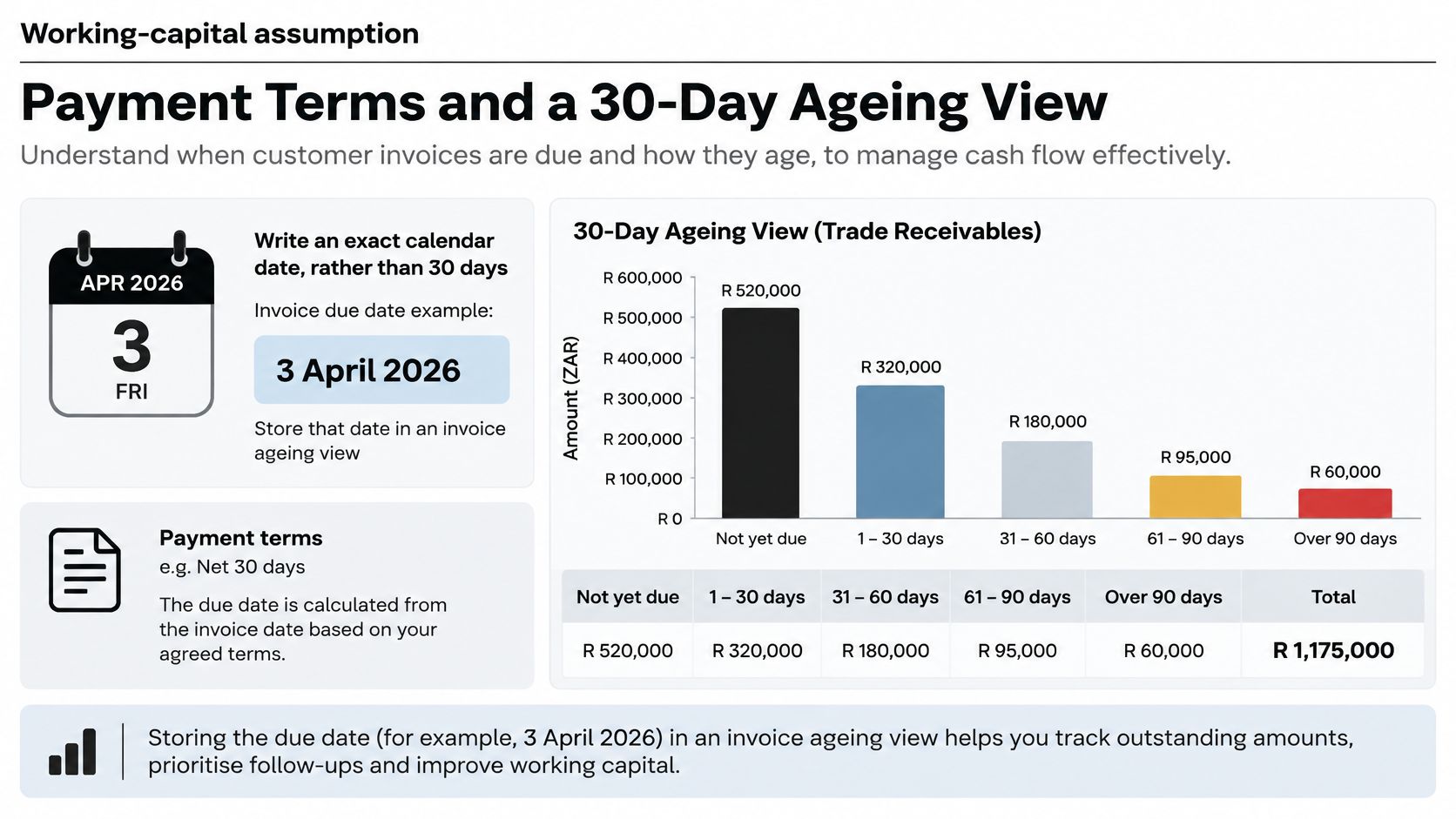
Write an exact contractual due date and store it as a date in your register, not as a note buried in the PDF. In the fictional kelp transaction, payment received on 21 April 2026 against a due date of 3 April 2026 is 18 days overdue, calculated by subtracting the contractual due date from the receipt date.
For unpaid invoices, use the register's reporting date instead of a receipt date. Don't classify an invoice by how long ago you created it when the question is how late the customer is.
The calendar view below makes that distinction practical.
South Africa's public-sector supplier-payment rules establish a 30-day benchmark; National Treasury's 2023/24 report found that provincial departments accounted for 70% of invoices paid after 30 days and 99% of invoices more than 30 days old and still unpaid at the end of March 2024. That's a public-sector finding, not a payment rule that automatically rewrites a private overseas customer's contract.
Invoice ageing against a 30-day benchmark
| Ageing band | Meaning | What the 2023/24 data implies |
|---|---|---|
| Current | Issued but not yet due | Treat the receivable as forecast cash, not money already available |
| 1–30 days overdue | Past the contractual due date, within the first overdue band | Follow up early rather than waiting for a prolonged delay |
| More than 30 days overdue | Beyond the register's escalation threshold | Use a formal escalation process; Treasury's public-sector findings illustrate the risk of persistent non-payment |
An exporter may be owed USD while needing ZAR for payroll, tax and local suppliers. A sound customer who pays late can still leave the exporter needing temporary funding.
Keep the invoice number, currency, outstanding amount, due date, responsible contact and next follow-up date together. Record disputes separately so a missing delivery document doesn't get mistaken for an unexplained refusal to pay.
Use a consistent chase order
- On the due date: Confirm the customer has the invoice and ask whether payment has been released.
- During the first overdue band: Send a second notice, resolve any specific query and request a committed payment date.
- After the escalation threshold: Give the account owner the invoice, supporting documents and contact history for structured escalation.
For teams standardising reminder language, PlatformDTC's dunning terminology provides context for the term used for organised payment follow-up.
Use the following video as a companion to your receivables review.
Bank and Currency Details for an Overseas Buyer
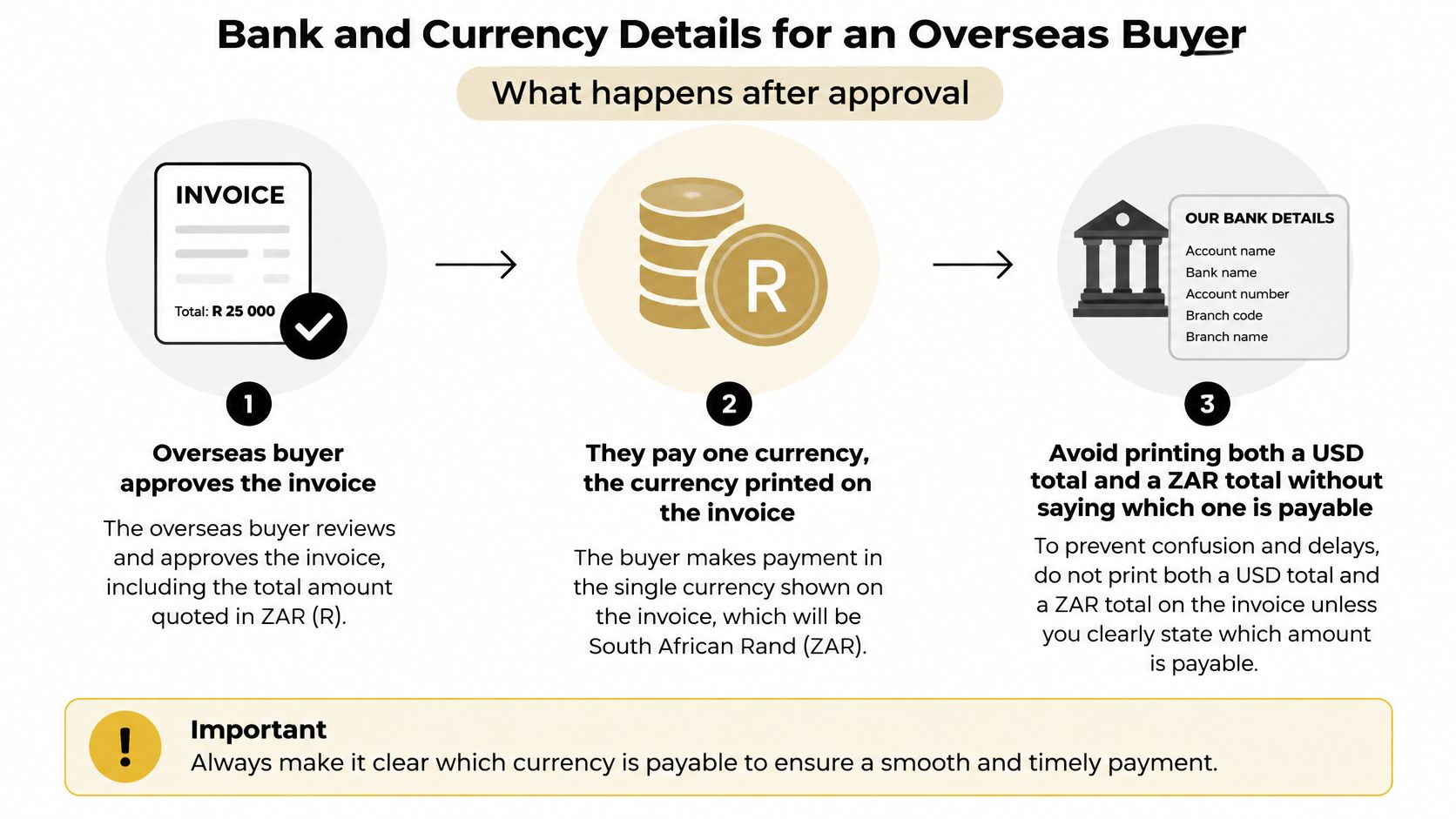
Once the overseas buyer approves the invoice, its payments team must turn your instructions into a bank transfer. Make one settlement currency unmistakable.
If you include a rand equivalent for internal reporting or reference, label it as non-payable. Two unqualified totals invite the buyer to choose the wrong currency or send an amount that doesn't clear the debt.
The payment sequence should remain clear from approval to transfer.
Build the beneficiary block from bank instructions
Use your receiving bank's verified instructions rather than copying an old invoice. Present the details in a consistent order:
- Account name: Match the supplier's legal name, using the verified beneficiary wording.
- Bank name: Give the receiving bank's name.
- Branch code: Include the code supplied for the account.
- Account number: Copy it accurately and check it independently.
- SWIFT/BIC: Include the international routing identifier supplied by the bank.
- Additional routing information: Add an IBAN only if the receiving account has one, and correspondent-bank instructions only when required by the receiving bank.
Don't invent an IBAN to fill a template's empty box. Remove an irrelevant field or mark it as not applicable after checking the bank's instructions.
A supplier billing in USD remains exposed to what those dollars will buy in rand when converted, unless the contract provides otherwise. That's separate from deciding who pays transfer charges, which should also be agreed rather than assumed.
Help both banks identify the receipt
Set the payment reference to the invoice number, rather than the customer's general account name. For this fictional shipment, a suitable purpose description identifies payment for exported dried kelp under the relevant invoice.
The South African business should select the appropriate Balance of Payments category with its bank and keep the supporting transaction documents ready. The overseas buyer shouldn't be expected to invent a South African reporting category.
Payment safeguard: Verify any change of bank details through a trusted contact channel independent of the change request.
Before sending, compare the beneficiary block with the supplier identity on the invoice. An unexplained trading-name mismatch or incorrect routing detail can cause a bank query, rejection or return.
That delay doesn't automatically reset the contractual due date. Resolve the banking problem promptly, keep the original payment obligation visible and document any revised arrangement agreed with the customer.
How the Same Invoice Becomes Structured Data
A readable PDF and a machine-readable invoice aren't the same thing. A person can recognise the buyer's address in a block of text; an accounting system needs to know which part is the legal name, which part is the address and which identifier belongs to the buyer.
It's like the difference between reading a printed address and sorting mail using a postcode. The information may be visible, but software needs it organised into recognised fields.
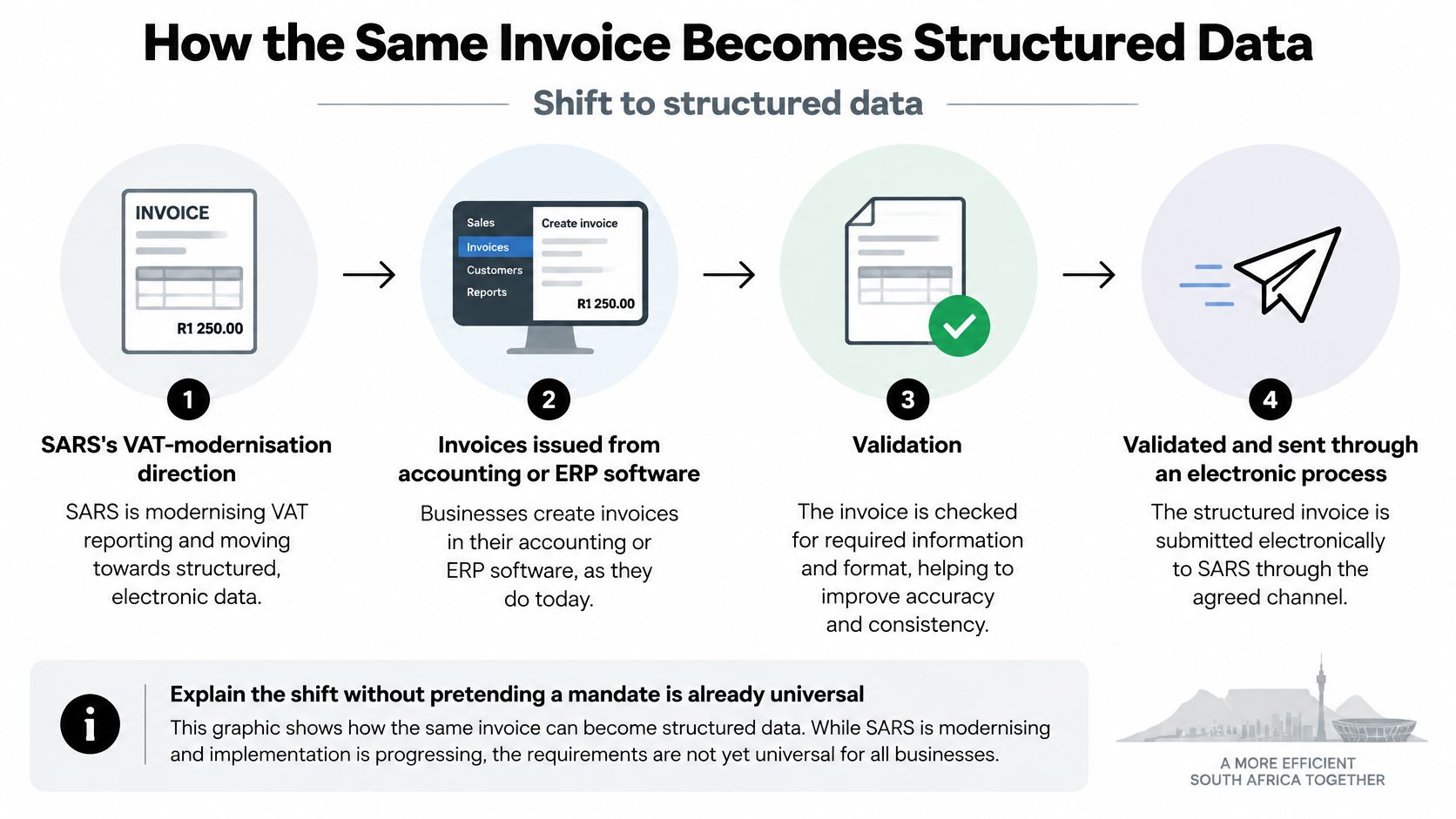
According to Thomson Reuters' South Africa regulatory update, SARS's developing VAT-modernisation direction includes structured invoices issued through accounting or ERP software, validation and transmission through an interoperability framework, with data potentially reported to SARS. The proposed progression is expected to begin with larger taxpayers and later extend to smaller businesses, but this is a developing framework, not a settled universal mandate.
The distinction between a document and its underlying data is shown below.
Store the fields behind the layout
Capture the invoice information in your accounting system, with separate fields for:
- Party identifiers: Supplier and buyer legal identities, addresses and applicable VAT registration numbers.
- Document identity: Invoice number, issue date, currency and purchase-order reference.
- Line-item data: Description, quantity, unit of measure, unit price, tax category, tax amount and line total.
- Settlement instructions: Payment terms, due date, beneficiary details and payment reference.
- Supporting records: Links to the purchase order, delivery evidence and relevant export documents.
The unit of measure deserves its own field. A quantity without an indication of kilograms, hours or individual items can create a matching error even when the PDF looks obvious to its author.
Likewise, retain the tax category separately from the displayed tax amount. A blank tax field shouldn't have to stand in for an explicit treatment.
Start with a manageable transition
An SME doesn't need to redesign every finance process at once. Start by entering clean customer, supplier and item records in the accounting system, then generate the PDF from those records.
Avoid manually retyping the same details into a separate design file. That creates two versions that can drift apart when someone changes a price, date or bank instruction.
Monitor final SARS regulations and the capabilities of your accounting software before claiming future compliance. The sample's layout is the visual layer; the organised field records are what let you carry the transaction into a different electronic format.
Issue the Invoice and Diary the Due Date
Run a send-or-hold check against the actual transaction file, not just the document preview. For the fictional kelp invoice, the unanswered questions about the full buyer address, banking instructions and export evidence must be resolved before issue.
Assign someone to approve the final version and retain that version with its supporting records. Don't let an edited draft and a previously emailed copy circulate as though they're interchangeable.
The release check
- Document type: Confirm the title reads Tax Invoice and that you've selected the appropriate invoice type for the supply.
- Unique identity: Search the register for CKE-2026-0142 and confirm it hasn't already been allocated to another transaction.
- Issue timing: Compare the invoice's issue date with the actual supply record and confirm the permitted issue window has been met.
- Buyer and order: Match the completed legal name, billing address and PO-8841 against the customer's authorised order.
- Settlement instruction: Confirm the customer has agreed to USD payment and the stated calendar deadline.
- Tax and calculation: Check the export treatment against the supporting evidence, then recalculate the goods, packing, tax and total.
- Beneficiary identity: Match the account name and routing details against the independently verified banking record.
A failed check means hold, correct and review. Sending an invoice with a note that the customer should ignore an incorrect amount or use different bank details elsewhere leaves conflicting instructions in circulation.
Send one complete, approved payment instruction, not a collection of corrections the buyer must assemble.
Diary and close the transaction
Record the agreed due date in the current band of the ageing register, assign the follow-up owner and retain the purchase order with the delivery and export evidence. Send the invoice through the customer's agreed submission channel and keep proof of submission.
Track the receivable until the funds arrive, then match the receipt using the invoice reference. Investigate any short payment, bank charge or currency difference before marking the invoice fully settled.
Our free invoice template creates a South African invoice with VAT and downloads a professional PDF in ZAR, USD, GBP or EUR. Our free BoP code checker helps identify the likely category for an export receipt or import payment, provides bank-ready wording and shows which documents to prepare. Visit Zaro to prepare your invoice and payment information before sending it to your customer.