
A Cape Town freight forwarder lands a USD invoice from Hamburg in the inbox, opens the bank quote, and realises the money isn't just moving, it's getting shaved. The commission looks manageable at first glance, then the SWIFT line appears, then the exchange rate lands a little wider than expected, and suddenly the exporter is funding the bank's margin instead of protecting theirs. That's the telegraphic transfer problem in South Africa, it's not the definition, it's the drag.
For South African exporters, freight companies, agencies, and professional services firms that settle 5 to 40 international payments a month, the mistake is the same. They treat a telegraphic transfer like a simple remittance, then absorb bank pricing that punishes mid-sized invoices and recurring cross-border work. This is a working guide for finance leads who want to stop overpaying, keep auditability intact, and know exactly when a bank TT still makes sense.
The Mid-Sized Invoice Most South African Exporters Still Lose Money On
A Cape Town exporter settling a USD 14,800 invoice from a Hamburg buyer does not need a definition lesson. They need the cost to stop leaking across commission, SWIFT charges, and FX conversion. On paper, a TT looks like a routine bank rail. In practice, it is a regulated, fee-loaded product with several points where value gets clipped.
Why mid-sized invoices hurt most
The cost profile bites hardest in the middle. Very small invoices get crushed by fixed fees, and very large ones spread those fees over a bigger value base. In the middle, between roughly USD 5,000 and USD 50,000, the percentage charge and the fixed SWIFT leg both matter, so the effective cost stays high.
That is why exporters who send a handful of supplier payments each month feel the drag so sharply. For example, if a bank charged 0.55%, added a R280 SWIFT surcharge, and built in an exchange-rate spread of 60 to 90 basis points, the total bite would sit around 2.3% of the rand value received before any intermediary deductions. I'm blunt about this because finance teams need the full landed cost, not bank comfort language.
Practical rule: if the bank quote is shown as one neat line item, assume more cost is hiding in the FX rate.
Who should care most
Finance leads at exporters, logistics firms, BPOs, consultancies, and any business sending recurring supplier payments abroad should pay attention. If you process international invoices every week, TT pricing is not a theory exercise. It is working-capital leakage.
The right response is not to abandon banks blindly. Measure the total landed cost invoice by invoice, and stop accepting the first quote as if it were the whole story.
What a Telegraphic Transfer Actually Does Behind the Scenes
A telegraphic transfer is not magic, and it's not a cash courier. It's an instruction chain. The bank in South Africa sends a payment message, and the money settles through bank relationships until the beneficiary's bank can credit the account. The old telegram analogy still helps, because the message moves first and the funds move later.
The key point is simple. SWIFT carries instructions, not money. That means same-day messaging can still end in a T+2 or T+4 experience when correspondent banks, cut-off times, and currency settlement windows get involved. The bank can say the payment was sent today. Your supplier still doesn't see usable funds until the chain completes.
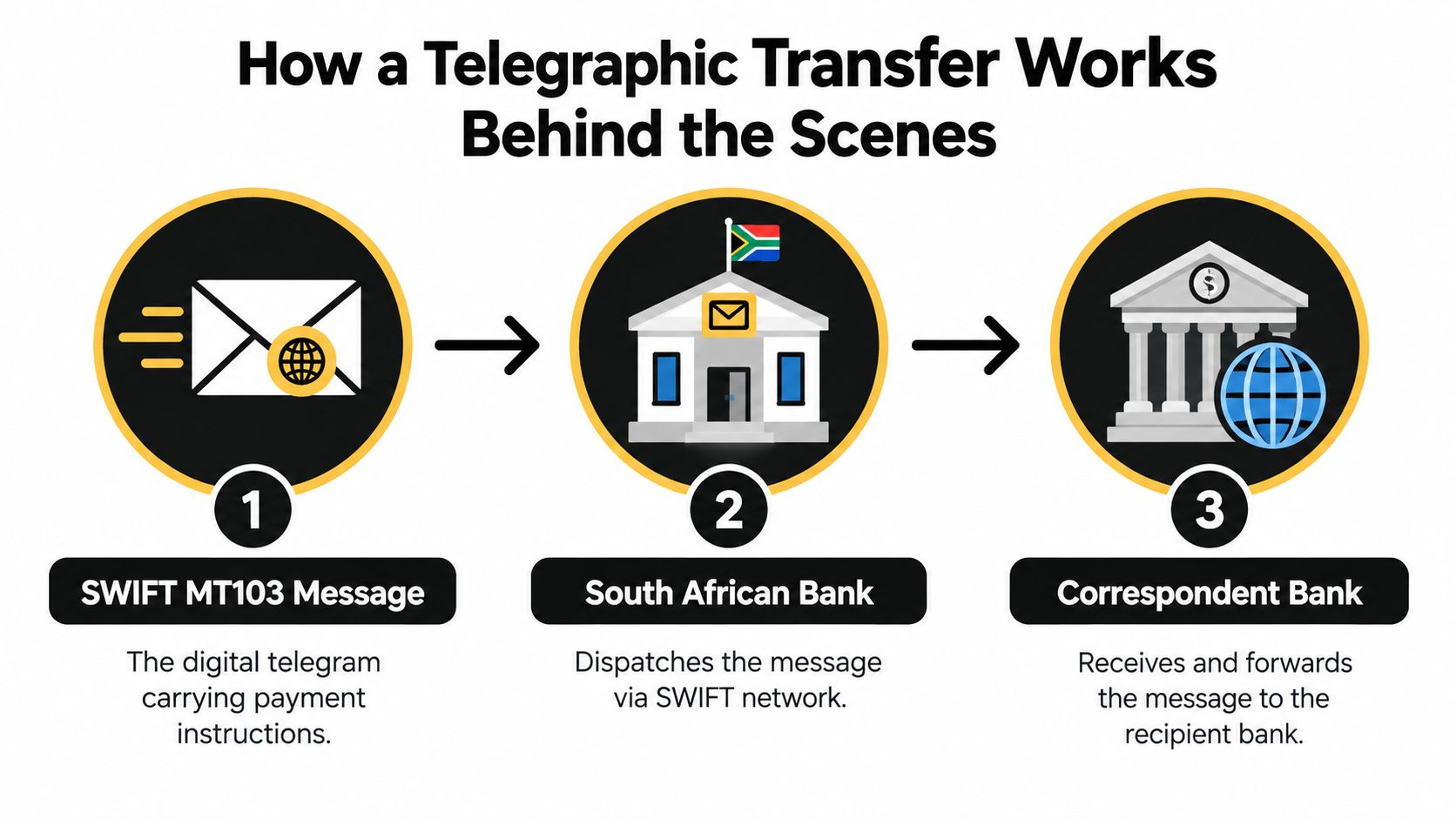
The six moving parts
A clean TT usually runs through six practical steps.
- You instruct your South African bank. The exporter submits the beneficiary details, invoice reference, amount, and purpose of payment.
- The bank screens the instruction. Compliance checks happen before the message leaves the bank.
- The bank creates the SWIFT MT103 message. That message is the digital instruction packet.
- A nostro or correspondent bank relays the transfer. Routing can branch if the beneficiary bank doesn't have a direct relationship.
- The beneficiary bank receives the message. It still has to reconcile the instruction with the incoming settlement.
- The recipient gets credited. Only then does the payment become usable on their side.
Each stage is a place where time and cost can enter the chain. The domestic bank charges for initiating the transfer, the SWIFT or communication fee gets applied in the messaging layer, and correspondent banks can deduct their own fees before the beneficiary sees the net amount.
Why the delay happens
The delay is structural, not accidental. Banks work with cut-off times, correspondent relationships, and settlement windows across multiple time zones. That's why a TT can be initiated quickly and still land slowly.
Video reference for the SWIFT flow is here:
If you understand that split between instruction and settlement, you stop arguing about why the bank “already sent it” and start asking the right question, which is whether the rail is fit for the invoice profile in front of you.
How South African Banks Really Price Telegraphic Transfers in 2026
South African TT pricing is not one fee. It's a structure. Standard Bank's 2026 pricing shows outward TT at 0.502% on the electronic channel, with a minimum of R210 and a maximum of R760, while inward TT is 0.448%, with a minimum of R180 and a maximum of R600. The same tariff also shows a separate communication fee of R122 for outward transfers, which is exactly the kind of layering finance teams need to watch closely. Standard Bank 2026 business pricing guide
The tariff structure that matters
The issue is the split between the percentage charge and the fixed messaging fee. The percentage scales with the invoice size, but the fixed SWIFT or communication leg does not. That creates a non-linear cost curve, especially for exporters paying a stack of mid-sized supplier bills.
Standard Bank's published pricing is useful because it shows the structure plainly. Electronic-channel outward transfers are cheaper than branch execution, and inward pricing is lower than outward pricing, but none of that changes the fact that the fixed fee bites hardest when the invoice is small or recurring. The older South African pricing pattern described in the brief matches the same logic, percentage commission plus minimum and maximum boundaries, which is how banks have long packaged TTs in this market.
Standard Bank 2026 Telegraphic Transfer Tariff Breakdown
| Fee Component | Outward TT | Inward TT |
|---|---|---|
| Percentage commission | 0.502% electronic channel, 0.700% physical channel | 0.448% electronic channel, 0.579% physical channel |
| Minimum fee | R210 electronic channel, R300 physical channel | R180 electronic channel |
| Maximum fee | R760 electronic channel, R995 physical channel | R600 electronic channel |
| Communication fee | R122 separate outward communication fee | Included in inward pricing structure |
Branch execution is materially more expensive, so if your bank still nudges you toward branch processing for routine cross-border invoices, push back hard. For most exporter workflows, the electronic channel is the only version worth considering.
Practical rule: never compare two rails on the percentage fee alone. Compare the percentage fee, the messaging fee, and the exchange rate together, or the bank quote will mislead you.
The reason this matters operationally is simple. A fixed fee is trivial on a large payment, but it distorts smaller invoices and recurring transfer flows. That's where bank pricing stops being proportional and starts being punitive.
Where Telegraphic Transfer Costs Quietly Bite Smaller Businesses
FinMark Trust's remittance research makes one uncomfortable point very clear, SWIFT-related fees can dominate the end-user cost on smaller transfers. It found market SWIFT fees in South Africa ranging from R80 to R180 per transaction, and showed that the SWIFT fee could represent 31.89% of a USD150-equivalent transfer, falling to 8.77% only when the send amount rose to USD200. It also noted that the bank's per-transaction cost to use SWIFT messaging was about R2.50, which tells you the retail charge is mostly pricing, not pure network cost. FinMark Trust cross-border remittances research
Why fixed fees punish low-value transfers
A lot of exporters misread the problem. They look at the bank commission and think the issue is the percentage. It isn't. The trap is the fixed communication charge sitting on top of a fee that already scales by value.
If you send one invoice, the fixed fee is annoying. If you send many smaller invoices, it becomes a tax on operational habits. That's why batch behaviour matters. A finance team that settles one larger monthly instruction will usually do better than a team firing off many small TT requests.
Effective TT Cost by Invoice Size in Rand
| Invoice Size (ZAR) | Bank Commission | SWIFT and Agent Fees | FX Spread | Effective Total Cost |
|---|---|---|---|---|
| Small invoice | Qualitatively high as a share of value | Qualitatively high as a share of value | Qualitatively meaningful | Qualitatively elevated |
| Mid-sized invoice | Moderate in absolute rand terms | Still material | Still meaningful | Often the worst effective band |
| Large invoice | Higher absolute rand amount | Less painful as a share of value | Still relevant | Lower effective percentage |
| Very large invoice | Larger total fee amount | More diluted | Still relevant | More efficient on a percentage basis |
That table is intentionally qualitative because the exact cost depends on your bank, route, currency pair, and beneficiary bank. The pattern is the important part. Small and mid-sized invoices absorb the fixed fee badly, while larger invoices spread it out.
The second hidden cost is the exchange-rate spread. Even when the fee line looks acceptable, the bank can still build margin into the rate. For finance leads, that means one quoted fee never tells you the price of the payment.
Telegraphic Transfer vs Fintech Rails and Card Based Alternatives
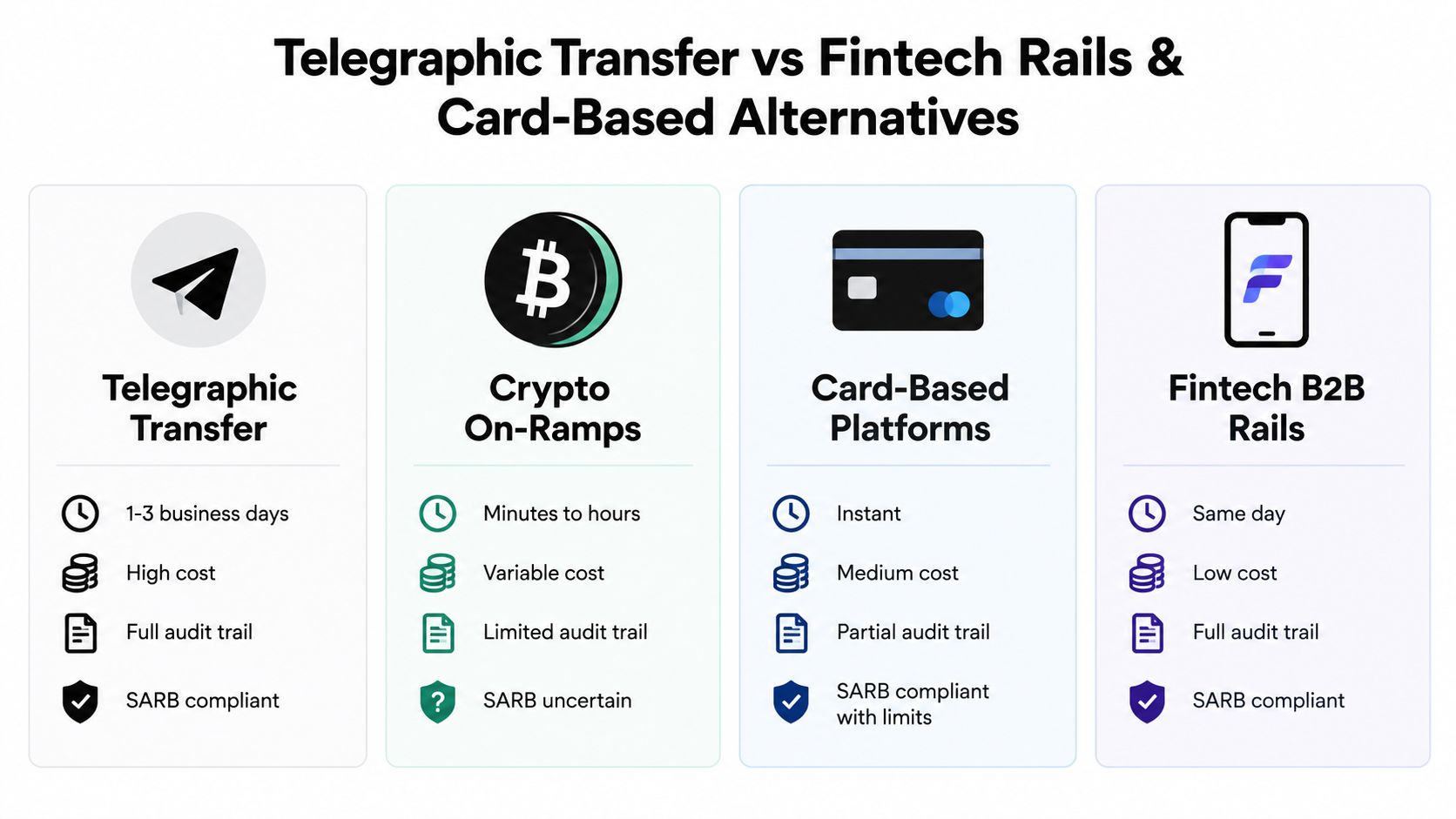
Telegraphic transfer is still the default in many South African businesses because it is recognised, documented, and familiar to auditors. That doesn't make it the right rail. For a settled invoice, the decision should come down to speed, cost, audit trail, and whether the counterparty bank can receive funds cleanly.
Crypto on-ramps can move fast, but they introduce valuation risk between purchase and transfer, plus the compliance posture is less straightforward than a normal bank-to-bank instruction. Card-based platforms can be convenient for certain spend categories, but they're not built for every supplier settlement. Fintech B2B rails usually win where the business wants a stronger cost line, clearer tracking, and less nonsense in reconciliation.
How I'd choose the rail
- Large settled invoices to a bank account: Keep the TT if the beneficiary bank is hard to reach on faster rails.
- Recurring mid-value B2B payments: Use a fintech rail if the landed cost is lower and the audit trail is clean.
- Urgent card-eligible spend: Use card-based platforms when the merchant structure allows it.
- Crypto settlement: Only consider it where the counterparty explicitly accepts it and treasury is comfortable with the operational and valuation risk.
The cleanest comparison is not ideological, it's operational. A TT gives you a formal bank message trail. A fintech rail often gives you faster settlement and a cheaper effective cost. Card platforms help when the spend is merchant-led rather than invoice-led.
Zaro fits into that comparison as one option for South African businesses that want to fund cross-border payments by local bank transfer and send funds to overseas beneficiaries without relying on a traditional TT flow. I'd treat that as a payments-operations decision, not a branding decision. If the rail gives you a better landed cost and a cleaner control environment, it deserves a seat at the table.
Practical rule: if you can't explain why the bank rail is worth the extra cost on this exact invoice, you're probably using the wrong rail.
The point is not to declare TTs dead. The point is to stop treating them as the default answer when a cheaper, clearer, better-audited alternative exists.
Tracking, Compliance and Audit Trails for Cross Border TTs
South African finance teams need a repeatable process every time they send or receive a TT. For electronic cross-border transactions of R20,000 and above, SME guidance says the transfer must be reported to the Financial Intelligence Centre through an International Funds Transfer Report, and the South African Reserve Bank's 2026 consultation shows that the regulatory environment is still moving. SME South Africa cross-border guidance
What to capture on every transfer
The operational discipline is simple.
- IFTR reporting: Make sure the report is filed when the transaction crosses the reporting threshold.
- UCR reference number: Keep the unique customs reference where it applies to the underlying trade flow.
- MT103 copy: Store the SWIFT message as proof of instruction and settlement.
- Invoice match: Reconcile beneficiary name, amount, currency, and purpose against the supplier invoice.
- Short pay handling: If the receipt lands short, trace the deductions through the intermediary chain.
The MT103 is the document your team should treat as the primary payment proof. If a supplier disputes receipt, that message tells you what was sent, where it went, and which reference fields were used. It also becomes the anchor for month-end matching, because the bank statement alone rarely tells the whole story.
Reconciliation is where the real work happens
For practical reconciliation logic, the payment team at Loopfour has a useful explainer on matching logic and exceptions. That matters because TT breaks often show up as exceptions, not as clean straight-through matches.
Keep the SWIFT tracking reference in your ERP, request the MT103 from the bank as soon as the payment is released, and flag every short-paid or delayed transfer before month-end close. That discipline turns a messy bank product into something your auditors and operations team can live with.
When to Keep a Telegraphic Transfer and When to Replace It
My view is straightforward. Keep the TT when the payment is large enough that the bank's percentage commission doesn't sting, or when the beneficiary bank is effectively unreachable on a faster rail. Replace it when the payment is recurring, mid-sized, and the all-in bank cost is visibly worse than a fintech quote.
Use the profile, not the habit
For large USD invoices above R1 million, a TT can still be defensible because the commission becomes easier to absorb relative to the value moved. For mid-value recurring B2B flows between R50,000 and R500,000, a fintech rail usually wins on landed cost and sometimes on control. For small ad hoc payments under R25,000, the fixed messaging charge alone can make the bank route a bad choice before you even look at FX.
TT vs Fintech Rail Decision Matrix by Invoice Profile
| Invoice Profile | Recommended Rail | Typical Total Cost | Reason |
|---|---|---|---|
| Large one-off supplier invoice | Telegraphic transfer | Higher in absolute rand, often acceptable in percentage terms | Bank reach and documentary certainty still matter |
| Recurring mid-value exporter payments | Fintech B2B rail | Usually lower landed cost | Fixed TT charges punish repetition |
| Small urgent invoice | Fintech or card-based platform | Often materially lower | The fixed SWIFT leg is too heavy |
| Hard-to-reach beneficiary bank | Telegraphic transfer | Depends on route | Accessibility can outweigh cost |
| Counterparty accepts alternative rails | Fintech rail | Usually better total value | Stronger cost control and cleaner reconciliation |
How to negotiate without wasting time
Ask your bank for a tiered commission schedule. Ask them to rebalance the SWIFT fee against the commission. Ask for the quote in writing, then compare it with a fintech quote on the same beneficiary, same currency, and same payment urgency. If you send volume each month, bundle it. Banks respond to predictable flow, not polite frustration.
The only rule of thumb I'd keep on a wall is this. Keep the TT when the beneficiary bank is unreachable on any faster rail. Replace it the moment a quoted fintech rate is even 50 basis points inside the bank all-in cost.
If you're trying to cut cross-border payment drag without losing control, Zaro gives South African businesses a way to fund international payments from local bank transfers, manage beneficiaries, and keep a clearer view of what leaves the country. Visit Zaro and compare it against your current TT cost on the next supplier invoice before the bank takes another quiet bite out of margin.