
A South African finance team can be juggling all of this at once, supplier payments to the US, receivables from overseas clients, online checkout for local customers, and payouts into African markets. The wrong fintech choice makes each workflow feel more expensive and less predictable, especially when fees, FX markups, and settlement paths stay hidden until the transfer is already underway. The better way to compare the top fintech companies is by the business problem they solve, not by brand familiarity, and that's the standard used here. If you're still shortlisting tools, a practical software trial checklist for teams helps keep implementation questions grounded in real workflows.
1. Zaro
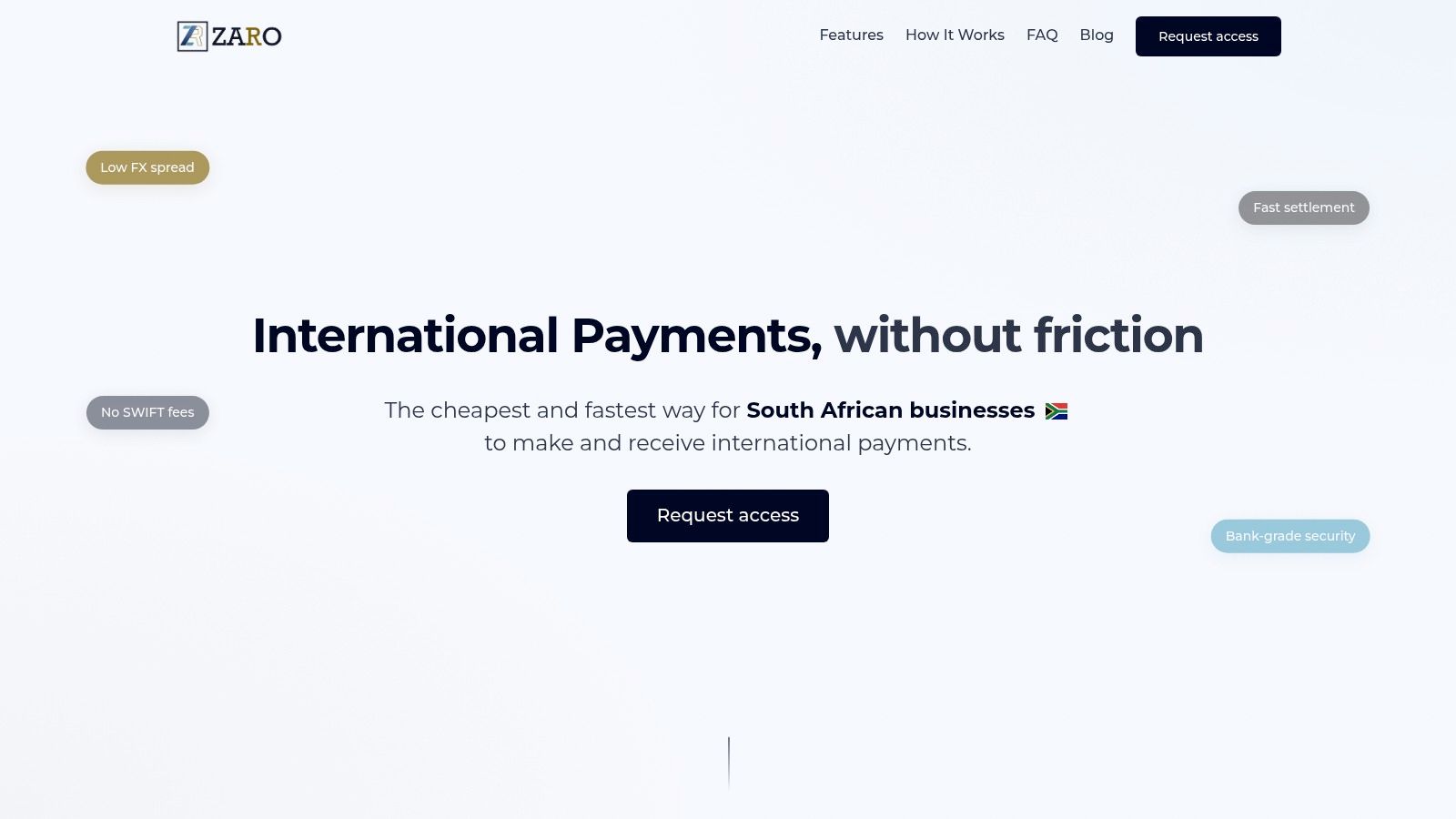
A South African finance team comparing cross-border options is usually dealing with one of four jobs, supplier payments, export receivables, BPO disbursements, or treasury control over FX. Zaro is aimed at the first two, plus the control layer around them. It is built for exporters, importers, CFOs, and BPOs that want predictable FX, transparent settlement, and business-grade controls instead of bank transfers that arrive with layered markups. Zaro says it uses real exchange rates with no SWIFT fees, so the main appeal is clearer landed cost, not just faster transfer initiation.
That distinction matters because South African buyers often compare the full cost stack, not a single headline fee. As noted in South Africa-focused market analysis, retail bank markups and transfer-operator spreads can sit well above the mid-market rate. Zaro is designed to reduce that gap. For finance leaders, the practical effect is better visibility before the payment goes out, which makes cash flow planning and margin checks easier.
Built for governed cross-border operations
Zaro's value is not only pricing. It also gives finance teams the controls they need to use a new rail without losing approval discipline. The platform includes KYB onboarding, multi-user access, customizable permissions, and bank-level security, so payments can stay governed even when the team moves away from slower legacy processes. Zaro is also an authorised Financial Services Provider and FIC-registered, which helps when compliance review is part of vendor selection.
The operational tools are practical too. ZAR and USD balances can be funded by standard bank transfers, and the platform includes an FX calculator, a VAT invoice template, and a BoP code checker to cut admin around cross-border receipts and payments. That matters for teams that repeat the same workflow every month and need fewer manual checks at each step.
For South African firms that want controlled cross-border payments with clearer pricing and fewer moving parts, Zaro fits the problem better than a general-purpose payments tool. Website, Zaro
2. Wise Business
Wise Business is the clearest comparison point for companies that want spot-rate FX with a transparent fee model. The platform is built around multi-currency accounts, local receiving details for major currencies, approvals, user roles, batch payments, and an API ecosystem that suits businesses with repeat international workflows. For South African exporters, that makes Wise a strong candidate when the main problem is sending or receiving money without opaque FX spreads.
It also has an important local angle. Wise has received conditional South African Reserve Bank approval to operate locally as a Category 2 ADLA, which suggests a meaningful commitment to the market rather than a superficial presence. That's relevant for teams that want a provider with increasing South African regulatory footing, especially if they value a familiar UX and upfront pricing.
Best fit and trade-offs
Wise works best when your business needs broad multi-currency handling, not just one corridor. The business account is well suited to firms that pay overseas suppliers, hold balances in several currencies, and need staff-level controls that don't require a heavy implementation project.
The trade-off is that corridor coverage and payment methods still matter. Some transfer types can rely on SWIFT or carry fixed fees, so it's worth mapping your actual sending patterns before assuming every route will be equally efficient. For South African finance teams, Wise is a good fit when transparency matters more than custom corridor design.
The real question isn't whether the fee is low, it's whether the fee is obvious before approval and consistent enough for treasury forecasting.
Website, Wise Business
3. Payoneer
Payoneer solves a different problem, it helps businesses collect from global clients and marketplaces rather than primarily optimizing outbound payments. That makes it especially relevant to South African exporters, freelancers, agencies, and BPOs that invoice overseas customers or receive platform-based income from channels such as marketplaces and client networks. The value proposition is consolidation, one account for receiving, holding, converting, and then disbursing funds.
The appeal is operational. If your team receives money in multiple currencies, Payoneer can reduce the mess of managing separate deposit paths and then moving funds into local banking systems. It also supports supplier and contractor payouts, so a finance team can use it as a hub between overseas receivables and local or global disbursements.
Where Payoneer fits in practice
Payoneer is strongest where receivables are the starting point. If your business already has customers or platforms that pay into Payoneer, the ecosystem familiarity can reduce friction during onboarding and payment collection.
The main trade-off is cost visibility. Fees can vary by corridor and method, and some users may face account-related charges depending on activity levels. That makes Payoneer less of a pure FX bargain play and more of an operational receivables platform, especially for firms whose primary need is to centralize cross-border inbound cash.
- Choose Payoneer if you receive from clients or marketplaces first, then decide how and when to convert.
- Choose another platform if your main pain is outbound FX transparency on supplier payments.
- Choose it for multi-currency cash pooling and global payout flexibility.
Website, Payoneer
4. Flutterwave South Africa
Flutterwave is a stronger fit for businesses that need to accept payments across markets while still settling into South African operations. It functions as a pan-African gateway, which makes it useful for SaaS companies, exporters, and digital businesses selling into multiple countries who want one integration instead of many local payment setups. For South African merchants, the attraction is not just card acceptance, but the ability to support several payment methods and still settle in ZAR.
That ZAR settlement point is important. If your finance team values local cash management, you may prefer a provider that keeps settlement straightforward rather than building a foreign-currency treasury workflow around every sale. Flutterwave also offers developer-friendly APIs for collections and payouts, which matters for businesses that need to expand method coverage without redesigning the checkout stack.
A gateway choice, not a treasury tool
Flutterwave is less about FX optimization and more about collections infrastructure. That distinction matters because a lot of top fintech company lists blur payment gateways, payout tools, and business FX services into one category. In practice, a South African merchant selling into Africa may need all three, but each workflow should be assigned to the right provider.
The trade-off is that USD settlement in South Africa is limited, so businesses that need foreign-currency receivables management may find the platform better for collection and local settlement than for treasury control. If your priority is fast onboarding, broad payment-method support, and ZAR settlement, Flutterwave earns serious consideration.
Website, Flutterwave
5. Peach Payments
Peach Payments is one of the most relevant choices for South African companies focused on online checkout, subscriptions, and payment orchestration. It covers cards, Pay by Bank, Instant EFT, mobile wallets, payment links, hosted checkout, tokenization, and recurring billing. That breadth makes it especially useful for e-commerce businesses and SaaS companies that care about conversion, recurring collections, and reliable local payment acceptance.
The fit is especially strong when your business needs local payment methods rather than cross-border FX. Peach is built for South African online revenue collection and payout flows, and its enterprise orientation shows up in the way it handles orchestration and recurring billing. If your finance and product teams need a gateway that plugs into a broader commerce stack, Peach is a serious contender.
Strong for subscriptions and local payment journeys
Recurring billing is where many businesses get stuck with weaker providers. Peach's support for tokenization and subscriptions reduces the operational burden of charging repeat customers, while its local support and integration ecosystem make it easier to work through the payment journey without constant workaround logic.
The downside is commercial clarity. Public pricing is limited, and many merchants are quoted custom rates, which means procurement teams have to spend more time in sales conversations before they can compare the actual cost. That's not necessarily a problem, but it does make early-stage shortlisting slower than with platforms that publish more detail.
For subscription businesses, the best gateway is usually the one that fails least often and gives finance teams enough control to reconcile payments without manual cleanup.
Website, Peach Payments
6. Paystack South Africa
Paystack is the most developer-friendly choice on this list for businesses that want a modern checkout layer with strong APIs and a clean onboarding experience. It suits South African entities that sell online, handle subscriptions, and want international card acceptance with ZAR settlement. The platform's appeal is simplicity, a clear fee structure, solid developer documentation, and the ability to unify online and in-person acceptance through terminals or virtual terminal options.
For SaaS and digital-first businesses, that matters. Paystack's tooling helps product and finance teams work from the same system, so subscriptions, disputes, and fraud controls sit closer to the rest of the payments stack. If your team wants something that feels closer to a modern API platform than a traditional merchant account, Paystack is worth testing.
Best for technical teams that value speed
The trade-off is currency handling. For South African merchants, checkout currency display and settlement are typically centered on ZAR, so businesses that need true USD billing or settlement in South Africa may find the model limiting. That's not a flaw if your goal is local online revenue collection, but it does matter if you're building a foreign-currency billing workflow.
Paystack is strongest where the payment experience itself is the product. If your team is shipping quickly and wants a gateway that won't slow engineering down, it belongs high on the shortlist.
Website, Paystack
7. Onafriq
Onafriq is the infrastructure play on this list. It connects banks, mobile money operators, and fintechs across African markets, which makes it useful for South African businesses that need to move value across multiple countries without stitching together separate local integrations. Its real strength is corridor reach, especially when the business problem is pan-African collection or disbursement rather than a single consumer payment flow.
That makes Onafriq particularly relevant for exporters, platforms, and financial institutions that operate at scale across African markets. If your company needs access to wallets, banks, and money transfer operators through one integration, Onafriq reduces fragmentation and can simplify cross-border African operations. Its participation in PAPSS also points to a settlement model designed for broader intra-African interoperability.
When infrastructure matters more than dashboard design
Onafriq isn't trying to look like a retail SME payments app, and that's the point. It's better understood as a network that sits underneath the payment experience, rather than a front-end finance dashboard. For enterprise buyers, that can be an advantage because they're buying connectivity, not just a user interface.
The trade-off is implementation. Pricing and onboarding are typically sales-led, and teams usually need a clear use case before the platform becomes useful. If your business needs African-market rails, not just card acceptance or FX, Onafriq belongs near the top of the list.
Website, Onafriq
Top 7 Fintech Companies Comparison
| Product | Implementation complexity (🔄) | Resource requirements & speed (⚡) | Expected outcomes / impact (📊) | Ideal use cases (💡) | Key advantages (⭐) |
|---|---|---|---|---|---|
| Zaro | 🔄 Medium, KYB business onboarding; finance‑team controls | ⚡ Low, bank transfers + stablecoin rails enable minute‑scale settlement | 📊 Predictable, very low‑cost FX; fast US→ZA receipts; tailored pricing | South African SMEs, exporters, CFOs needing predictable FX and fast payouts | ⭐ Very low FX spread; near‑zero SWIFT fees; enterprise security & compliance |
| Wise Business | 🔄 Low, self‑serve onboarding, APIs available | ⚡ Low, multi‑currency accounts; some corridors may use SWIFT | 📊 Transparent spot‑rate FX with upfront fees; reliable multi‑currency flows | SMEs needing spot FX, batch payments, multi‑currency receiving (incl. SA) | ⭐ Transparent pricing; strong API/platform and growing SA presence |
| Payoneer | 🔄 Low, self‑serve global receiving & marketplace integrations | ⚡ Moderate, local receiving accounts, conversions and withdrawals | 📊 Consolidated multi‑currency receivables and disbursements across marketplaces | Exporters, freelancers, marketplaces consolidating cross‑border receipts | ⭐ Broad marketplace reach; unified multi‑currency hub |
| Flutterwave (South Africa) | 🔄 Medium, API integration; some features require approvals | ⚡ Moderate, cards + alternatives; ZAR settlement and regional reach | 📊 Fast go‑live, published ZA pricing, broad buyer payment options | Merchants/SaaS expanding in Africa wanting one integration and ZAR settlement | ⭐ Pan‑African footprint; multi‑method acceptance and clear ZA pricing |
| Peach Payments | 🔄 Low–Medium, gateway onboarding; enterprise pricing may require sales | ⚡ Moderate, cards, Instant EFT, wallets; tokenization & recurring billing | 📊 Fast (next‑business‑day) ZAR payouts; strong subscription/orchestration support | South African e‑commerce and SaaS needing subscriptions and local plugins | ⭐ Strong local integrations; enterprise orchestration; subscription tools |
| Paystack (South Africa) | 🔄 Low, developer‑friendly, fast onboarding | ⚡ Low, API‑first, optional terminals; ZAR settlement | 📊 Reliable card acceptance, subscription support, clear SA fee model | SaaS and online businesses needing robust developer tooling | ⭐ Excellent developer experience; simple fees; quick implementation |
| Onafriq (formerly MFS Africa) | 🔄 High, enterprise/partner integrations and onboarding | ⚡ High, network connectivity across 30+ African markets; integration work | 📊 Wide pan‑African collections & payouts; reduced intra‑African settlement friction (PAPSS) | Enterprises, fintechs and banks needing single integration for African corridors | ⭐ Purpose‑built African network; single integration for many markets |
Match the Provider to the Payment Workflow
The cleanest way to choose among the top fintech companies is to map each one to a payment workflow. Zaro and Wise Business are the strongest options for transparent cross-border FX, but they serve slightly different needs, Zaro is purpose-built for governed South African business payments, while Wise is broader for multi-currency use. Payoneer is better when the money comes in first through clients or marketplaces, because receivables aggregation is its core strength.
For checkout and collections, the split is also clear. Flutterwave is a good fit for multi-country collections with ZAR settlement, while Peach Payments and Paystack are better for online checkout, recurring billing, and subscription-led revenue. Onafriq sits underneath those use cases when the need is pan-African infrastructure rather than a retail gateway or FX account.
Before signing anything, finance teams should compare a few things in writing. Check the corridors you use, the settlement currencies you need, the pricing model, the compliance requirements, the permissions and approval structure, the available APIs, payout timing, and how much onboarding depends on sales-led implementation. Those details matter more than a generic “best fintech” label, especially in South Africa where payment needs often span local checkout, African expansion, and cross-border supplier flows.
For businesses that care most about governed, predictable cross-border payments, Zaro is especially relevant because it combines transparent FX, business onboarding, and operational controls in one workflow. If that sounds closer to your team's reality than a consumer-style money app, it deserves a serious demo.
South African businesses that want predictable international payments can start by comparing Zaro against the specific corridors and approval workflows they use today. If you need transparent FX, business onboarding, and team controls in one place, visit Zaro and see how it fits your payment workflow.