
Your Johannesburg business has a confirmed export order, but the buyer's commitment doesn't pay your supplier. Production needs cash, the freight booking needs approval, and your customer won't pay until the goods arrive. Meanwhile, the rand keeps moving, and your bank wants documents your operations team hasn't assembled.
That's where trade finance becomes a treasury problem rather than a product search. Before asking which facility has the lowest rate, establish what must happen between accepting the order and having cleared, usable money in your account.
Why South African Exporters Need a Trade Finance Playbook
A purchase order from a buyer in Lagos, London or Shanghai can look profitable while creating an uncomfortable funding gap. You might need to buy imported inputs, pay local staff and settle freight before your customer accepts delivery. If you take the order without mapping those obligations, you're committing cash you may need elsewhere.
Start with the transaction, not the borrowing limit. Identify when money leaves, when you expect it back, and what could prevent either event from happening as planned. A buyer's willingness to pay, a bank's willingness to finance and an authorised dealer's ability to process a payment are separate questions.
Trade finance is about timing, not just capital. Money available after the supplier's deadline doesn't solve the supplier's deadline.
Assign responsibility before accepting the order
For an owner-managed exporter, the practical starting point is a shared transaction record. Finance, sales and logistics should work from the same commercial terms, document requirements and expected dates.
- Sales owns the promise. Record the buyer, agreed currency, payment terms and conditions for acceptance.
- Operations owns the evidence. Identify who produces shipping documents and confirms dispatch, delivery and any exceptions.
- Finance owns the funding gap. Establish which obligations require cash before the buyer pays.
- Treasury owns execution. Confirm the settlement route, currency conversion decision and required payment references.
Don't leave a disagreement about payment terms until the goods are aboard a vessel. Resolve it while you can still change the contract.
Price the order as a cash commitment
Your margin calculation should include financing, freight, payment charges and currency exposure, not merely production costs. Ask what happens if the buyer pays late, disputes part of the delivery or requests different documents after dispatch.
For finance leads and owners already exporting, this is the discipline to establish this quarter: approve the commercial deal and its cash-flow plan together. For businesses preparing to export, use that same discipline before accepting the first overseas order. Revenue growth isn't a substitute for a fundable transaction.
What Trade Finance Actually Solves
An exporter and an importer want opposite things. The exporter wants payment before surrendering control of the goods; the importer wants evidence that the goods meet the agreement before releasing cash. Distance makes verification harder, and different currencies complicate the eventual settlement.
The relationship is easier to understand as a set of connected gaps.
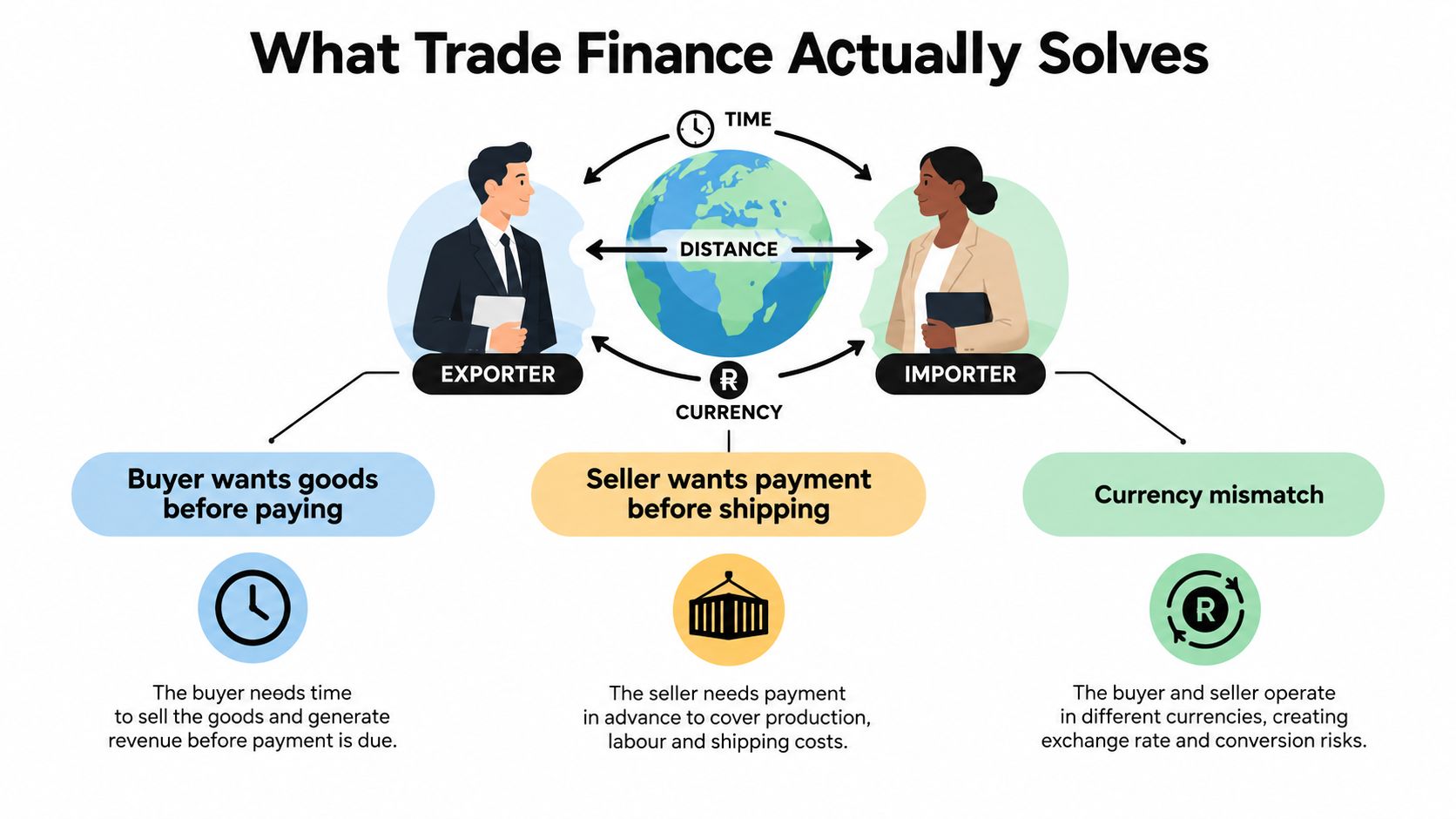
Trade finance connects commercial commitments to cash availability and payment protection. Think of working capital as money travelling through the business. You spend it on an order, convert it into goods, then into a receivable, and finally back into available cash.
A financing arrangement can bring that final cash receipt forward. Another arrangement can postpone a supplier payment. A risk-protection instrument can introduce a bank or insurer to carry a defined exposure, subject to its terms.
Separate funding from protection
Pre-shipment finance addresses spending before dispatch, such as procurement and production. Post-shipment finance addresses the period after dispatch when you've delivered against the contract but haven't collected the receivable.
Those are different credit decisions. Before shipment, the funder must consider whether you can complete the order; afterwards, the assessment shifts towards the receivable, documentary evidence and buyer's ability to pay. Neither arrangement automatically removes currency risk or a dispute over product quality.
Keep the intended outcome explicit:
- Fund execution. Make the goods and move them without starving ordinary operations.
- Improve collection certainty. Agree what evidence supports payment and who must provide it.
- Protect the commercial margin. Manage currency exposure separately from the funding decision.
- Contain disputes. Understand which risks remain yours even when a bank participates.
For a general explanation of the underlying mechanics, this video provides another way to approach the subject.
South Africa's institutional structure makes coordination important. The country's trade-finance system developed across commercial banks and public export-support institutions rather than around a dedicated EXIM bank, according to the South African Institute of International Affairs' examination of trade-finance institutions.
Don't expect a single provider to resolve every exposure. Your job is to ensure that the funding, protection and settlement arrangements fit together.
The Main Trade Finance Instruments and When to Use Them
Choose an instrument by identifying the failure you need to prevent. An unpaid invoice, an unfunded production run and a contractual performance obligation require different solutions.
There's no defensible universal price band without a transaction-specific quotation. Compare cost components rather than invented market averages: funding interest, issuance or confirmation charges, document handling, amendments, minimum fees and currency conversion.
Match the instrument to the commercial problem
Letters of credit introduce a bank's undertaking to pay against a complying documentary presentation. Consider a confirmed LC for an unfamiliar buyer when the issuing-bank or country exposure also needs attention. Budget for documentary work and bank charges; obtain the proposed wording before agreeing the sale, and confirm that every required document is obtainable.
Documentary collections use banks to handle documents against agreed payment or acceptance instructions. They don't provide the same bank payment undertaking as an LC. My recommendation is to reserve them for relationships where you're comfortable retaining buyer risk, and compare handling charges against the actual protection gained.
Receivables finance and invoice discounting turn eligible unpaid invoices into earlier cash. Establish whether you remain liable if the buyer doesn't pay, whether disputes are excluded and whether the buyer must acknowledge the assignment. The Business Loan Warrior invoice guide is a useful starting resource when comparing invoice financing and factoring terminology.
Pre-shipment and purchase-order finance fund procurement or production against an accepted order. Request pricing for the full production-to-repayment period, including possible delays. The funder will need an order, supplier costs, an execution plan and a credible repayment source.
Guarantees and standby LCs support specified contractual obligations, including bid, performance and advance-payment commitments. They aren't interchangeable with cash advances. Review claim wording, expiry, fees and any collateral or cash-margin requirement before accepting the buyer's proposed terms.
Supply-chain finance can provide earlier payment against invoices approved by a participating larger buyer. Ask when an invoice becomes eligible, who approves it and what happens during a dispute. Compare the discount cost with your alternative funding, rather than assuming the programme is favourable.
Trade finance instruments at a glance
| Instrument | Best for | Buyer risk covered | Speed | Typical docs |
|---|---|---|---|---|
| Confirmed LC | Unfamiliar buyers | Defined bank undertaking, subject to compliance | Allow for issuance and checking | LC, invoice, transport documents, stipulated certificates |
| Documentary collection | Established relationships | No equivalent bank payment undertaking | Depends on handling and buyer action | Collection instruction, invoice, transport documents |
| Receivables finance | Eligible post-shipment invoices | Depends on recourse and exclusions | Depends on verification | Invoice, delivery evidence, receivables ledger |
| Pre-shipment finance | Orders beyond available production cash | Not automatically | Requires underwriting and drawdown approval | Purchase order, supplier quotes, production budget |
| Guarantee or standby LC | Contractual security | Covers the specified obligation | Depends on wording and approval | Contract, undertaking text, application |
| Supply-chain finance | Approved invoices to participating buyers | Depends on programme terms | Follows buyer approval | Approved invoice, programme agreement |
For a smaller exporter without a trade desk, my default recommendation is a layered approach: explore confirmed-LC protection, and any separately approved LC-backed advance, for unfamiliar buyers; receivables finance for established customers; and pre-shipment support when an order exceeds available working capital. Don't pay for complexity that doesn't address a real exposure.
Why Most SMEs Are Rejected Before They Pick an Instrument
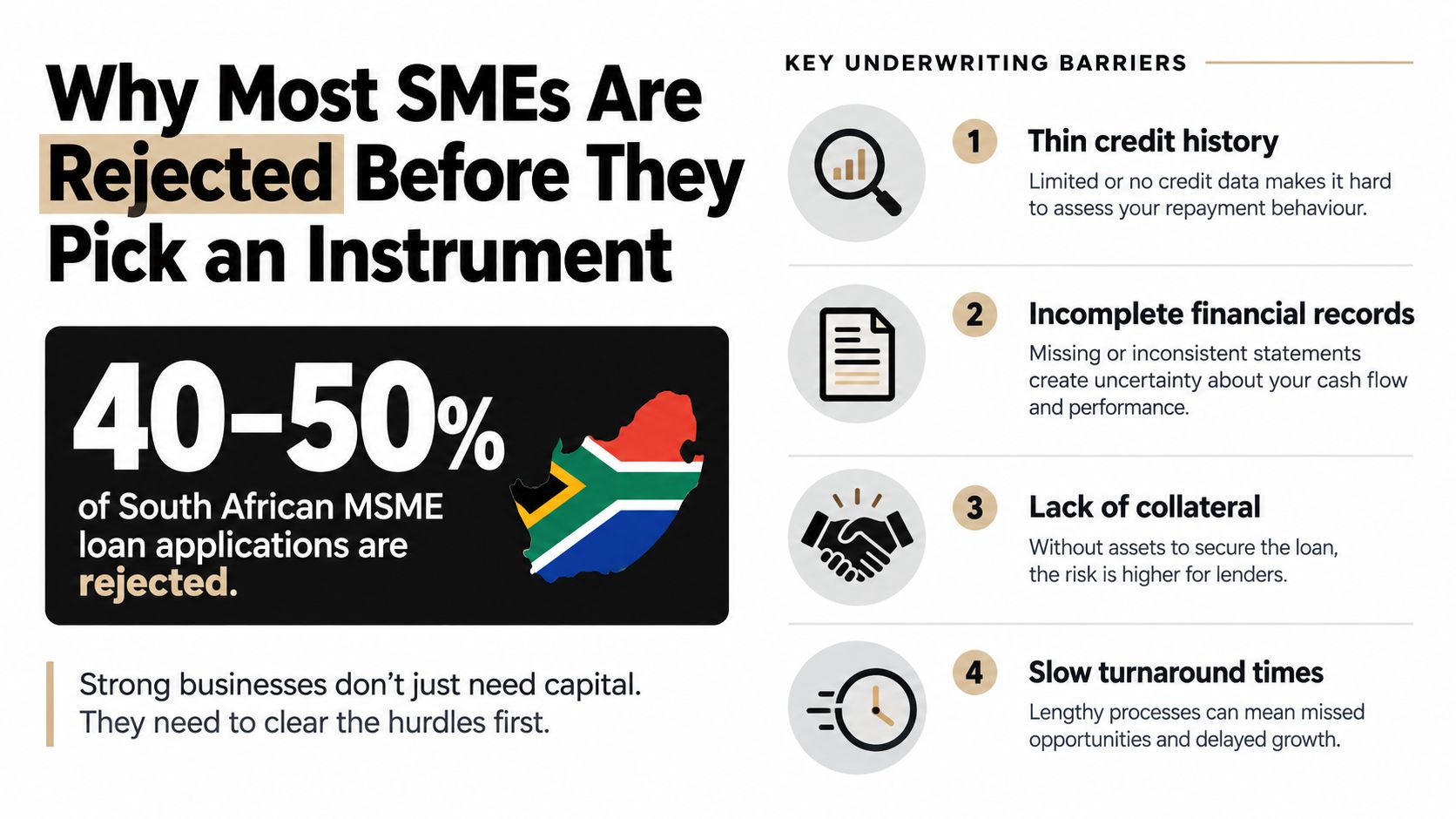
A polished application won't compensate for an order nobody can verify. Nor will a long-standing customer relationship help much if the invoices, delivery records and bank receipts tell different stories.
The financing constraint is real. In the August 2024 South Africa Trade Barometer, the access-to-finance index reached 49, up from 44 in May 2023 but still below the neutral level of 50; respondents cited weak credit histories at 39% and insufficient collateral at 25%, according to the South Africa Trade Barometer's financing findings.
The barriers below are a useful prompt for reviewing your own application.
Build a finance-ready file
Don't send a funder an unlabelled folder of attachments. Organise the evidence by transaction, using consistent buyer names, invoice references and currency amounts.
- Buyer evidence. Include legal identity, available credit reports, trading history and payment behaviour.
- Commercial agreement. Keep the accepted purchase order, contract, payment terms and approved amendments together.
- Execution records. Attach supplier quotations, the production plan, packing lists and relevant bills of lading or air waybills.
- Customs evidence. Retain the applicable SARS customs declaration and supporting shipment references.
- Collection history. Match invoices with foreign-currency receipts, credit notes and outstanding balances.
- Cash-flow forecast. Show expected inflows, committed outflows and the funding gap by currency.
Ask the prospective lender for its transaction-specific checklist before submission. Requirements can differ by buyer, destination, instrument and the lender's own credit policy.
Make the repayment argument explicit
Trade-finance eligibility isn't identical to ordinary loan eligibility. A transaction with a validated order and traceable repayment source deserves a transaction-level assessment, even when the exporter lacks substantial fixed assets. That's an argument to present, not a promise that the funder will approve it.
Explain what happens if production slips, the buyer rejects part of the shipment or receipts arrive late. A credible downside plan is more useful than a forecast that assumes everything works.
Credit-review discipline: Give the funder evidence it can reconcile, not a story it has to reconstruct.
The wider SME-finance discussion reinforces the point: reported MSME loan rejection rates of 40–50%, more than 117 South African SME funding programmes and a financing shortfall above R350 billion appear together in Euromoney's examination of ecosystem banking and SME finance.
More applications aren't your immediate answer. Better evidence is the part you can control.
Managing FX Risk as a Cash Flow Problem
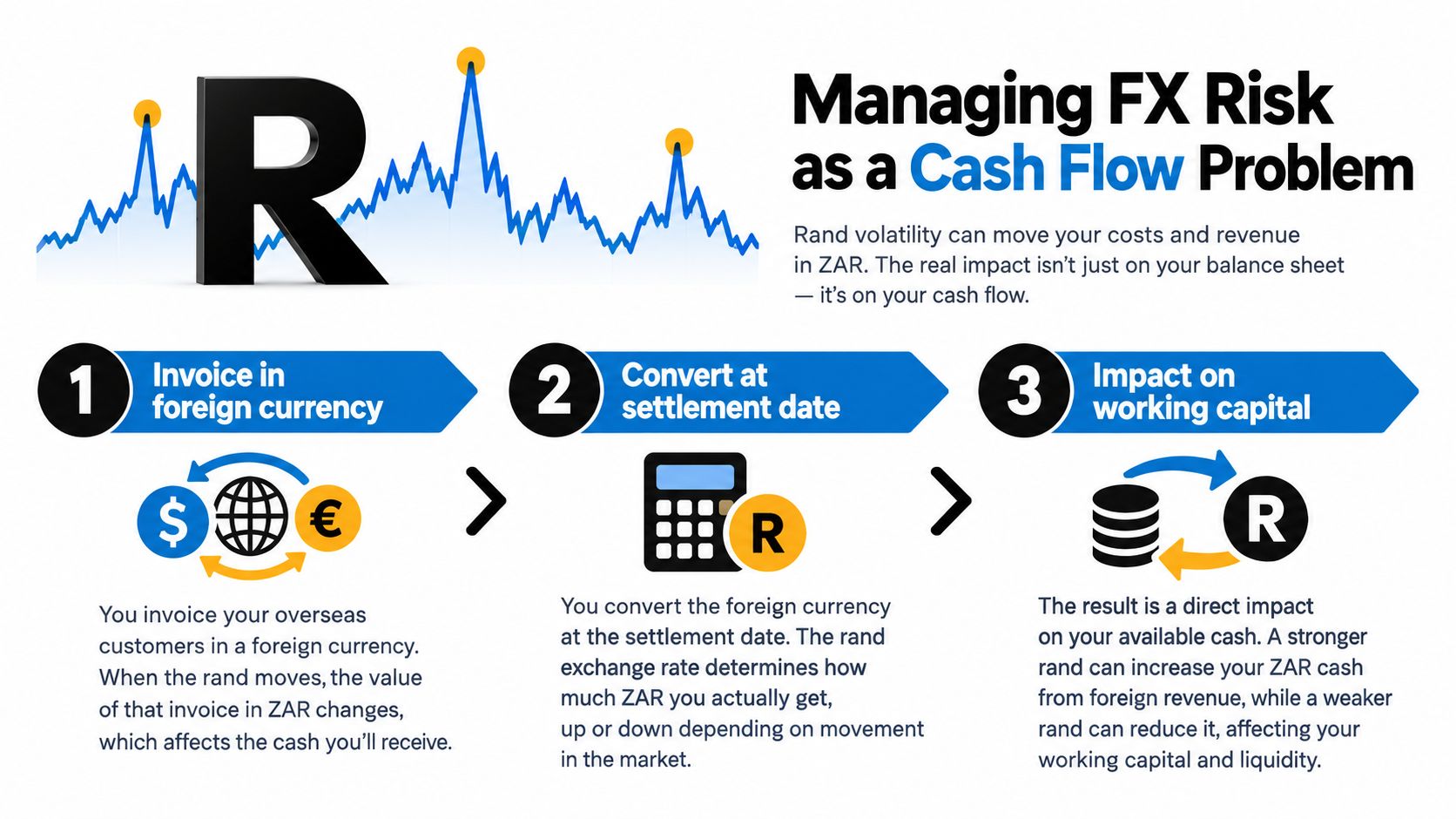
Your invoice margin isn't secure just because the customer accepted the price. A weaker rand can increase the local cost of imported inputs before export receipts arrive. A stronger rand can reduce the rand value of foreign-currency receivables when you convert them.
That exposure belongs in the working-capital forecast. In the Africa Trade Barometer, 76% of surveyed businesses identified improved foreign-currency liquidity as a trade facilitator, while 28% attributed business challenges to currency fluctuations, according to the survey's findings on foreign-currency access and volatility.
The conversion date connects currency movements directly to available operating cash.
Run treasury from an exposure schedule
Build a spreadsheet or treasury-system view showing currency, counterparty, invoice reference, expected settlement date and exposure type. Separate committed obligations from forecast sales. Don't treat an unsigned opportunity as dependable cover for an actual supplier payment.
Match foreign-currency receipts with obligations in that currency where practical and permitted. But check dates as well as amounts: an expected dollar receipt doesn't fund a dollar payment due before it arrives.
Then compare the executable all-in conversion cost against the rate used to price the order. Include the spread, transfer charges, intermediary deductions where applicable and settlement costs. Ask how long the quote remains valid and how much the recipient should receive.
Decide what to fund and what to protect
A shortfall in available currency and an unfavourable exchange rate are different problems. Receivables finance can address the wait for cash; it doesn't automatically protect the conversion rate. An FX hedge can address a defined currency exposure, but it doesn't make a disputed customer pay.
Use this decision checklist:
- Known supplier deadline. Assess whether pre-funding or trade credit gives you greater certainty.
- Verified receivable awaiting payment. Compare financing cost with the operational consequence of waiting.
- Committed currency exposure. Discuss suitable protection with an authorised provider, including what happens if the receipt is delayed.
- Uncertain sales forecast. Avoid creating a firm currency obligation without understanding the consequences.
For payment-term assumptions, Supply Automate's net 30 cash flow guide offers a useful reference point. Your forecast should still use the contract and the customer's actual payment behaviour, not the invoice label alone.
A zero-spread quote removes a pricing component; it doesn't remove market movement or guarantee the lowest total cost. Judge FX execution by net cash delivered, timing and certainty.
The Regulatory Timeline That Decides Whether You Get Paid
Treat export compliance as part of the collection plan, not a task to complete after money arrives. Your finance team should be able to connect the commercial agreement, goods movement, customs evidence and incoming payment without asking someone to reconstruct the transaction.
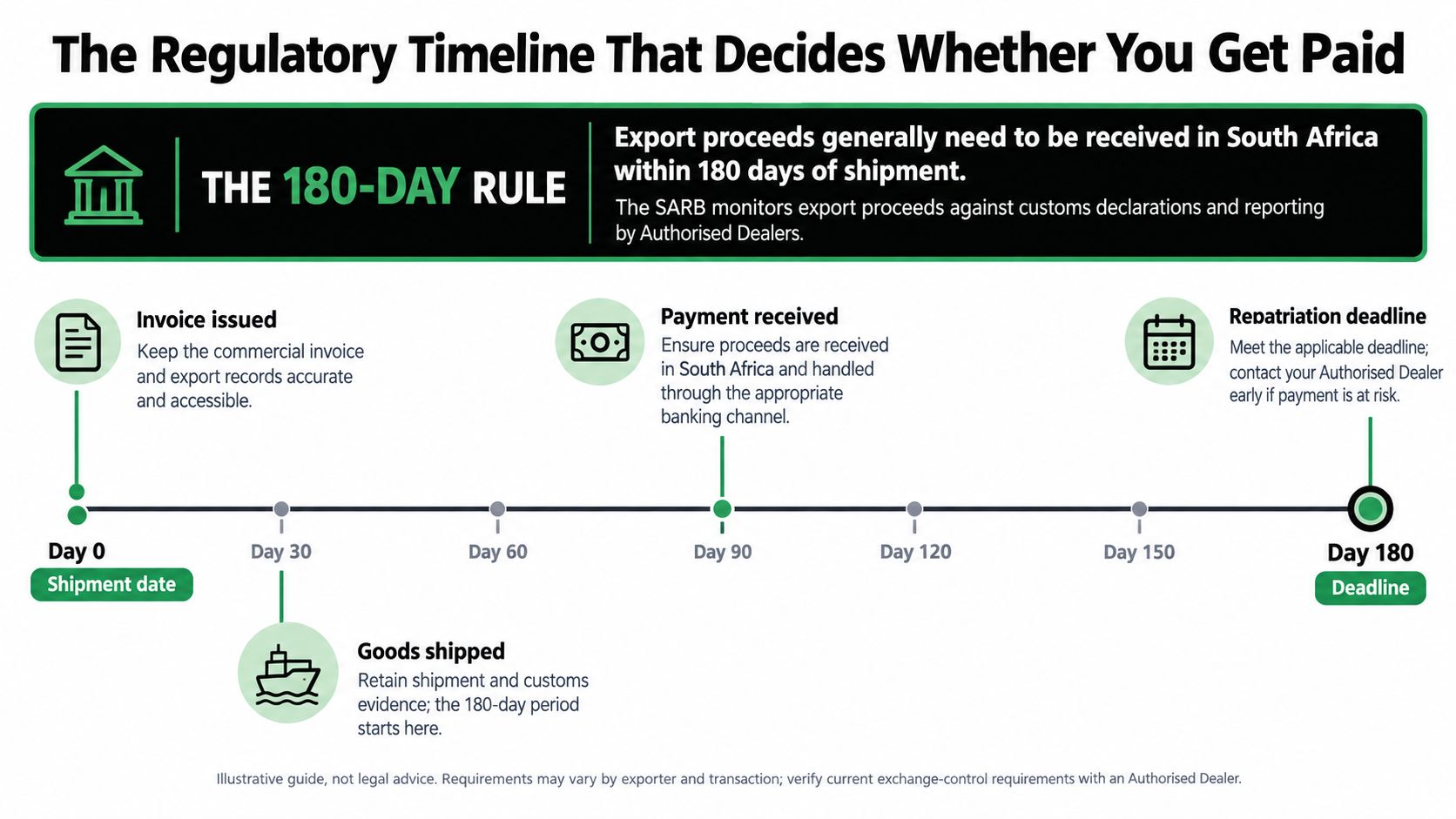
The operational baseline is prescribed SARS customs evidence, authorised-dealer reporting and receipt of export proceeds within a reasonable period, generally no later than six months after shipment. Confirm the currently applicable requirements and any exceptions with your authorised dealer: the government capital-flow document linked to this framework is labelled draft, so it shouldn't be treated alone as proof of the rules currently in force.
Use the timeline below as a workflow prompt, not as a substitute for that confirmation.
Connect the commercial and reporting records
At order acceptance, confirm the buyer's legal name, invoice currency, payment terms and required documents. Resolve LC wording or financing conditions before procurement creates an irreversible cash commitment.
At dispatch, capture the actual shipment details and retain the applicable customs declaration. Align invoice quantities and references with the goods shipped, especially when the order moves in separate consignments.
At invoice issuance, confirm that the buyer has received an acceptable invoice and knows the payment instructions. For receivables funding, assemble the delivery and approval evidence required for drawdown.
At receipt, provide the transaction information requested by the authorised dealer and match the funds to the correct invoice. Keep customs reporting to SARS distinct from cross-border foreign-exchange reporting through the authorised dealer. They're connected records, not interchangeable filings.
Give exceptions a named owner
Don't let an overdue payment sit on an ageing report without a documented next action.
- Delayed buyer. Record the revised commitment and ask the authorised dealer promptly about required action or approval.
- Partial shipment. Allocate invoices, customs evidence and receipts to the relevant consignment.
- Disputed invoice. Separate the disputed amount from the amount the buyer accepts, retaining the correspondence.
- Different payment currency. Document the agreed conversion basis and reconcile any balance instead of clearing it without explanation.
Use Loopfour's AR process framework as a reference when assigning collection stages, escalation responsibilities and dispute follow-up. Your export procedure must also include the customs and authorised-dealer requirements specific to the transaction.
Reconciliation is treasury work. A receipt isn't fully resolved until finance can explain what it settles and support that explanation.
Bringing It Together With Centralised Payment Infrastructure
Centralise the payment record even when you use different providers for financing, protection and settlement. Finance should be able to see the approved obligation, payment instruction, conversion, receipt and supporting evidence without searching across individual inboxes.
Evaluate infrastructure against operational requirements, not a headline exchange rate.
- ZAR and USD accounts. Check how funding, receipts and supplier payments fit your actual currency needs.
- Transparent FX execution. Request the executable rate and complete charge breakdown, including any SWIFT or intermediary costs.
- Team controls. Require appropriate permissions, payment approvals and accessible transaction history.
- Reconciliation evidence. Confirm that exports and statements preserve the references your finance team needs.
A central platform doesn't replace credit underwriting, customs records or authorised-dealer obligations. It should make the related cash movements easier to trace and manage.
This quarter, assign an owner to each outstanding weakness: complete the finance-ready file, select protection and funding appropriate to the buyer, review FX execution, and align collections with the applicable export-proceeds deadline. Test the workflow using a live transaction before rolling it across the business.
Aim for predictable working capital, not the lowest advertised rate. A facility only earns its cost when your team can draw it, execute the order and reconcile repayment.
Alongside bank-based payment options, Zaro offers South African businesses ZAR and USD accounts, cross-border payments, real exchange rates with zero spread, no SWIFT fees and multi-user controls. Visit to assess its payment and FX capabilities against your next export receipt and supplier settlement, while keeping your financing and authorised-dealer requirements explicit.