
The Treasury Central Supplier Database (CSD) is South Africa’s national register for businesses that want to sell goods or services to the state. Put simply, an organ of state should not be awarding work to a supplier whose details are not on the CSD.
A useful way to picture it is as government’s combined address book and vetting file. A supplier proves who it is once, instead of carrying the same paper trail from one department, municipality or public entity to the next.

How the Treasury Central Supplier Database Works
The CSD was introduced under the Office of the Chief Procurement Officer to replace scattered supplier lists with a single, standardised national source. Before that, national, provincial and local buyers could all hold slightly different records for the same company.
The result was predictable duplication. Suppliers kept resubmitting registration papers, tax details and banking information, while buyers lost time trying to compare records or find a suitable business quickly.
| Question | Short Answer |
|---|---|
| Who runs it? | The National Treasury’s Office of the Chief Procurement Officer |
| Who must register? | Suppliers wanting to transact with an organ of state |
| What does it store? | Standardised supplier, tax, contact, ownership and service information |
| Is registration compulsory? | Yes, before an organ of state may award business |
| Does it guarantee work? | No, it provides access to opportunities, not an award |
One Shared Record for Many Buyers
The practical value is much like giving every buyer in a large building the same trusted directory. A supplier’s legal identity, tax status, contact details and listed activities sit in one consistent place.
Organs of state can then draw on that record when preparing quotations, tenders and other procurement processes. That cuts repeated administration and makes it easier for buyers to match needs with suppliers that appear capable of meeting them.
Registration is access to public procurement opportunities, not a government contract.
That difference is worth keeping in mind. An active CSD profile lets a supplier be considered; it does not promise a quotation request, tender award, purchase order or income.
A Living Record of Business Information
Treat registration as a living supplier record, not a form you complete once and forget. Ownership, contact details, tax information, banking details and business activities can all shift as a company grows or changes direction.
Accuracy matters just as much for classification. A specialist supplier listed under vague or unsuitable categories may never surface in the searches buyers actually run, rather like a good shop filed under the wrong heading in a mall directory.
At its core, the CSD gives suppliers and organs of state one shared source of supplier information. It standardises how businesses are identified and made visible for public procurement, while the decisions behind quotations, bids and contracts remain with the buying organisation.
Before registering, businesses should check their company, tax, ownership, banking and service information through official National Treasury or Office of the Chief Procurement Officer channels. Use the CSD as the entry point to government supply opportunities, then keep the profile current whenever the business changes.
The Treasury Central Supplier Database sits between two groups with very different needs: the organs of state buying goods and services, and the businesses hoping to sell to them.
For buyers, the value lies in the records themselves. Departments, municipalities and public entities can search, filter and compare suppliers before a single quotation, tender, transversal contract or deviation goes out the door. It works a bit like a shared catalogue: the buyer narrows the field first, then reads the proposals.
For a business that wants to invoice the state, a live, usable profile is the starting point. Registering is closer to clearing the entrance gate at a trade fair than securing a spot on the floor. The business becomes visible and eligible to take part, yet no stand, invitation or order comes with it.
Registration opens the door to public procurement; it does not hold a place in the queue.
What the Two Sides Need
Because of its scale, the CSD operates as national procurement infrastructure and carries far more weight than any departmental contact list. Buyers lean on accurate records, and suppliers lean on those same records staying up to date. Let a profile go stale and a perfectly capable business can be screened out before price, experience or capability even enters the conversation.
On the buyer side, the essentials are accurate company details, tax status, banking information, contact points and ownership records. Those fields confirm the legal entity on the other end of a transaction and keep documents and payments moving to the right place.
Suppliers need that same precision, because buyers filter on structured data. A well-matched goods-and-services classification gets a firm found; a lapsed tax status or an unrecorded change in ownership can stall everything. For exporters and service businesses already living with compliance routines, keeping CSD details current folds into work they already do instead of demanding a whole new system.
This is where registration earns its keep: procurement decisions draw on information shared across organisations. A department might invite quotes off a supplier list, and months later a municipality comes back asking for tax or banking confirmation. An accurate profile keeps old discrepancies from surfacing at every new stage.
Businesses That Benefit Most
- Manufacturers and suppliers of goods gain the most from detailed product categories, clean legal-entity records and banking details that reflect the current account.
- Professional and technical service firms, from consultancies to specialist contractors, appear in more relevant searches when their listed activities mirror what buyers are actually looking for.
- SMEs, cooperatives and ownership-diverse suppliers get access to a shared national channel, provided their tax, ownership and contact details stay current.
- Exporters and cross-border service businesses do well to line up their public-facing records with the compliance and payment processes they already maintain.
Think of your record in the Treasury Central Supplier Database as a form you complete yourself. Every field answers a question that a buyer asks before spending public money with your business.

Filling it in one field at a time works, but it's easier to think in groups. Once you see how the fields cluster, the whole record starts to make more sense.
Company Registration and Tax Details
Your registered name, company number and tax information form the foundation of the record. Think of them as the deed to a property. A buyer uses them to confirm that the legal entity on the other side of a quotation actually exists and can be paid.
VAT Status and Contact Details
VAT status tells a buyer whether your invoices need to carry VAT and how it should be treated. It's a small detail, but getting it wrong can hold up a payment for weeks.
Contact details do a different job. They make sure that quotation requests, tender clarifications and payment queries reach someone who can actually answer them, rather than landing in an inbox nobody checks.
Business Activities and Categorised Goods and Services
This is the cluster where most businesses quietly lose visibility. Buyers search by category, so the classification you choose determines whether you show up in their results at all.
Picture a small components manufacturer that files its products under a very broad heading, something like "general engineering". The business may be fully qualified and well run, yet it never appears in the searches a buyer actually runs, because those searches target specific product categories.
A supplier can be perfectly qualified and still be invisible if its classification is too broad.
Location and Ownership Information
Your physical address, province and ownership details show where the business operates and who controls it. Buyers use these fields to apply eligibility filters, and they also check that ownership matches what you have declared elsewhere, such as in tender documents.
Why Accuracy Matters More Than Completeness
Buyers filter structured data before they read a single proposal. That's the reality many suppliers only discover after the fact. A vague or outdated entry can remove your business from consideration long before anyone opens your documents.
The table below shows what happens when each category goes wrong.
| Information Category | Why Buyers Care | Consequence If Wrong or Outdated |
|---|---|---|
| Company registration and tax | Confirms the legal entity can be paid | Payment delays or rejected verification |
| VAT status | Determines invoice treatment | Invoice queries and processing delays |
| Contact details | Connects buyers with the right person | Missed quotation requests |
| Business activities | Matches the supplier to specific needs | Invisible in relevant searches |
| Goods and services categories | Drives search and filtering | Excluded before proposals are read |
| Location and ownership | Applies eligibility filters | Incorrect filter results or verification flags |
Treat your record as a working document, not a one-off task. Update it whenever the business changes direction, and make a habit of reviewing it every quarter. This matters most after changes to ownership, staff or service lines, because those are the moments when an outdated entry is most likely to cost you an opportunity.
Getting onto the Treasury Central Supplier Database is less of a single click and more of a process you work through. You create a record, describe the business accurately, and then keep that record up to date as the company changes.
Think of it like a passport rather than a brochure. A brochure says whatever its writer wants it to say. A passport gets checked before anyone trusts it at the border.
The infographic below walks through that journey, from the first profile to the checks behind the record and the upkeep that follows.
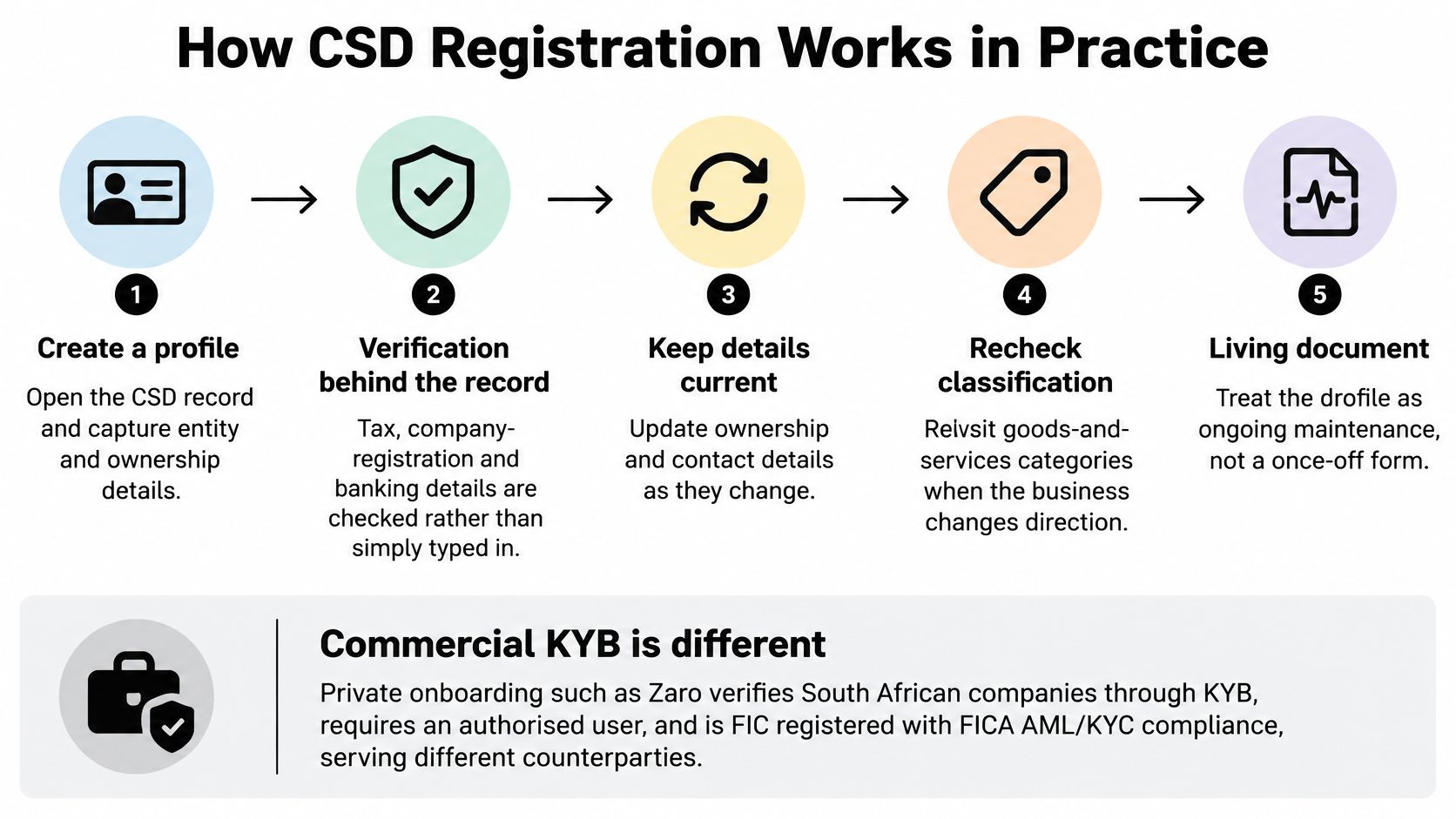
The picture makes one thing clear. Buyers trust the record because the key facts have been checked, and the profile stays useful only if you treat it as ongoing work.
Create the Profile and Capture the Entity
Start by creating the supplier profile and recording the legal entity. This covers the registered name, company details, ownership, and the people linked to the business.
Ownership is more than a side note. Buyers use it to see who controls the firm and to compare it with what you declare later in tender documents.
Capture your contact points at the same time. A quotation request that lands with someone who left the firm years ago might as well never have been sent.
Why Verification Sits Behind the Record
The database exists so that organs of state can rely on one shared file. Tax details, company-registration information and banking details are checked rather than simply typed in and accepted.
That check is why a buyer can move faster. They don't have to rebuild your identity from scratch for every department, municipality or public entity they deal with.
Buyers trust a CSD record because tax, company-registration and banking details are verified, not merely declared.
A typed address can be wrong and still look tidy on a form. A checked banking record is closer to a bank confirming an account before a payment leaves the building.
A Useful Parallel That Is Not the Same Process
Private onboarding follows the same logic of checking before trusting. Zaro, for example, onboards South African companies only after a Know Your Business check.
The user must be authorised to bind the organisation. Zaro is FIC registered and meets FICA requirements for anti-money-laundering and know-your-customer compliance.
Those checks serve a payments firm and its customers. They don't replace a CSD profile, and a CSD profile doesn't replace them.
- CSD registration lets organs of state identify a supplier for public procurement.
- Commercial KYB lets a private firm confirm a company before offering it a financial service.
- Each process has its own counterparty, its own rules, and its own outcome.
Habits That Keep the Record Alive
Keep ownership and contact details current. A director change or a new phone number should reach the profile before the next buyer search, not after.
Re-check your goods-and-services classification when the business changes direction. A firm that has moved from general supply into a specialist line shouldn't stay under the old tag.
Treat the profile as a living document. Review it whenever tax status, banking or activities shift, rather than filing it away as a once-off form.
I couldn't locate the published registration counts for 2020/21 and 2021/22, or the figures for women-, youth- and disability-owned suppliers, so I've kept those points general rather than guess at numbers. Please add the official figures from National Treasury before publishing.
What the Registration Numbers Reveal About Competition

Think of the Central Supplier Database as a very large shop window. Every new listing adds another item, and buyers have to scroll past all of them to find what they need.
Reading the Year-End Totals
National Treasury reports the registered base at the end of each financial year. Between 2020/21 and 2021/22, that total grew, which means more businesses were competing for the same public spending.
The exact figures matter here, so check the published reports for the precise numbers. They are the authoritative source, and any summary written from memory will only get you so far.
Who Makes Up the Register
Ownership categories add another layer to the picture. Women-owned, youth-owned and disability-owned businesses each appear in the database with their own counts and their own share of the total.
These categories overlap, so their counts must never be added together.
A single business can belong to several groups at once. A firm that is both youth-owned and women-owned is still one supplier. Add the two columns together and you end up counting it twice, which overstates the register.
Why Scale Changes the Game
A register of this size is national procurement infrastructure, not a small administrative list. That shifts how businesses stand out. In practice, differentiation comes down to three things:
- Accurate classification, so buyers find you in the right searches
- Current compliance across your tax, company and banking records
- Credible delivery capability that matches what you claim
Being listed is only the starting point. Many registered suppliers don't receive orders in any given period. The ones that do tend to be the businesses that keep their records sharp and can actually deliver what their profile promises.
Why Accurate Ownership Data Matters
Buyers who filter by ownership depend on the information being right. An outdated entry can keep a qualifying business out of a search, or let an unqualified one slip in.
Accurate details protect both sides of that search. Suppliers are seen for who they really are, and buyers can trust the filters they apply.
What This Means for Your Business
The practical takeaway is straightforward. In a crowded register, precision counts for more than simply being present.
Three habits help most:
- Review your ownership details against your company records every quarter
- Re-check your categories whenever your service mix changes
- Confirm your tax and banking details well before tenders close
Each habit keeps your record aligned with what buyers are searching for. A few small updates now can prevent missed opportunities later.
Competition on the register is less about who is listed and more about who is ready. Buyers can find, compare and trust the businesses that stay accurate, and that is the real edge in a crowded market. Keep your record current and you'll stand out for the right reasons.
Winning a place on the Treasury Central Supplier Database is only the first step. Once the contracts start coming in, a separate set of money tasks kicks in, and those tasks follow their own rules.
Think of it this way. A clean government supplier record won't sort out your invoicing, your foreign exchange or your cross-border settlement. Those are separate disciplines, and mixing them up is one of the most common reasons payments get held up.
Three Free Tools for Everyday Finance
Exporters, BPO firms and CFOs often have state contracts running alongside international customers. That's where Zaro comes in. It offers three free tools that sit outside the CSD process and take some of the daily workload off your desk:
- Invoice template: Builds a South African invoice with VAT and downloads a professional PDF in ZAR, USD, GBP or EUR.
- BoP code checker: Works out the likely Balance of Payments category for an export receipt or import payment, gives you bank-ready wording, and lists the documents you should have on hand.
- USD to ZAR converter: Pulls the live mid-market rate and compares it with what a bank might charge in FX spread and SWIFT fees.
The Operating Flow from Sign-Up to Payment
There are four stages to getting started, and each one sets up the next.
- Sign up and complete Know Your Business (KYB) verification.
- Fund your ZAR and USD accounts by bank transfer.
- Make and receive cross-border payments.
- Receive cards, which are coming soon.
Zaro makes cross-border transactions as easy as local EFTs.
Zaro's services are for businesses only, and onboarding happens after a KYB check. Users need to be authorised to bind their organisation. Zaro is an authorised Financial Services Provider registered with the FSCA.
What Finance Teams Should Look For
Several features matter most to finance teams:
- Low FX spreads with transparent pricing based on volume and corridor
- Fast settlement and no SWIFT fees
- Bank-grade security, with fees disclosed before a transaction is confirmed
- Enterprise controls, such as multi-user access and advanced team permissions
Pricing is set out in the agreement or quoted when you sign up, so you know what you're paying before you start.
Keeping Payments Separate from CSD Rules
This section is advisory and sits apart from CSD requirements. Tools like these help with money movement, but they don't change how the Treasury Central Supplier Database registers or assesses suppliers.
Think of the CSD as the front door and your payment tools as the back office. Each needs its own checks, and neither can stand in for the other.
For example, say an exporter receives USD for services. Checking the likely BoP category before the funds arrive means the right documents are ready when the bank asks for them. That small bit of prep saves real time when the money lands. Check it first, every time.
Confirm registration rules through official National Treasury channels before you act on them.
Four points sit outside the main steps of this guide. Each one tends to come up once a business is already on the Treasury Central Supplier Database, usually when the first real questions start arriving.
Does Registration Guarantee a Contract
No. Think of a live profile as a ticket through the door, not a seat at the table. Organs of state still decide who to invite, assess and appoint.
What actually determines whether a buyer finds you is the quality of your record. Accurate classification, current tax status, matching ownership details and reachable contacts all shape whether you show up in a search.
A broad goods-and-services tag can bury a capable firm, much like a plumber filed under "general services" who never gets the call for a burst pipe. Be specific.
Registration gives access to public procurement. It does not award a contract.
Is CSD Registration the Same as KYB
No. The two checks serve different counterparties, and one cannot stand in for the other.
CSD registration lets an organ of state identify a supplier for public procurement. A Know Your Business check, such as the one Zaro runs before onboarding a South African company, confirms a firm for a private financial service.
Put simply, a payments provider still needs its own KYB, and a public buyer still needs a CSD record. Neither replaces the other.
What to Do When Details Change Mid-Contract
Update your profile as soon as ownership, tax status or service classification changes. Waiting until the contract ends is a common mistake.
Buyers filter on the live record. An outdated director, a lapsed tax position or a category that no longer fits the work can hold up a payment or drop you from the next search. Small gaps like these tend to cause the biggest headaches.
For anything that needs confirmation, go straight to the official National Treasury and Office of the Chief Procurement Officer channels rather than relying on informal advice.
Can a Foreign-Owned Business Supply the State
Foreign-owned and non-South African businesses should not assume they qualify based on a general guide. Eligibility can depend on the type of entity, the buyer and the procurement method.
Confirm the current position with National Treasury and the Office of the Chief Procurement Officer before you register or bid. Those are the right channels for eligibility questions.
The habits covered earlier in this guide still apply. Keep ownership, tax, contacts and classification current so your record stays usable.
If state work sits alongside export receipts or foreign invoices, Zaro helps South African businesses move money across borders after a KYB check. See how it works at Zaro.