If you're running a business that deals with international payments, the USD forex rate today is more than just a number—it’s a critical piece of data that directly affects your bottom line. Getting this figure right is the key to accurate budgeting, costing, and ultimately, your profitability.
Your Quick Guide to the USD Forex Rate Today
For any South African business touching global trade, keeping a close eye on the daily USD/ZAR exchange rate is non-negotiable. This rate is in constant motion, and every little shift can have a big impact on the cost of your imports or the revenue you bring in from exports. Even minor fluctuations can add up to significant financial gains or losses, which is why having access to live data is so important.
When you see a rate quoted on the news or a financial website, you're usually looking at the mid-market rate. Think of this as the 'pure' exchange rate—it's the halfway point between what buyers are willing to pay and what sellers are asking for on the global markets. It's the most honest benchmark you can get, without the markups that banks and other providers typically build in. Using the mid-market rate as your reference point helps you understand the true cost of your foreign exchange transactions.
USD to ZAR Rate at a Glance
To give you a clear and immediate picture of the market, here’s a summary of the key metrics for the USD/ZAR currency pair today.
| Metric | Current Value (ZAR) |
|---|---|
| Mid-Market Rate | 17.34 |
| Today's High | 17.41 |
| Today's Low | 17.31 |
| 24-Hour Change | +0.04% |
This table provides a quick, at-a-glance reference to help you gauge the current market sentiment and make informed decisions.
Looking at recent trends, the Rand has been showing a bit of resilience. As of September 2025, the USD/ZAR rate is hovering around 17.34 ZAR. To put that in perspective, the Rand has actually strengthened by about 1.46% over the past month. This kind of context is exactly what you need for effective strategic financial planning. For a deeper dive into South Africa's currency performance, you can find more detailed insights on platforms like Trading Economics.
Understanding the Forces That Move the USD/ZAR Rate
The usd forex rate today isn't a random number. It’s the product of a constant tug-of-war between powerful economic forces in both South Africa and the United States. For any business trying to get a handle on currency risk, understanding what pulls these strings is absolutely essential.
Think of it like this: every day, several key factors are pushing and pulling on the USD/ZAR exchange rate. These pressures are what cause the daily swings that can make or break your profit margins. We can generally group these into macroeconomic data, central bank actions, and overall market mood.
Key Macroeconomic Indicators
At its core, a currency's strength is a reflection of its country's economic health. Key reports from both nations offer a direct glimpse into their performance, and forex traders react instantly.
- Gross Domestic Product (GDP): A growing GDP points to a healthy, expanding economy, which usually gives its currency a boost. A shrinking GDP, on the other hand, often signals trouble and can weaken the currency.
- Inflation (CPI): High inflation eats away at a currency's buying power. This typically weakens it unless the central bank steps in with higher interest rates to cool things down.
- Employment Data: Strong job numbers, particularly out of the US, often give the Dollar a lift because they signal a thriving economy that attracts investment.
Central Bank Policies and Interest Rates
Arguably the biggest players in the short-term currency game are the South African Reserve Bank (SARB) and the US Federal Reserve. Their decisions on interest rates can cause major waves.
When a central bank hikes interest rates, it suddenly becomes more attractive for foreign investors to hold that country's currency because they can earn a higher return. This rush of demand often pushes the currency's value up.
For example, if the SARB raises its repo rate to fight inflation while the US Fed keeps its rates the same, global investors might move their money into ZAR assets to chase that better yield. This would strengthen the Rand against the Dollar.
Commodity Prices and Geopolitical Stability
South Africa’s economy is deeply connected to its natural resources. As a major exporter of commodities like gold, platinum, and coal, the Rand's value often moves in lockstep with global prices for these goods. When commodity prices are high, more US Dollars flow into the country to pay for them, which increases demand for the ZAR and strengthens it.
The influence of the US Dollar extends beyond traditional markets, too. Its stability and value are often mirrored in the world of digital assets, including digital USD currencies like USDC.
Finally, don't forget the human element. Geopolitical events like elections or regional conflicts create uncertainty. During uncertain times, investors often flock to what they see as "safe-haven" currencies, and the US Dollar is the world's primary safe haven. This flight to safety can weaken the Rand significantly.
Analysing Historical Rate Trends for Strategic Planning
Knowing the USD forex rate today gives you a vital, real-time snapshot. But for serious strategic planning, you need to zoom out and look at the bigger picture. By digging into historical data, your business can start to spot patterns—periods of wild volatility versus relative calm—and connect those movements to what was actually happening in the world economy at the time. This context is what allows you to build more resilient financial forecasts and smarter hedging strategies.
Looking at how the USD/ZAR pair has behaved in the past uncovers the risks and opportunities that are baked into its DNA. Take the last six months, for example. The Rand has been on a bit of a run. Data from late March to late September 2025 shows the USD/ZAR rate dropped by about 5.01%.
The pair peaked at 19.742 on April 8th before dipping to a low of 17.342 on September 19th—a pretty significant downward trend. To really get a feel for how these things play out, you can explore more detailed exchange rate histories.
Visualising Intraday Rate Movements
Just as important as the long-term view is understanding how the rate ebbs and flows throughout a single day. The timeline below gives you a sense of these typical intraday fluctuations, showing how the USD forex rate today can shift at different points during business hours.
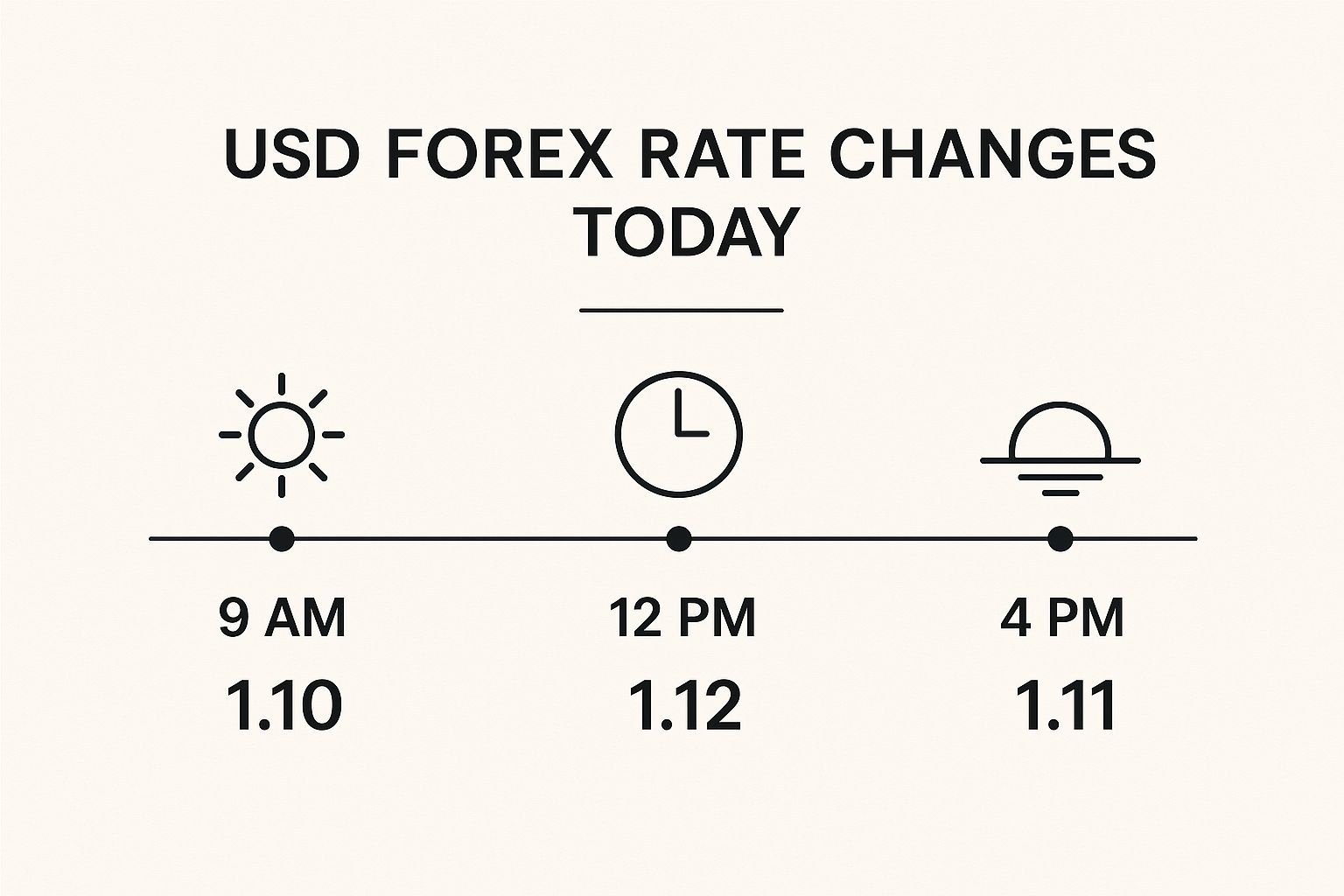
This kind of visualisation makes it clear how even tiny movements during the trading day can impact the final cost of a transaction, hammering home why real-time data is so crucial.
When you ground your financial decisions in a solid understanding of the market's past behaviour, you're in a much better position to anticipate what might come next and protect your profit margins from nasty currency surprises.
Of course, historical analysis isn't about crystal ball gazing. No one can predict the future with 100% certainty. It’s about preparing your business for a range of possibilities, all based on solid evidence from the past. That knowledge is what lets you make proactive financial decisions, rather than constantly reacting to the market's whims.
Turning Daily Forex Volatility into an Advantage

For any South African business dealing with international suppliers or clients, daily market volatility is a constant. But instead of seeing the constant flux in the USD forex rate today as a risk, it’s much smarter to view it as an opportunity.
These daily shifts, which are measured in tiny increments called pips, can have a much bigger impact on your international transactions than you might think. Even a fractional change in the rate can mean substantial cost savings or extra revenue, all depending on when you decide to make your payment. If you want to dig deeper into how these market movements work, this guide on understanding market volatility is a great starting point.
Calculating the Real-World Impact
Let's look at a practical example. Say your business has a $50,000 invoice to pay to a US-based supplier. The exact moment you make that payment within a single day can make a tangible difference to your bottom line.
- Scenario A (Day's High Rate): If you make the payment when the rate is at its peak for the day, say 17.45 ZAR, the transaction will cost you R872,500.
- Scenario B (Day's Low Rate): But what if you wait? If you execute that same payment when the rate dips to its daily low of 17.30 ZAR, the cost drops to R865,000.
Just by timing the transaction well, your business saves R7,500 on one invoice. This is a perfect illustration of how keeping a close eye on the live exchange rate can directly protect your profit margins.
This isn't just hypothetical. Looking back at September 2025, the USD/ZAR rate moved between a high of around 17.468 ZAR and a low near 17.278 ZAR in just a handful of days. While these might seem like small ranges, they present clear and consistent opportunities to manage your costs effectively. By learning to read these movements, you can turn daily forex volatility from a constant headache into a genuine financial advantage.
How Importers Can Reduce Costs with Real-Time Rates
If your South African business buys goods or services in US Dollars, you know the daily exchange rate isn't just a number—it's a direct hit to your cost of goods sold. Every little fluctuation can either squeeze your profits or give you some much-needed breathing room. Just accepting whatever rate you're given when it's time to pay is like leaving cash on the table.
This is where a proactive approach to your foreign exchange makes all the difference. When you actively watch the live usd forex rate today, you give your business the power to pick better moments to pay those international invoices. It's about turning a reactive cost into a real strategic advantage.
A Practical Scenario in Cost Savings
Let’s put some numbers to this to see how it works in the real world. Say your company has a $75,000 invoice to pay a US supplier. We all know the USD/ZAR rate can jump around quite a bit, even in a single day.
- If you make the payment when the rate is 17.55 ZAR, that invoice costs your business R1,316,250.
- But what if you used a platform like Zaro to watch the market? You might spot a moment when the rate dips to 17.40 ZAR. Making the payment then drops the cost to R1,305,000.
Just by timing it right, you've instantly saved R11,250 on one single payment. Imagine that effect multiplied across all your international payments for the year. Those small, fractional improvements add up fast, potentially saving you tens or even hundreds of thousands of Rands.
By shifting from a passive to an active currency management strategy, importers can effectively reduce operational costs and significantly improve their gross margins without changing a single supplier or product.
This kind of control used to be something only massive corporations with their own treasury departments could manage. Not anymore. Modern financial platforms give businesses of any size the tools to see real-time spot rates, get alerts for the rates they want, and pay at the best possible time. This direct market access means you stop losing money to hidden bank markups or bad timing, giving your business a genuine competitive edge.
How Exporters Can Maximise Revenue from USD Sales
If you're a South African exporter earning in US Dollars, the daily currency conversion is a make-or-break moment for your bottom line. It's tempting to hold onto that USD income, waiting for a stronger USD forex rate today to boost your Rand-based revenue. While this can pay off, it also carries risk. The trick is to turn that gamble into a calculated financial strategy.
Just accepting the rate on the day your funds arrive is a passive approach that leaves your business at the mercy of the market's whims. A much smarter move is to actively monitor the market, spot favourable trends, and convert your dollars when the time is right. This shifts forex management from a simple administrative chore to a real revenue-generating part of your business.
A Practical Example in Revenue Optimisation
Let’s see what this looks like in the real world. Imagine a local software company has just been paid $100,000 by a client in the United States. The timing of their currency conversion will directly decide how much of that hard-earned money makes it to their South African bank account.
- Scenario 1 (Immediate Conversion): The company converts the funds right away at a rate of 17.35 ZAR. This gives them a total of R1,735,000.
- Scenario 2 (Strategic Conversion): Using a real-time platform, they see the Rand is weakening and decide to hold on. A few days later, they lock in a conversion when the rate hits 17.50 ZAR.
In the second scenario, the company’s revenue climbs to R1,750,000. By simply timing the conversion with live market data, they’ve added an extra R15,000 to their revenue. That’s pure profit, earned without any additional sales or work.
This simple act of timing the market correctly not only shields export profits from bad rate movements but also brings a welcome degree of financial predictability to the business.
This kind of strategic patience turns the exchange process from a potential cost into a definite profit opportunity. Today, platforms like Zaro give you the tools you need—live spot rates, automated rate alerts, and instant execution—to lock in the best possible rates. It’s about making sure every dollar you earn works as hard for your business as you do.
Common Questions About the USD to ZAR Exchange Rate
If you’re running a business that deals in both US Dollars and Rands, you’ve probably asked yourself some of these questions. Getting to grips with the answers is the first step toward building a currency strategy that actually protects your margins and makes sense of the usd forex rate today.
What Is the Best Time to Exchange USD to ZAR?
Everyone’s looking for that "golden hour" to make a forex transaction. The truth is, there isn't one perfect time, but market activity does peak when the US and European trading sessions overlap. More activity usually means more liquidity, which can translate into tighter spreads.
But honestly, trying to time the market perfectly is a dangerous game for any business. A much smarter approach is to work backward from your own financial goals. Use a real-time rate tool to lock in a target rate that guarantees your profit margin, and then pull the trigger when the market hits that number. It’s a far more reliable way to manage your currency risk.
How Do Interest Rate Changes Affect the Rand?
The interest rates set by the South African Reserve Bank (SARB) have a huge and direct impact on the Rand's value. Think of it this way: when the SARB hikes interest rates, holding ZAR becomes more appealing for foreign investors who are chasing higher returns.
This spike in demand for the Rand naturally strengthens it against other currencies, including the US Dollar. On the flip side, when the SARB cuts rates, the Rand often weakens as that international capital starts looking for better returns elsewhere.
It's a relationship you need to watch. Any news about a potential rate hike from the SARB is often a signal that the Rand could strengthen against the Dollar. This can have a real effect on everything from your import costs to your export revenues.
Why Does My Bank's Rate Differ From the Online Rate?
This is a classic and a source of endless confusion for many. The rate you see splashed across financial news sites is the mid-market rate. You can think of this as the 'real' exchange rate, without any added costs or markups.
Your bank, however, gives you what's called a retail rate. This rate includes their profit margin, which is a hidden markup known as the 'spread'. That's exactly why the rate your bank offers is always worse than the mid-market rate you find online. Knowing this difference is key—it allows you to find more transparent services that give you a rate much closer to the real market value.
Stop losing money to hidden bank fees and unfavourable rates. With Zaro, you get access to the real mid-market exchange rate with zero spread, ensuring your business saves on every single international transaction. Make smarter payments with Zaro today.