
For South African businesses, the implied USD to GBP exchange rate was approximately USD 1 = GBP 0.7402 on 12 August 2026, with GBP 1 costing about USD 1.3511. That rate is derived through the rand, so your actual pound cost depends on both the USD/ZAR and GBP/ZAR legs, not just the headline cross-rate.
Why do so many companies treat the USD to GBP exchange rate as one universal number when the money often moves through South Africa's own currency first? A Google result might show a clean market quote, but your bank, payment provider, and beneficiary can all experience different prices once spreads, timing, and transfer charges enter the transaction.
That distinction matters if you receive dollars, pay a UK supplier in pounds, or budget a foreign-currency invoice from a ZAR cost base. The exchange rate isn't a bookkeeping detail. It determines how much working capital leaves the business and how confidently you can price, forecast, and settle international obligations.
The Hidden Reality Behind the USD to GBP Exchange Rate
There isn't one universal USD to GBP exchange rate waiting to be collected by every business. There's a reference rate, often called the mid-market rate, and there's the commercial execution rate your provider gives you. The difference between them is where many businesses lose money without seeing a separate line item.
A search engine may display a market price based on recent trading conditions. Your bank then adds its own margin to the conversion. The payment may also pass through correspondent institutions, each with the ability to deduct a charge or deliver a different amount than your finance team expected. The invoice still says the same amount, but the ZAR required to settle it changes.
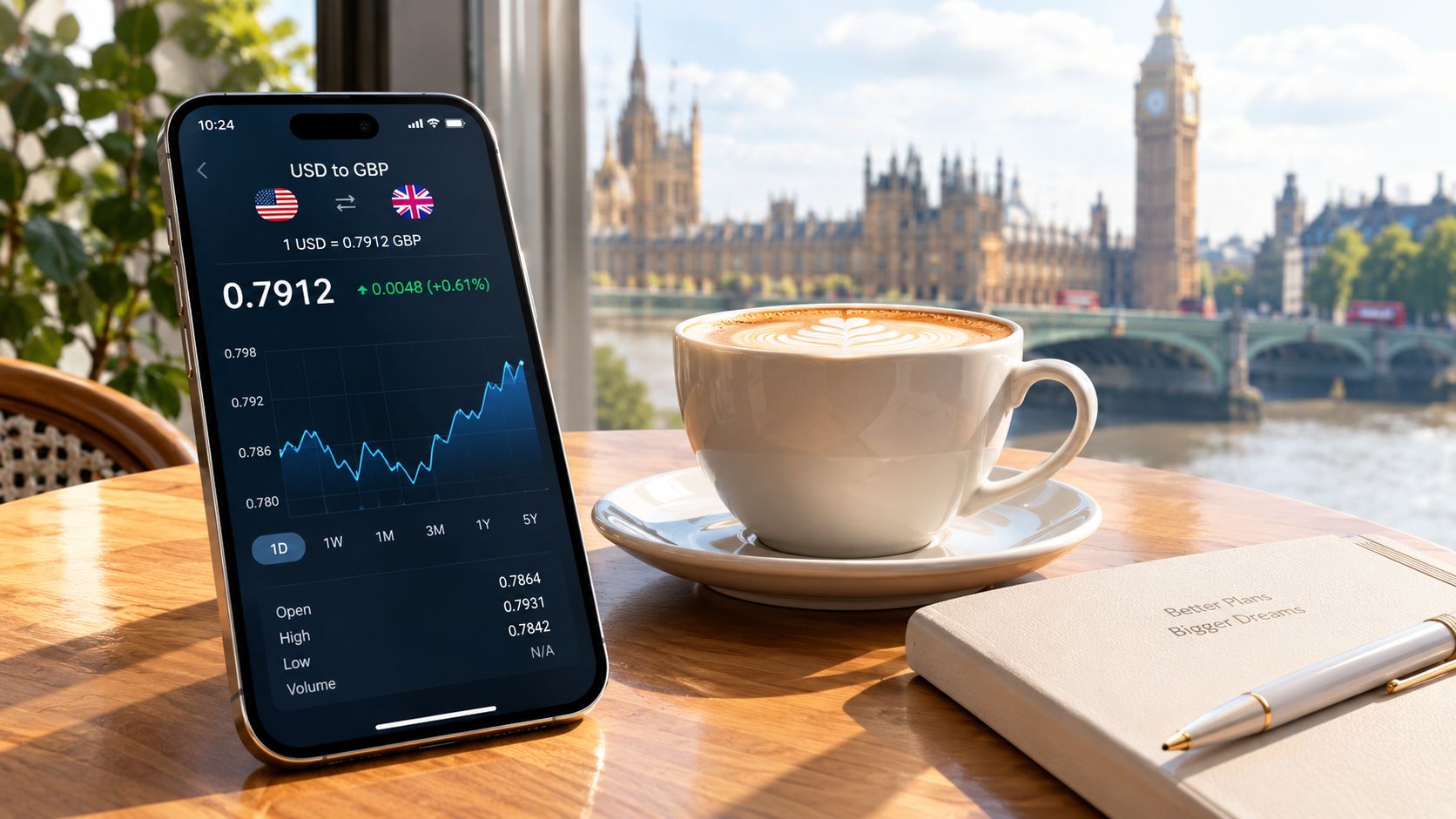
The quote on screen is not the amount received
A finance manager should separate three prices:
- Reference price: A neutral indication of the relationship between currencies.
- Execution price: The rate at which the provider converts your funds.
- Settlement result: The amount that arrives after conversion charges, transfer fees, and any intermediary deductions.
The third figure is the one that belongs in your accounts payable reconciliation. Looking only at the displayed rate gives your team a false sense of control. A provider can advertise a competitive-looking transfer fee while recovering its margin through the exchange rate.
CFO rule: Compare the total ZAR debited with the exact GBP amount received. Never compare transfer fees alone.
The South African Reserve Bank's selected historical rates provide a neutral local reference for treasury analysis and invoice budgeting. That doesn't mean the published rate is the rate your bank must deliver. It gives you a benchmark against which to test the commercial quote.
The same discipline applies to financial reporting workflows. If your team is collecting rates from multiple sources, a structured PlotStudio AI financial workflow can help organise the inputs used for analysis and review. The objective is simple, create an audit trail from the reference rate to the amount paid.
A business that fails to make this distinction is not managing foreign exchange. It is accepting a price it hasn't properly measured.
Understanding the Cross-Rate and the ZAR Connection
Why should a South African business study the rand when it needs a USD to GBP exchange rate? Because the rand often forms the intermediary leg, and providers can add margin on both sides before pounds reach your UK supplier.
The calculation is straightforward:
USD/GBP = USD/ZAR ÷ GBP/ZAR
Take the rand price of one US dollar and divide it by the rand price of one British pound. The result is the implied USD/GBP cross-rate, even when your payment instruction appears to convert dollars directly into pounds. Your provider may still price the transaction through USD/ZAR and GBP/ZAR behind the scenes.
On 12 August 2026, the South African Reserve Bank recorded the US dollar at R16.1776 and the British pound at R21.8560. Dividing the first figure by the second produces an implied rate of approximately USD 1 = GBP 0.7402, while the inverse is approximately GBP 1 = USD 1.3511. These figures come from the SARB selected historical rates.
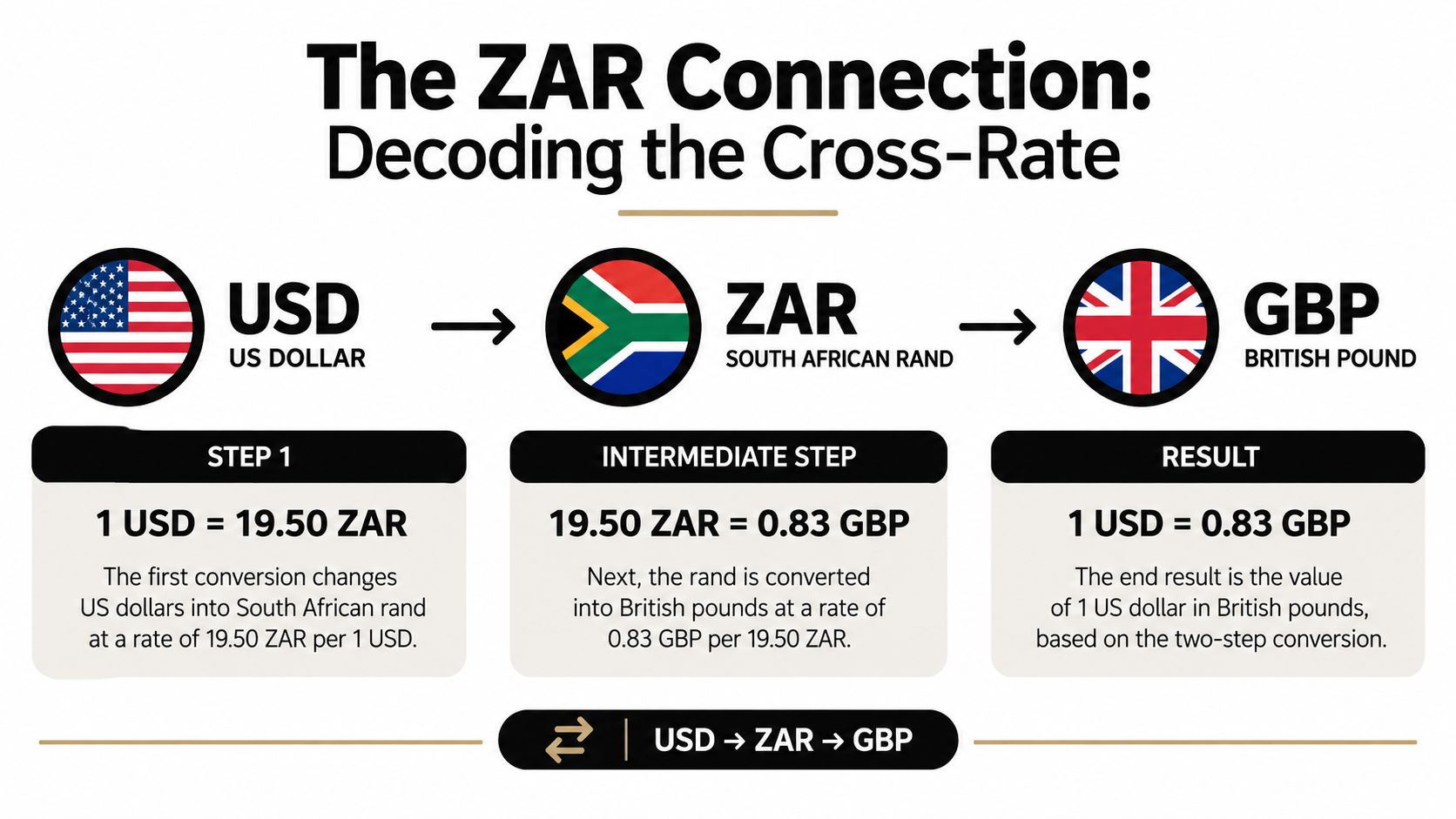
Work through the two ZAR legs
Suppose your company holds dollars and must pay a UK supplier in pounds. Ask five questions before approving the transaction:
- What rate is the provider using to buy your USD against ZAR?
- What rate is it using to sell you GBP against ZAR?
- Were both rates captured at the same time?
- Has the provider added a separate margin to the conversion?
- What exact amount of GBP will the supplier receive?
The hidden cost usually sits in the two ZAR legs. A provider can buy your USD at a weaker rate against the rand, then sell GBP at a stronger rate against the rand. The displayed direct cross-rate may look acceptable while the commercial execution produces fewer pounds.
The following table applies the reference figures above. The “calculated rate” is a benchmark for checking a quote, not a commitment to the rate your business will receive.
| Currency Pair | ZAR Value (Approximate) | Calculated Rate |
|---|---|---|
| USD/ZAR | R16.1776 per USD | USD 1 = R16.1776 |
| GBP/ZAR | R21.8560 per GBP | GBP 1 = R21.8560 |
| USD/GBP | Derived from the two ZAR legs | USD 1 = GBP 0.7402 |
| GBP/USD | Inverse of the derived cross-rate | GBP 1 = USD 1.3511 |
The practical consequence is material. If a South African company converts R1 million, the reference figures imply approximately USD 61,814 before fees or spreads, or approximately GBP 45,753 using the implied cross-rate. Those amounts come from the historical figures published by the Reserve Bank. They do not represent a live commercial quote, and the provider's margins can reduce the final GBP payment.
Why the rand changes your decision
A direct USD/GBP chart can conceal the exposure carried by a business whose functional currency is ZAR. If the rand weakens against the pound, a pound-denominated obligation costs more in local-currency terms. If it weakens against the dollar at the same time, the value of dollar receipts also changes.
Record all three currencies in the payment file: the original invoice currency, the funding currency, and the company's functional currency. Reconcile the amount debited in ZAR with the GBP amount received. That control shows whether the variance came from the USD/GBP relationship, the USD/ZAR leg, the GBP/ZAR leg, or provider pricing. It also gives treasury a defensible basis for challenging an expensive quote.
Market Forces That Move the Exchange Rate
What moves a USD to GBP payment for a South African business? The answer is not only the dollar and the pound. The rand sits between them, creating two separate pricing legs that can change for different reasons.
The dollar reflects conditions in the United States and global markets. The pound responds to UK economic and political developments. Your provider may price both currencies against ZAR before completing the payment, so the final GBP result depends on the relative movement of USD/ZAR and GBP/ZAR. A calm USD/GBP chart can therefore conceal meaningful risk in the rand legs.
Interest-rate expectations drive demand between currencies. Investors compare the return and perceived risk of holding assets in each market. A change in expected central-bank policy can strengthen one currency while weakening another. Inflation affects purchasing power and can alter those policy expectations.
Political stability and economic performance matter as well. A policy change, fiscal concern, election uncertainty, or weaker growth outlook can change how investors value a currency. Set a budget rate for planning, but do not treat it as a settlement rate. Review the quote again when the payment is ready.
The rand adds a local risk layer
The rand's history shows why this exposure deserves direct attention. It was introduced in 1961 at R2 to GBP 1. By 1990, approximately R2.55 bought USD 1, and by 1999 the rate had weakened to R6.14 per dollar. The rand fell by more than 35% against the US dollar between January 2008 and January 2009, then weakened beyond R17 per dollar during the COVID-19 pandemic, as documented in this historical overview of the South African rand.
These milestones do not forecast the next quote. They establish the risk clearly. A company can face a much higher ZAR cost for a GBP liability even when the direct USD/GBP rate appears stable. The intermediary currency can move against you before the provider completes either conversion.
Commodity prices also affect the rand because South Africa's external position is tied to trade in raw materials and manufactured goods. Geopolitical shocks can move investors toward perceived safe-haven currencies and away from risk-sensitive markets. A stronger dollar does not automatically make every UK payment more expensive. Assess both ZAR legs and the provider's quoted conversion path.
For businesses handling trading activity, Stewart Accounting Services on HMRC provides useful UK context on spread betting, CFDs, and forex tax treatment. It does not replace advice for a South African company. Keep a payment transaction separate from a speculative position, and record the currencies, rates, and settlement amounts used.
The High Cost of Spreads and Hidden Fees
The most expensive part of an international payment is often the charge you can't see. A bank may show a modest transfer fee while embedding its profit in the USD/ZAR or GBP/ZAR rate. Your accounts team then records the visible fee and misses the larger economic cost inside the conversion.
A spread is the difference between the rate at which a provider buys a currency and the rate at which it sells it. In a cross-border payment, your business can be exposed to a margin when dollars are converted and another margin when pounds are delivered. If the provider handles the transaction as two ZAR-linked prices, the cumulative effect can be worse than the headline direct quote suggests.
Compare the final outcome, not the marketing
A bank transfer should be assessed using a complete cost statement:
- Rate received: The actual USD/ZAR and GBP/ZAR prices used.
- Visible fee: The amount charged for initiating or processing the transfer.
- Intermediary deductions: Any amount removed before the beneficiary receives funds.
- Beneficiary result: The exact GBP amount credited to the supplier.
- Timing risk: The rate and charges that apply if settlement occurs later than expected.
A provider that advertises a low fee hasn't necessarily offered a low-cost payment. Conversely, a visible fee may be acceptable if the conversion rate is transparent and the final amount received is stronger. The only meaningful comparison is the total ZAR cost for the required GBP settlement.
The cheapest transfer is the one that delivers the required amount to the beneficiary at the lowest verified ZAR cost.
Traditional banks often bundle conversion, payment processing, compliance review, and correspondent banking into one workflow. That can be convenient, but it makes the price difficult to audit. Finance teams may receive a confirmation showing the debit from their account without a clear breakdown of the rate applied to each currency leg.
Modern FX platforms generally compete by showing the rate and charges more clearly before confirmation. That doesn't make every platform cheaper, and it doesn't remove market risk. It does give the payer a better basis for comparing providers and deciding whether the payment should be executed immediately or managed through a broader treasury plan.
The spread can damage more than one invoice
A single unfavourable conversion reduces the cash available for that payment. Repeated conversions also distort supplier-cost analysis, gross-margin reporting, and cash-flow forecasts. The business may blame rising input costs when the underlying problem is inconsistent execution pricing.
Set a policy that requires the payment operator to retain the provider quote, the reference rate used for comparison, the final amount debited, and the amount received. Without those records, the company can't identify whether the loss came from market movement, a spread, a fee, or a timing mismatch.
Strategies to Secure Better USD to GBP Rates
Better FX management starts with a change in behaviour. Don't ask a provider only for “the rate”. Ask for the all-in ZAR cost, the exact GBP amount the supplier will receive, and the time at which the quote expires. That forces the provider to expose the commercial result rather than one attractive component.
Use a simple decision process for every material payment:
- Define the obligation. Record whether the supplier requires GBP, USD, or a fixed local-currency amount. The currency written on the invoice determines the exposure.
- Map the funding route. Identify whether the company is paying from ZAR, existing USD, or another currency. This shows which ZAR leg matters.
- Obtain comparable quotes. Request the same settlement amount and value date from more than one provider.
- Test the receipt. Compare the net GBP received, not merely the displayed conversion rate.
- Record the decision. Keep the quote, approval, settlement confirmation, and reconciliation in the payment file.
Match the conversion decision to the cash flow
Convert immediately when the invoice is due, the amount is known, and the business values certainty more than the possibility of a better later rate. Retain USD when the company has a genuine future dollar obligation and converting into GBP would add an unnecessary currency round trip. Agree a GBP amount with the supplier when both sides need certainty, then set an internal approval date for the conversion.
Don't delay a payment just because the market might improve. That is speculation unless the company has a documented risk limit and a treasury process capable of absorbing a worse outcome.
| Factor | Traditional Bank | Modern Fintech |
|---|---|---|
| Rate visibility | May combine the market rate with a provider margin | Usually presents the conversion price and charges before confirmation |
| ZAR leg control | Often difficult to isolate within a bundled payment | Easier to compare the funding and settlement currencies |
| Transfer pricing | Visible fees may not show the full conversion cost | Pricing is commonly designed for direct comparison |
| Payment workflow | Familiar banking relationship and established controls | Digital workflow with provider-specific onboarding and controls |
| Best use | Businesses that prioritise existing banking infrastructure | Businesses that prioritise rate transparency and payment comparison |
The table isn't a licence to choose a fintech provider without due diligence. Review its regulatory position, onboarding requirements, settlement process, support model, and controls for multiple users. A lower quoted price is irrelevant if the provider can't meet your compliance and operational requirements.
A useful treasury dashboard should show the invoice currency, funding currency, ZAR equivalent, reference rate, execution rate, total charges, and beneficiary receipt. A short internal review of those fields will reveal hidden costs faster than a monthly search for the “best” USD to GBP rate.
Transforming Your Cross-Border Payment Strategy
A company that receives USD and pays UK suppliers in GBP should stop managing each transaction as an isolated bank instruction. The finance team needs a currency map showing which invoices are fixed, which receipts are available, and where the business is exposed to ZAR movement.
Start with a weekly payment register. For each item, record the original currency, required settlement currency, due date, approved budget in ZAR, provider quote, and final receipt. Then review the differences. If the budget variance comes from the rate, the spread, or a separate fee, classify it correctly. That turns an unexplained cost into a controllable process.
The scale of the South Africa and UK relationship makes this discipline commercially relevant. Trade in goods and services between the countries reached £11.8 billion in the four quarters to Q2 2025, with South African exports to the UK at £6.8 billion and UK exports to South Africa at £5.0 billion, according to the UK government's South Africa trade and investment factsheet. A business doesn't need to be large to feel the effect of poor conversion pricing.
Accurate bookkeeping supports the same control. Clear records in a system configured for foreign-currency sales and purchases, such as a properly managed approach to setting up Xero for your store, help finance teams reconcile what was invoiced, what was converted, and what was ultimately paid.
The right approach is direct. Benchmark the ZAR legs, compare the net beneficiary result, and choose a payment partner that shows the economics clearly. Treat every USD to GBP payment as a treasury decision, not an automatic bank task.
Zaro gives South African businesses a transparent way to manage cross-border payments using real exchange rates, with no spread and no SWIFT fees according to its published offering. Visit Zaro to compare your current USD to GBP payment process, centralise ZAR and USD funding, and give your finance team clearer control over international settlement.