
Ever heard of Forex? It’s short for the foreign exchange market, and it's where the world trades currencies. It’s a staggering market, with over $7.5 trillion changing hands every single day. To put that in perspective, it completely overshadows the world's stock markets combined.
Think of it less like a stuffy financial institution and more like a massive, constantly buzzing global network where money itself is the commodity being bought and sold.
The Forex Market Explained in Simple Terms

Picture a sprawling marketplace that never sleeps, where instead of fruit or textiles, people are exchanging currencies. That's Forex in a nutshell.
Every time a South African company pays a supplier in Europe, or a tourist swaps Rands for Dollars at the airport, they're dipping their toes into this market. It’s not some abstract concept reserved for bankers; it’s a living, breathing part of the global economy that affects businesses like yours every day.
This isn’t a market with a physical address like the JSE. It’s a completely decentralised network that operates 24 hours a day, five days a week, connecting banks, corporations, and individuals across every time zone. All transactions happen electronically, directly between two parties in what's known as an over-the-counter (OTC) market.
To boil it down even further, here's a quick look at the core concepts.
Forex Market at a Glance
| Concept | Simple Explanation |
|---|---|
| What is it? | A global marketplace for exchanging national currencies. |
| Who participates? | Banks, governments, corporations, and individuals. |
| How big is it? | The largest financial market, trading over $7.5 trillion daily. |
| Where is it? | It's decentralised, with no physical location. Trades are electronic. |
| When is it open? | 24 hours a day, five days a week. |
Ultimately, understanding the Forex market is the first step towards mastering your international business finances.
For any South African business buying or selling across borders, getting a handle on Forex is non-negotiable. The constant ebb and flow of currency values directly impacts the price you pay for imports, the profits you make from exports, and, of course, your bottom line.
Meet the Key Players Driving the Market
The forex market isn't some monolithic building on a street corner; it's a sprawling, interconnected network of different players, all trading for their own reasons. Getting a handle on who's buying and selling—and why—is the key to understanding why currency values move the way they do. The participants range from enormous institutions that can shift the entire market to individuals betting on price swings.
At the very top, you have the central banks, like our own South African Reserve Bank. These institutions aren't in it for profit. Their job is to act as stewards of their nation's economy—intervening in the market to manage their currency's value, keep inflation in check, and maintain overall stability. Think of them as the market's ultimate guardians and influencers.
This infographic gives you a brilliant visual breakdown of the forex market's structure, showing just how massive it is and who the main groups are.
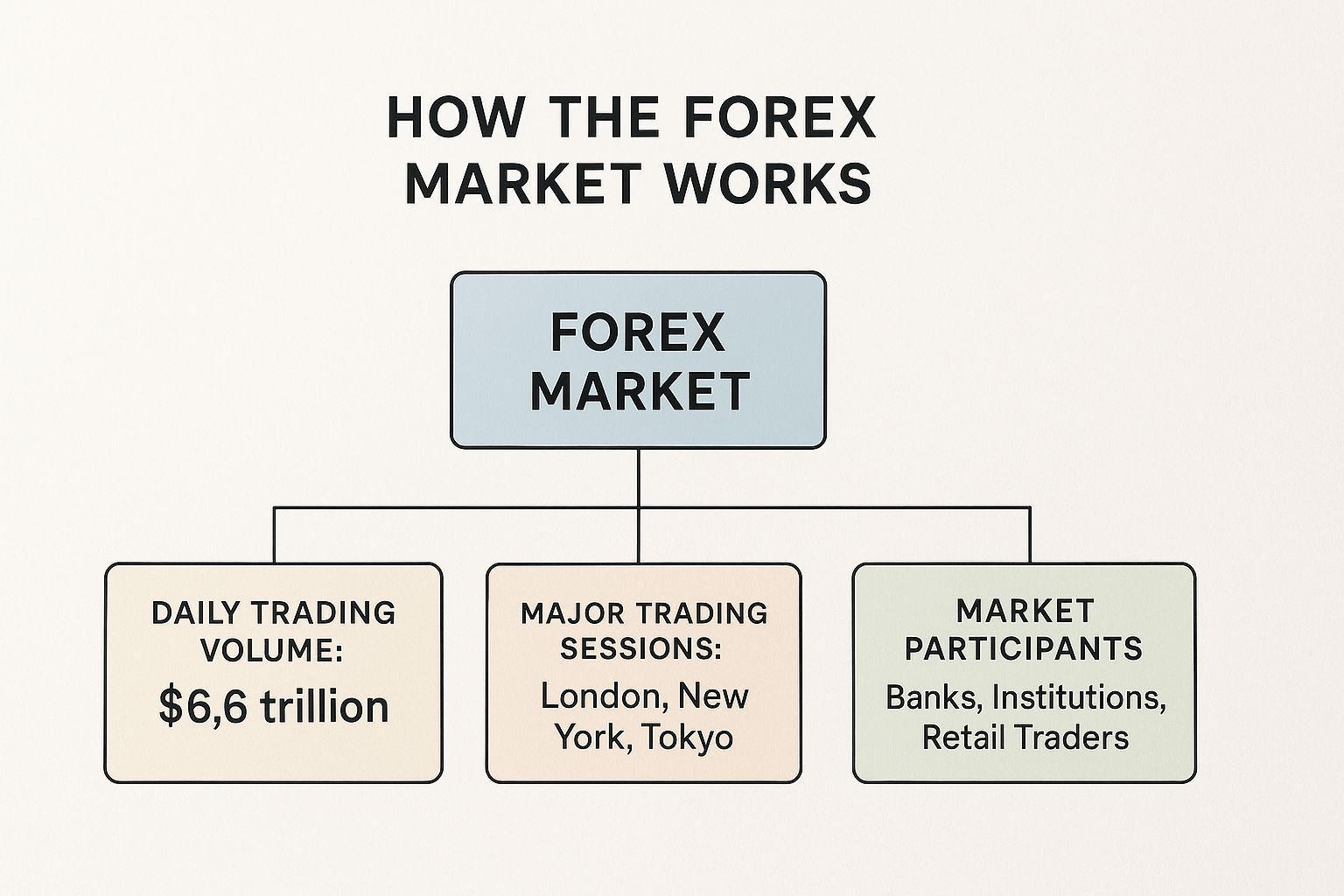
As you can see, the sheer daily trading volume is staggering, and it's all driven by banks, corporations, and individual traders who form the core of this global marketplace.
The Major Market Movers
The real heavyweights are the major commercial and investment banks. They're responsible for the largest volume of trades, acting both for their clients (like multinational corporations needing to move money) and for their own accounts. These banks create what’s known as the interbank market, trading currencies directly with each other. The rates they set here are the ones that eventually filter down to the rest of us.
Then you have the multinational corporations. Imagine a South African winery that exports its products to the United States. They get paid in US Dollars, but their staff, suppliers, and operating costs are all in Rand. They have to sell those dollars to buy Rand, and that simple business need directly impacts the USD/ZAR exchange rate.
Investors and Speculators
This group includes everyone from large investment managers and hedge funds to individual retail traders. Their goal is straightforward: to profit from the constant ebb and flow of currency values. They analyse economic news and market trends to speculate whether a currency will strengthen or weaken against another.
When you understand what motivates each player—from a central bank making a policy decision to a corporation bringing its profits home—you start to see the real forces of supply and demand at work in the forex market.
South Africa is a serious contender in this global arena. Our country's daily forex turnover is more than $20 billion, a testament to our sophisticated financial infrastructure. In fact, projections estimate the local market will grow from USD 3.86 billion to around USD 6.85 billion by 2033, highlighting its growing influence on the world stage. You can read more about the growth of South Africa's forex market to get the full picture.
What Really Determines Exchange Rates
Ever find yourself wondering why the Rand is up one day and down the next? It’s not random. At its heart, it all boils down to the simple economic dance of supply and demand. Think of a currency just like any other product on a shelf—its price is set by how many people want to buy it versus how many are looking to sell it.
When global investors feel good about South Africa’s economic prospects, they’ll snap up Rands to pour money into local businesses or government bonds. That surge in demand gives the Rand a boost. On the flip side, if South African companies need more US Dollars to pay for imports, they have to sell Rands to get them. This floods the market with Rands, increasing supply and pushing its value down.
The Key Economic Drivers
Behind this simple push and pull of supply and demand are several powerful economic forces. Getting a handle on these is essential for anyone whose business touches the forex market.
- Interest Rates: When the South African Reserve Bank hikes interest rates, it can be like a magnet for foreign capital. Investors looking for a better return on their money will buy Rands, which naturally strengthens the currency.
- Economic Growth: A healthy, growing economy is a sign of stability and opportunity. Positive GDP numbers and low unemployment make the Rand far more appealing to investors around the world.
- Inflation: High inflation is a currency killer. It eats away at purchasing power. If prices in South Africa are climbing faster than elsewhere, the Rand’s real value drops, and it will likely weaken against other currencies.
- Political Stability: Nothing spooks investors like political uncertainty. A stable political climate builds confidence, while any hint of instability can cause capital to fly out of the country, putting heavy pressure on the currency.
A country’s ability to ride out economic storms is a massive confidence signal for the markets. Think of foreign exchange reserves as the nation's financial safety net.
A great example of this is South Africa’s gross foreign exchange reserves, which recently hit a new high of around $70.42 billion. This substantial cushion, made up of gold and foreign currency, shows the world that the country is well-equipped to handle market shocks.
But it’s not just about the hard numbers. Market psychology and major news events play a huge role in moving currency values, often in a matter of minutes. Understanding the strategies for trading the news can give you a real edge in anticipating the kind of fluctuations that could impact your bottom line.
Understanding the Currency Pairs That Drive Your Business
In the forex market, currencies are never traded in isolation; they always come in pairs. It’s a bit like a seesaw—as one currency’s value rises, the other’s falls in comparison. Getting your head around this simple dynamic is the first step for any South African business dipping its toes into international trade.
Every currency pair is made up of a base currency (the first one) and a quote currency (the second). Take the familiar USD/ZAR pair, for instance. Here, the US Dollar is the base, and our South African Rand is the quote. The exchange rate simply tells you how many Rands you'll need to buy a single US Dollar.
This isn't just jargon. It's the fundamental language of the forex market. Mastering it means you’ll always know exactly what an exchange rate means for your bottom line, whether you're pricing an export or paying an overseas supplier.
If you’re a local business, you’ll quickly find that a few specific pairs dominate your attention. Exporting delicious Cape wines to the UK? You'll be keeping a sharp eye on the GBP/ZAR rate. Importing machinery from Germany? The EUR/ZAR will be your daily focus.
The Most Common Currency Pairs for South African Businesses
To help you get started, here's a look at some of the most important currency pairs for South African trade.
| Currency Pair | What It Represents | Importance for SA Business |
|---|---|---|
| USD/ZAR | The value of the US Dollar against the South African Rand. | This is the big one. Most global commodities (like oil and gold) are priced in USD, making this pair critical for importers and exporters alike. |
| EUR/ZAR | The value of the Euro against the South African Rand. | The Eurozone is a massive trade partner for South Africa, so businesses dealing with countries like Germany, France, or the Netherlands live by this rate. |
| GBP/ZAR | The value of the British Pound against the South African Rand. | Crucial for any business with strong trade ties to the United Kingdom, from tourism to agriculture and financial services. |
| CNY/ZAR | The value of the Chinese Yuan against the South African Rand. | With China being one of our largest trading partners, this pair is vital for companies importing manufactured goods or exporting raw materials. |
| BWP/ZAR | The value of the Botswana Pula against the South African Rand. | A key pair for regional trade within Southern Africa, affecting cross-border commerce, investment, and supply chains. |
Knowing which pairs directly impact your business is half the battle won. It allows you to monitor the right information and make smarter financial decisions.
Major, Minor, and Exotic Pairs: What’s the Difference?
Forex traders often group currency pairs into three main categories. Understanding these helps you gauge a pair's trading volume, volatility, and direct relevance to your operations.
Major Pairs: These are the heavyweights of the forex world. They always feature the US Dollar on one side, paired with another major currency (like the Euro in EUR/USD or the Japanese Yen in USD/JPY). They’re the most traded, which means they are highly liquid and tend to have tighter spreads.
Minor Pairs: Think of these as major currencies trading amongst themselves, but without the US Dollar. Good examples include EUR/GBP or AUD/JPY. They are still very active but generally have a bit less liquidity than the majors.
Exotic Pairs: This is where our own currency often fits in. An exotic pair matches a major currency with one from an emerging market. The USD/ZAR is a classic example. These pairs are absolutely essential for businesses trading in specific regions but can be more volatile.
It’s worth noting that the retail forex scene here is booming. In South Africa, and across the continent, the number of traders is climbing by around 30% each year. This surge in interest, detailed in reports about forex trading growth in Africa, makes a solid understanding of these key pairs more critical than ever—not just for traders, but for every business involved in the global economy.
How Forex Swings Can Make or Break Your Business
It’s one thing to grasp the theory of forex and how exchange rates tick up and down. It's another thing entirely to see how those movements directly impact your company's bottom line. For any South African business trading internationally, currency fluctuations aren't just abstract numbers on a screen; they're a real-world force that can seriously affect your revenue and profits.
Let's ground this in a practical example. Picture yourself as the owner of a fantastic winery in the Western Cape, exporting your award-winning Pinotage to customers all over Europe.
The Exporter's Win: A Weaker Rand
Imagine the Rand takes a dip against the Euro. This means that for every Euro your European clients pay, you get more Rands back in your local bank account.
- Your New Edge: Suddenly, your wine is more affordable for European buyers, even though you haven't changed your Euro price one bit. This can make you much more competitive, potentially leading to a welcome surge in sales.
- The Bottom Line: Your profit margin on every single bottle sold gets a healthy boost. In this scenario, a weaker Rand is brilliant news for your export business.
This simple example shows how the ZAR's movement can become a powerful driver of growth when you're selling goods or services across borders.
The Importer's Squeeze: A Weaker Rand
Now, let's flip the coin. Say your business imports specialised machinery from a supplier in the United States, with the price locked in US Dollars.
If the Rand weakens against the Dollar, the cost of that exact same shipment shoots up in Rand terms. The dollar price is unchanged, but you now have to find more Rands to settle the invoice.
Forex risk isn't just for traders on Wall Street. It's a core business reality that can either supercharge your profits or quietly eat them away, depending on which side of the deal you're on.
This puts immediate pressure on your margins. You're left with a tough decision: do you absorb the extra cost and take a hit on your profits, or do you pass the increase on to your South African customers and risk losing sales? This is exactly why managing your currency exposure isn't a "nice-to-have"—it's a fundamental part of smart financial strategy for any business with international ties.
Your Essential Forex Questions Answered
Even when you've got the basics down, a few practical questions always seem to pop up once your business starts handling foreign currencies. We've put together this quick Q&A to tackle the most common queries we hear, helping you get more comfortable with the world of forex.
Think of this as your go-to guide for clearing up any lingering uncertainties about what forex really means for your day-to-day operations.
What Are the Forex Market Trading Hours?
One of the most remarkable things about the forex market is that it’s open for business 24 hours a day, five days a week. It all kicks off on a Sunday evening (our time here in South Africa) when Sydney opens, and it doesn't stop until New York closes up shop on Friday evening.
How is this possible? The market literally follows the sun, moving from one major financial hub to the next—Tokyo, London, and then New York. This constant handover means there's always a part of the market awake and active, allowing for continuous trading right through the work week.
What Is the Difference Between Forex and Stocks?
The main difference is what you're actually trading. When you deal with the stock market, you're buying or selling shares—a small piece of ownership in a company like Naspers or Anglo American.
With forex, you're trading currencies. A transaction in a pair like USD/ZAR means you're buying one currency (US Dollars) and selling another (SA Rand) at the same time, all based on their constantly shifting value against each other. The forex market is also vastly larger and more liquid than the stock market, and it doesn't have the rigid opening and closing bells you find on a stock exchange.
For a business, forex isn't about speculative bets. It's about smart, practical currency management—making sure the natural ups and downs of exchange rates don't eat into your hard-earned profits.
How Do I Start Managing Forex for My Business?
The very first step—and honestly, the most important one—is to get a clear handle on your currency risk. This means sitting down and identifying every single transaction that involves a foreign currency, from paying suppliers in Europe to getting paid by customers in the US.
Once you know exactly where you stand, it's time to partner with a bank or a specialised forex provider. They'll help you set up a foreign currency account and show you the tools of the trade for managing risk.
A great example is a forward exchange contract (FEC). This simple agreement lets you lock in an exchange rate today for a payment you need to make or receive in the future. It takes the guesswork out of the equation, protecting your business from sudden, unfavourable currency swings and keeping your profit margins safe.
Getting on top of your forex doesn't need to be complicated or expensive. With Zaro, you get the real exchange rate with zero spread, which means no hidden bank markups and no SWIFT fees. To simplify your international payments and protect your bottom line, find out more at https://www.usezaro.com.