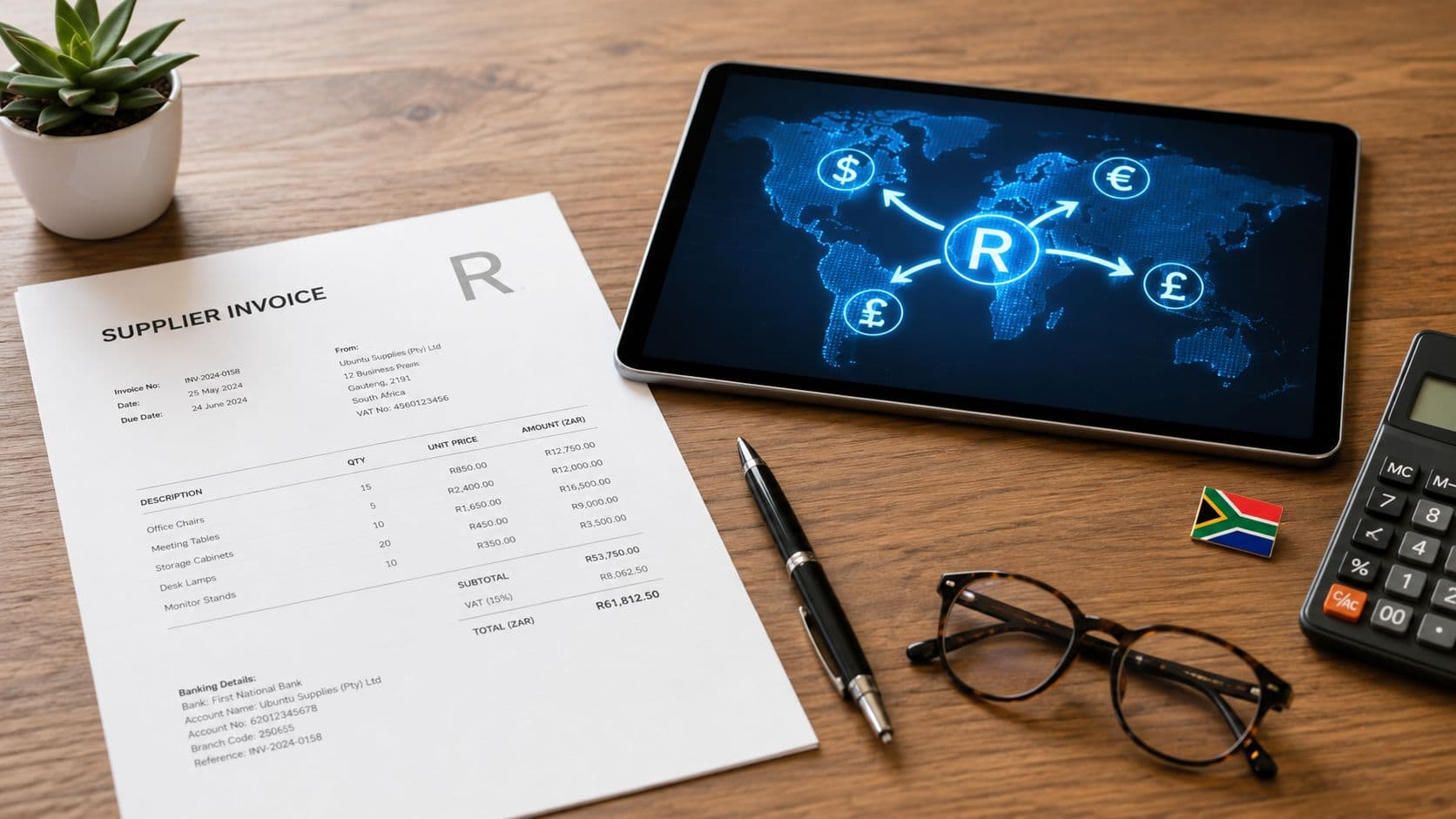
A supplier invoice is a commercial document issued by a seller to request payment for goods or services delivered. In South Africa, it can also support an input VAT claim, start the 30-day payment clock, and provide the evidence needed to settle an overseas supplier correctly.
You're a Cape Town apparel importer, and your first invoice from a textile mill in Guangzhou has just arrived. It shows fabric descriptions, quantities, prices in a foreign currency and bank details, but you're unsure whether it's ready for payment, whether SARS will accept it, or whether the amount on the page is the amount your business will ultimately spend in rand.
That uncertainty is common. A supplier invoice sits at the intersection of procurement, accounting, tax, payment controls and foreign exchange. Treating it as a simple request for money can lead to duplicate payments, delayed approvals, unsupported VAT claims or an avoidable dispute with a supplier.
Understanding What a Supplier Invoice Really Is
A supplier invoice records what a seller supplied, who received it, how much is owed and when payment is expected. The supplier issues it after supplying goods or services, although some commercial documents may be sent earlier to support ordering, customs or approval.
For the Guangzhou textile mill, the invoice should allow your finance team to connect four things: the purchase you authorised, the fabric that arrived, the amount the mill is charging and the bank account that will receive the payment. It becomes part of your accounting records, not merely an email attachment.
Practical rule: If your team can't connect an invoice to a real supplier, an approved purchase and a received good or service, pause payment until someone resolves the gap.
A quote normally describes proposed prices before the buyer commits. A pro forma invoice can provide estimated transaction details before shipment, but it isn't the final accounting record for a completed supply. A receipt confirms that money has already been received. A statement of account summarises transactions and balances across a period. The supplier invoice is the document that normally asks the buyer to pay for a particular supply.
Why the distinction matters in ZA
South African businesses need more than a commercial record when VAT is involved. SARS requires a valid tax invoice to contain prescribed information, and the document's format affects whether the buyer can support an input VAT claim. The SARS tax invoice requirements also set different requirements according to transaction value.
The invoice can trigger a second important event. For South African public-sector payments, Treasury's rule is that creditors must generally be paid within 30 days of receiving an invoice, unless a contract provides otherwise. Treasury reported 401,691 invoices paid after the 30-day deadline, valued at R33.7 billion, in 2021/22, and 362,068 late invoices valued at R35.1 billion in 2023/24. These figures appear in Treasury's supplier invoice payment report.
For an overseas supplier, the invoice also becomes the reference point for currency conversion, payment instructions, customs documentation and reconciliation. The core question isn't only “what is a supplier invoice?” It's whether the document gives your business enough reliable information to approve, record and pay the obligation.
The Key Components Every Supplier Invoice Must Include
A useful invoice tells a complete story without forcing the buyer to search through emails. Your accounts payable team should be able to identify the supplier, match the charge to an authorised purchase, confirm the calculation and determine how to pay.
The exact format varies by supplier and jurisdiction, particularly in cross-border trade. For a South African VAT tax invoice, however, SARS prescribes core details. The following table gives a practical working model.
Anatomy of a Supplier Invoice
| Invoice Field | What It Contains | Why the Buyer Needs It |
|---|---|---|
| Supplier identity | Legal name, address and contact details | Confirms who supplied the goods or services and supports vendor verification |
| Buyer identity | Your registered business name and address | Shows which entity owes the money and prevents invoices being posted to the wrong company |
| VAT registration number | Supplier's VAT number where applicable, and required recipient details for a full tax invoice | Supports tax validation and the evidence needed for an input VAT claim |
| Invoice label | “Tax Invoice”, “VAT Invoice” or “Invoice” | SARS requires one of these words on a valid tax invoice |
| Invoice number | A unique serial or sequential reference | Creates an audit trail and helps identify duplicate invoices |
| Issue date | Date the invoice was issued | Helps establish the payment timetable and match the document to the supply |
| Supply date | Date goods were delivered or services were performed, where shown separately | Helps finance staff record the transaction in the correct period |
| Purchase order reference | The buyer's PO number or contract reference | Allows matching against the approved purchase |
| Line items | Description, quantity or volume, unit price and line total | Lets the buyer check what was supplied instead of approving an unexplained total |
| VAT breakdown | VAT rate and VAT amount, shown where required | Separates the tax component from the net value |
| Total amount | Subtotal, VAT and final amount payable | Provides the posting and payment value |
| Payment terms | Due date, agreed credit period and any discount terms | Guides payment scheduling and supplier communication |
| Banking details | Account name, account number, bank, branch or routing information, plus SWIFT or BIC for international transfers | Allows settlement, but must be independently verified before payment |
| Currency | Currency in which the supplier expects payment | Prevents a foreign exchange misunderstanding and supports accurate cost recording |
| Supporting references | Shipment, delivery note, bill of lading or customs references | Helps connect the invoice to goods in transit and import records |
A compliant South African tax invoice must include the supplier's name, address, VAT registration number, serial number, issue date, description, quantity or volume, value and VAT charged, as set out by SARS's tax invoice guidance. A foreign supplier's document may not contain every South African field, so your team should distinguish between a commercial invoice used to pay an overseas supplier and a domestic VAT tax invoice used to support local VAT treatment.
Banking details deserve separate attention. A finance employee shouldn't rely solely on a late email saying the supplier has changed its account. Use a trusted contact method already held in your vendor records, especially before sending a first payment or paying a new beneficiary.
How Supplier Invoices Fit Into Accounts Payable and Cash Flow
The invoice journey starts when the document enters your business and ends only when the payment and accounting record agree. Each hand-off either protects cash or releases it.

Six control points from receipt to reconciliation
Receive and log the invoice. Save the original PDF or paper scan in a controlled location, record when it arrived and assign it to the correct supplier. The receipt date matters because it may determine when the payment clock begins.
Capture the data. Record the supplier, invoice number, dates, currency, line items, VAT and total in the accounts payable system. Check for an existing invoice with the same number before creating a new record.
Match the documents. Compare the invoice with the purchase order and goods received note. This is the three-way match. It confirms that your business ordered the goods, received them and is being charged the agreed amount.
Obtain approval. Send exceptions to the person responsible for the purchase or cost centre. An approval should show who authorised the expense, not just that someone forwarded an email.
Schedule payment. Place the approved invoice in the relevant payment run according to its agreed terms, currency, cash position and any commercial priority. A due date that isn't visible to the team is a due date that can be missed.
Pay and reconcile. After settlement, match the bank transaction to the invoice, clear the payable in the general ledger and retain the invoice with its purchase order, delivery evidence and approval trail.
Skipping the match can result in payment for goods that never arrived. Skipping duplicate checks can pay the same invoice twice. Skipping tax validation can leave the business with an invoice that doesn't support the intended VAT treatment.
For South African public-sector entities, Treasury says payments are generally due within 30 days from receipt of an invoice, unless a contract says otherwise. The late-payment figures cited earlier show why an invoice's arrival and approval dates need to be visible rather than left in a shared inbox.
Supplier Invoice Rules and Legal Requirements in South Africa
A document from a supplier is not automatically a South African tax invoice. A commercial invoice can request payment for goods or services, while a tax invoice is a prescribed VAT record. That distinction affects whether your business can support an input VAT claim.
For the document to support the relevant VAT treatment, the supplier must be a registered VAT vendor and the transaction must relate to a taxable supply. The information required also depends on the value of the consideration, meaning the amount charged for the supply.
The value thresholds
A full tax invoice is required when the supply exceeds R5,000. It must show the prescribed supplier and recipient details, invoice number, issue date, description, quantity or volume, value and VAT information. The document must also use the words “Tax Invoice”, “VAT Invoice” or “Invoice”.
For a supply above R50 and up to R5,000, SARS allows an abridged tax invoice. It still needs enough information to identify the supplier, transaction, value and VAT, although some full-invoice details may be omitted. For consideration of R50 or less, a tax invoice is not required, but the business should keep a receipt or another suitable record.
Use the SARS tax invoice checklist to compare the document with the applicable requirements.
SARS Tax Invoice Requirements by Transaction Value
| Required Field | Over R5,000, Full Tax Invoice | R50 to R5,000, Abridged | Under R50, Record Only |
|---|---|---|---|
| Required label | “Tax Invoice”, “VAT Invoice” or “Invoice” | “Tax Invoice”, “VAT Invoice” or “Invoice” | No tax invoice required |
| Supplier details | Required | Required | Keep a suitable record |
| Supplier VAT number | Required where the supplier is a VAT vendor | Required where applicable | Retain available evidence |
| Invoice serial number | Required | Required | Record reference where available |
| Date of issue | Required | Required | Record transaction date |
| Description and value | Required | Required | Receipt or other record should identify the transaction |
| Quantity or volume | Required | May be omitted under the abridged rules | Not prescribed as a tax invoice field |
| Recipient details | Required for a full tax invoice | Some recipient details may be omitted under the abridged rules | Not applicable as a tax invoice |
| VAT amount | Required where VAT is charged | Required where VAT is charged | No tax invoice claim based on the threshold alone |
SARS says the supplier must issue a tax invoice within 21 days from the time the supply is made. If an old document arrives much later, check that the invoice date and supply date are accurate before posting it. This protects the VAT record and gives the accounts team a clear basis for review.
The invoice should remain with its supporting records for the applicable retention period. A practical South African finance process should allow for five years of record retention, keeping the invoice, proof of receipt, purchase order and approval trail available for review. That evidence also helps a ZA business explain a VAT claim, resolve a supplier query, or support payment documentation for a cross-border transaction.
Common Variations of Supplier Invoices You Will See
A busy exporter might receive several invoice types in the same month. They don't all have the same accounting or VAT effect.

A credit note reduces the amount owed. Suppose a supplier invoices your business for a batch of imported packaging, then accepts a return because part of the shipment is damaged. The supplier issues a credit note against the original invoice. Your team should link the credit note to that invoice, reduce the payable and adjust any related input VAT rather than treating the credit as unrelated income.
A debit note moves the amount in the opposite direction. If a supplier undercharged for an agreed item or discovers that a pricing correction is needed, the supplier may issue a debit note for the difference. Finance should match it to the original transaction and assess the corresponding VAT adjustment.
Documents that aren't final payment invoices
A pro forma invoice resembles an invoice but generally precedes the final supply. An importer may use it to obtain internal approval, support customs processes or arrange a letter of credit. It doesn't, by itself, create the same VAT claim as a valid tax invoice for a completed taxable supply.
A commercial invoice is the final sales document used in many international shipments. It describes the goods, seller, buyer, value and terms for the transaction, and may support customs clearance. Its usefulness for customs doesn't automatically make it a South African VAT tax invoice.
Recurring invoices cover repeat services such as a monthly retainer, software subscription or managed-service arrangement. Each issue still needs its own invoice reference and should be checked against the contract and service period. A recurring charge isn't a licence to approve every invoice without review.
Self-billed invoices can also appear where the buyer prepares the document on behalf of the supplier under an agreed arrangement. Confirm that the arrangement and document satisfy the relevant tax and contractual requirements before treating it as a normal supplier invoice.
Verification and Processing Steps Before You Pay
Use the invoice, purchase order and goods received note as three pieces of the same transaction. The six-step workflow below shows how a document moves from receipt through review and approval to payment.

Start with the three-way match
Compare the invoice with the purchase order and goods received note line by line. Check the supplier name, description, quantity, unit price, currency and delivery evidence. A mismatch should go back to the responsible buyer or supplier for clarification. Do not alter the invoice to fit an internal expectation, because that can distort the VAT record, payment amount or approval trail.
Validate the vendor record next. Confirm that the supplier's VAT details suit the transaction, the beneficiary account belongs to the supplier and any bank change has been verified through a trusted channel. For an international supplier, retain the reviewer's confirmation and the payment instruction used. These records help explain who approved the payment and which details were checked.
Look for payment fraud signals
Pause the payment and investigate if any of these signals appear:
- Duplicate references: The invoice number already exists, or the same document returns with a different date or amount.
- Unexpected urgency: The sender demands immediate payment or asks staff to bypass the usual approval route.
- Changed beneficiary details: Bank information differs from the approved vendor master record.
- Unfamiliar parties: The invoice names another legal entity or comes from a supplier no one can identify.
- Unexplained round values: The total has no line-item support or does not match the order.
After review, send the invoice to the correct approver and record the decision. Post the approved amount to the accounts payable ledger, schedule payment according to the agreed terms and retain the invoice with its supporting documents. This creates a clear audit trail for the purchase, approval and settlement.
Keep the SARS invoice checklist available to staff who validate local tax invoices. Organised records make later queries faster and support the team's VAT evidence, payment history and explanation of any exception.
Cross-Border Payments and Best Practices for Paying Suppliers
An overseas supplier invoice is also an FX and landed-cost document. The amount printed on the invoice may be in USD, CNY, EUR or another currency, while your accounting records and cash planning may be in rand. The final ZAR cost depends on the exchange rate used when you pay, plus any bank, correspondent or transfer charges.
Agree the commercial terms before the order is placed. Confirm the invoice currency, payment method, due date, responsibility for fees and delivery terms. Terms such as telegraphic transfer, cash against documents and open account describe different risk and timing arrangements, while Incoterms such as FCA or DDP define different responsibilities around delivery and costs.

Use a payment process that matches your exposure:
- Calculate total landed cost: Include currency conversion, bank fees, taxes, freight and other charges rather than comparing suppliers only by invoice total.
- Manage known currency obligations: A forward contract can lock an exchange rate for a future payment, subject to your provider's terms and risk policy.
- Compare settlement routes: Review the exchange rate, transfer fee, SWIFT charge and intermediary-bank treatment offered by banks and payment providers.
- Verify beneficiary details twice: Use two independent communication channels before paying a new supplier or accepting changed banking details.
- Consolidate where appropriate: Grouping suitable invoices into a payment run can reduce repetitive operational work and make reconciliation easier.
For a South African SME, a platform such as Zaro can capture invoice data, route it for approval, support three-way matching and process cross-border payments. It can also help teams view ZAR and USD activity in one payment environment, but the business still needs its own supplier validation, approval controls and accounting records.
The invoice should connect to customs and import documentation where relevant. Keep the commercial invoice, shipment evidence, payment confirmation and internal approval together so the finance team can explain the transaction from purchase order to final settlement.
Putting It All Together A Supplier Invoice Checklist for ZA Businesses
Before approving a supplier invoice, ask:
- Identity: Does it name the correct supplier and your correct legal entity?
- Commercial detail: Does it show the goods or services, quantities, prices, currency and total?
- Tax status: Is it a valid South African tax invoice where VAT treatment requires one?
- VAT evidence: Is the supplier VAT number present where required, and does the document meet the applicable SARS threshold?
- Timing: Is the issue date accurate, and was the tax invoice issued within the required 21-day window?
- Matching: Does it agree with the purchase order and goods received note?
- Approval: Has the authorised person approved the cost?
- Payment: Are the beneficiary details independently verified, and are the currency and charges understood?
- Records: Are the invoice, delivery evidence, approval and payment confirmation filed for the required retention period?
For a local invoice, accuracy supports VAT recovery and a defensible audit trail. For an overseas invoice, it also protects the business against incorrect FX costs, payment fraud and reconciliation problems. A disciplined process helps your team pay genuine suppliers on time without surrendering control.
If your South African business pays overseas suppliers, visit Zaro to see how invoice data capture, approval workflows, three-way matching and cross-border payment processing can fit into your accounts payable process. Review your supplier payment controls alongside your FX costs, then choose a workflow that gives your finance team clear records from invoice receipt to settlement.