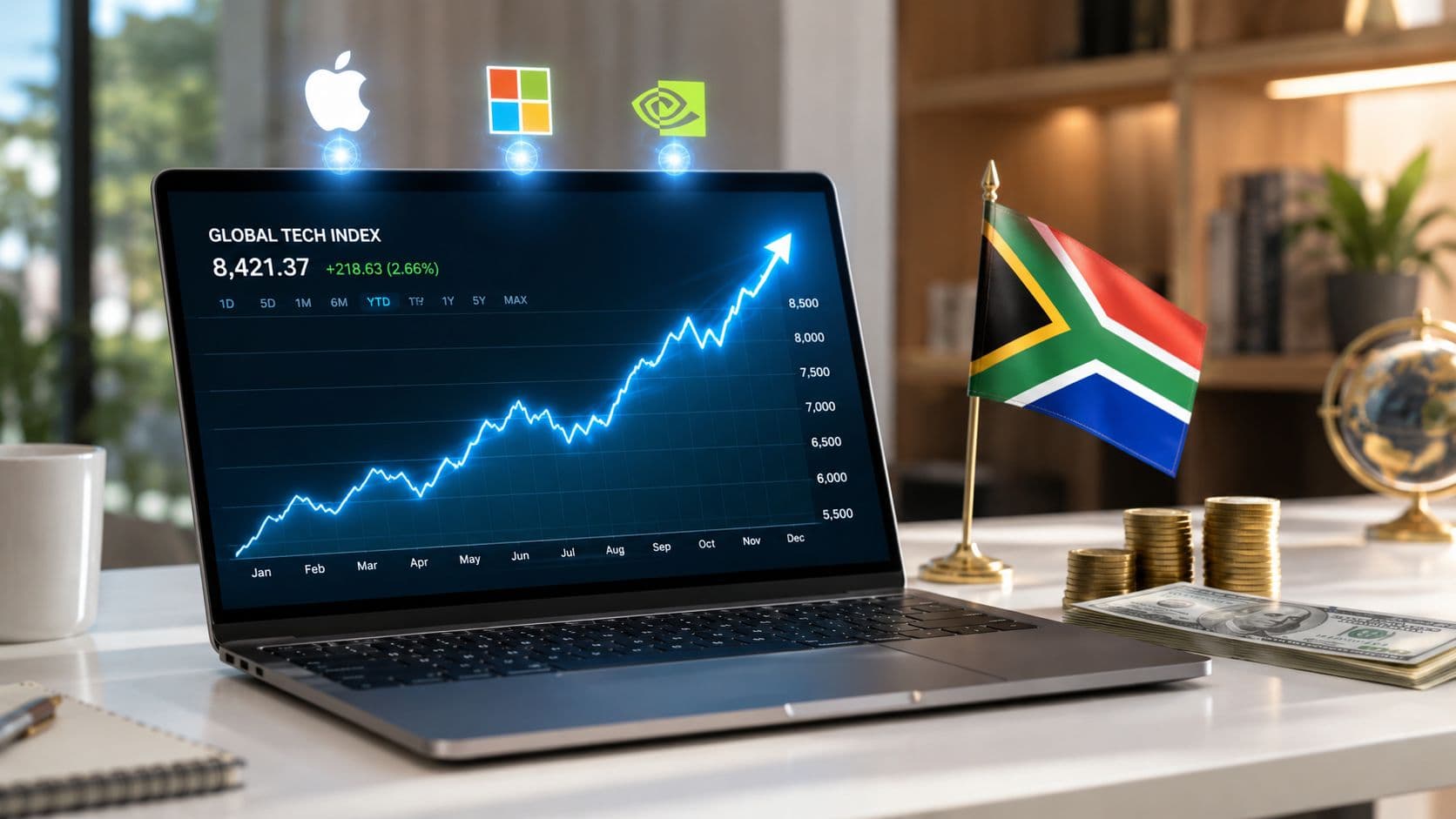
The NAS100 is the Nasdaq-100 index, a benchmark of 100 large non-financial US companies listed on Nasdaq, and in South Africa it's most often accessed through a CFD or index futures quote rather than by owning those constituent shares. By August 2026, one South African market-data page showed the index around 29,400 to 29,700 points, with a 52-week range of 22,841.42 to 30,762.20 (Nasdaq-100 history and structure).
You may be sitting at your laptop in Johannesburg, Cape Town or Durban, watching a broker app flash NAS100 while the JSE is quiet. The label looks simple, but it can conceal several important questions: are you looking at the index itself, a CFD, a futures contract or an exchange-traded fund? Is the quote in US dollars, or has the platform converted the display into rand? And does “Nasdaq” refer to the famous US technology benchmark or a separate South African index?
Those distinctions affect ownership, financing, currency exposure, trading hours and tax treatment. A patient look at each one can make the quote on your screen much easier to understand.
Why South Africans Keep Seeing NAS100 on Their Screens
Sipho in Sandton opens his broker app at 16:30 SAST and sees NAS100 moving quickly while the JSE is quiet. The label usually refers to the Nasdaq-100, an index tracking 100 of the largest non-financial companies listed on Nasdaq. It represents a market basket, not a single technology company or every business traded on that exchange.
The symbol appears frequently on South African retail platforms because they provide access to US equity markets through CFDs or index derivatives. Sipho normally is not buying Apple, Microsoft or another constituent share. He is taking a position on whether the quoted index price rises or falls, under the contract terms set by his broker.
The rand display can hide a dollar position
A platform might show the quote in rand, calculate margin in rand and convert profit or loss automatically. The display feels local, while the underlying exposure may still follow a USD-denominated US index. If the Nasdaq-100 rises as the rand weakens against the dollar, the rand value of the result can differ from the index movement alone.
South African market data often uses NAS100 as shorthand for the global Nasdaq-100. One ZA market-data page displayed a level of 29,209.23 USD, a 24.161% one-year change and reported volume of 275,557,922 (South African NAS100 market data). These figures describe the global index quote. They do not mean that a South African account owns the underlying shares.
The symbol alone does not identify the product. Before clicking Buy or Sell, check the product name, displayed currency, contract specification and whether the position gives you ownership or only exposure to price movements.
A separate Nasdaq South Africa Index, known as NQZA, tracks securities assigned to South Africa. It began on 3 December 2012 with a base value of 1,000.00. Although both indexes carry the Nasdaq name, they cover different markets. That distinction matters whenever a platform presents several Nasdaq-related instruments side by side.
How the Nasdaq-100 Index Is Built
The Nasdaq-100 is a selected basket, not a list of every company traded on Nasdaq. It includes 100 of the largest non-financial companies listed on Nasdaq, then gives bigger companies a stronger effect on the index's movement.
The calculation uses float-adjusted market capitalisation. In plain terms, it focuses on the value of shares available for public trading. Strategic, restricted or closely held shares are not treated as if investors could freely buy and sell them.

A simple way to read the weighting
The weighting works like a megaphone. Every constituent contributes to the index, but the largest companies have a louder signal. If a heavily weighted technology company moves sharply, its effect can exceed the effect of a smaller member making the same percentage move.
For a South African trader viewing NAS100 on a platform, this helps explain why the quoted index may respond strongly to news from a few large US technology and growth companies. The exposure is broad, yet its performance can still be concentrated.
The membership is not permanent. Nasdaq uses scheduled reconstitution and rebalancing processes to allow companies to enter or leave as their size, eligibility and market characteristics change. These rules keep the index focused on its intended group rather than preserving a historical list of companies that were large when it began.
Why the comparisons matter
The S&P 500 contains 500 large US companies and includes financial businesses, giving it broader coverage of the US corporate market. The Dow Jones Industrial Average contains 30 companies and uses a price-weighted method. Under that method, a company's share price plays a different role from its total market value.
The Nasdaq-100 is therefore commonly used as a concentrated large-cap technology and growth benchmark, although its members can represent other industries. That concentration provides exposure to major US innovators while increasing sensitivity to company-specific news. A disappointing announcement from a heavily weighted member can influence NAS100 more than news from a small constituent.
Ways Investors Can Access NAS100
A South African investor looking at a NAS100 quote is choosing access to price movement, ownership, or both. Buying every underlying share directly would require an international brokerage account, foreign-currency funding and regular portfolio adjustments as the index weights change.
An ETF provides a more organised ownership route. Products such as Invesco QQQ and Irish-domiciled UCITS alternatives are built to offer basket-style exposure, subject to their structure, listing venue, fees and availability on the investor's platform. You own units in the fund, not the index itself.
The route familiar to many South African retail traders is a broker's NAS100 quote, usually a CFD or index derivative. The trader aims to benefit from price changes without owning the constituent shares. CFDs may support long and short positions, while also bringing financing charges, spread costs and counterparty exposure. The rand value of any result can also change when the quoted product is in US dollars.
The three practical doors
| Route | Typical ZA Access | Margin Requirement | Main Cost | Best For |
|---|---|---|---|---|
| Constituent shares | International brokerage account | Usually none unless borrowed funds are used | Brokerage, conversion and custody costs | Investors who want direct ownership |
| ETF | Global platform, or an available local offshore investment route | Usually none in a standard cash position | Fund charges, brokerage and currency conversion | Longer-term diversified exposure |
| CFD or futures | South African-facing derivative broker | Usually available, subject to product terms | Spread, margin financing, overnight costs and commissions | Experienced traders seeking directional exposure |
Futures are exchange-traded contracts with defined specifications. For the E-mini Nasdaq-100, the contract size is $20 times the index level, and the minimum price fluctuation is 0.25 index points, worth $5 (E-mini Nasdaq-100 contract specifications). Those terms belong to that futures contract, not automatically to a broker's CFD. Check what one contract represents before comparing platforms.
A CFD showing one lot may therefore create a different market exposure from one E-mini futures contract. Read the contract size, margin requirement, financing treatment and currency terms first, then translate the possible gain or loss into rand.
If you are learning how markets are analysed before selecting a vehicle, these equity research blog posts can help distinguish company research from index and derivative decisions. Start with the exposure you want, then select the product that delivers it.
The Global Nasdaq-100 vs the Nasdaq South Africa Index
A South African trader can type “NAS100” into a platform and see a US market instrument, while a search for “Nasdaq South Africa” leads to a local index. The shared Nasdaq name does not make them interchangeable.
The global Nasdaq-100 tracks 100 large non-financial companies listed on Nasdaq in the United States. Its performance is tied to US equities and is commonly quoted in USD. The Nasdaq South Africa Index, or NQZA, is a separate float-adjusted, market-capitalisation-weighted index for securities assigned to South Africa. It is a local-market comparator, not the index usually meant by NAS100.
The distinction at a glance
| Feature | Nasdaq-100 Global | Nasdaq South Africa Index |
|---|---|---|
| Geographic focus | United States | South Africa |
| Constituents | Large non-financial Nasdaq-listed companies | Securities assigned to South Africa that meet index requirements |
| Currency context | Commonly quoted in USD | South African market reference |
| Sector character | Strong exposure to US technology and growth companies | Local-market composition |
| Apple, Microsoft and Nvidia | May be represented as global constituents | Not represented as US constituents |
| Main local risk | US equity moves plus USD/ZAR translation | South African equity and rand-market conditions |
The local index began on 3 December 2012 with a base value of 1,000.00. Its mid-2026 reading was 1,598.87, with a daily range of 1,595.46 to 1,600.64 and a previous close of 1,597.53. Those figures describe NQZA, not NAS100.
The practical difference for a South African account is the source of the exposure. NAS100 can combine US technology and growth-company movements with USD/ZAR translation. NQZA reflects securities assigned to South Africa and local rand-market conditions. A platform's label may be shortened, so check the ticker suffix, displayed currency, exchange description and constituent list before placing an order. The symbol alone is not enough.
A Worked Example of Trading NAS100 From South Africa
A worked example can clarify the concept, but it mustn't be mistaken for a recommendation. The figures below are hypothetical and use an illustrative CFD specification, not a universal broker contract.
Assume a South African trader sees NAS100 at 18,000 points and the broker defines one CFD contract as $1 per point. One contract would represent $18,000 of notional exposure, calculated as 18,000 points multiplied by $1 per point. At an assumed exchange rate of R18.50 to the US dollar, that exposure would translate to roughly R333,000.
If the broker required 5% margin, the margin calculation would be 5% of the notional value. That would be approximately R16,650 on the assumed figures, before considering the broker's other requirements, fees or currency conversion.

What a one-percent move would mean
A 1% upward move from 18,000 points would equal 180 index points. At $1 per point, a long position would show about $180 profit, which converts to approximately R3,330 at the assumed R18.50 exchange rate, before spreads, swap or other charges.
For a short position, the same downward move would produce a similar result in the opposite direction. If the index rose by 1% instead, the short position would lose approximately that amount before costs. A loss of this size would reduce the available margin quickly if the trader's account held little excess capital.
Margin is not the value of the trade. It is the amount set aside to support a much larger notional position.
The actual outcome can differ because CFD contract sizes, margin requirements, spreads and financing terms vary. The E-mini futures contract uses a much larger multiplier, $20 times the index level, with a $5 minimum tick value, so futures traders must use the exchange specification rather than borrow calculations from a CFD example (E-mini Nasdaq-100 specifications).
Rand movement adds another layer. A favourable index move can produce a smaller rand gain if the dollar weakens against the rand, while a stronger dollar can increase the rand value of a USD-linked gain or loss.
Trading Hours, Drivers and Real Risks for ZA Users
A South African trader checking NAS100 at the laptop must first identify which clock matters. Regular US trading hours commonly run from 16:30 to 23:00 SAST in winter and 15:30 to 22:00 SAST in summer. Some platforms provide almost 24-hour weekday CFD access, usually with a daily settlement break (South Africa NAS100 trading hours).
The difference comes from daylight-saving time in the United States, while South Africa keeps the same local time year-round. A routine that works in one season can therefore place a trader early or late for the period when liquidity and price activity often increase.

What usually moves the quote
Several forces can move the Nasdaq-100 at once:
- Company results: Earnings and guidance from major technology and consumer companies can quickly change expectations.
- Interest-rate expectations: Federal Reserve decisions affect how investors value future growth and technology cash flows.
- Economic releases: Inflation, employment and other US data can alter expectations for monetary policy.
- Currency conditions: USD/ZAR movement changes the rand value of a USD-linked position, even if the index itself stays unchanged.
Trading access across most of the day does not provide identical conditions throughout. Spreads, order depth and volatility can change between sessions. An extended-hours broker quote may also differ from the regular US cash market, so a South African trader should check the platform's hours and pricing terms.
Risks that deserve a written plan
Prices can gap overnight or over a weekend while the trader is away from the screen. CFD financing may accumulate on positions held beyond the trading day, while contract terms can include spread charges or dividend adjustments.
Rand exposure adds a separate result to the index move. A gain in dollars may convert into a smaller rand gain if the dollar weakens against the rand. A stronger dollar can increase the rand value of a USD-linked gain, or enlarge the rand loss when the trade moves against the trader.
South African users should establish how their activity is treated for tax purposes and confirm their obligations with a qualified adviser familiar with SARS rules and offshore derivatives. The label “US index” alone does not determine the tax result.
What NAS100 Means for South African Businesses
NAS100 exposure isn't only a retail trading conversation. A South African business may monitor the index because it provides information about global technology sentiment, US growth expectations and the value of dollar-linked cash flows. Monitoring an index doesn't automatically make a hedge appropriate, but it can help a finance team identify which risks deserve attention.
Consider a Stellenbosch winery receiving export revenue in US dollars. A finance manager could compare the business's receivable exposure with a suitable USD hedge, including carefully assessed derivatives or investment instruments. The relevant question isn't whether NAS100 will rise. It's whether the proposed instrument offsets the business's actual currency and revenue risk without creating a new, larger speculative position.

Three business conversations to have
- Export receipts: A company with USD receivables should map the timing, amount and certainty of those receipts before selecting any hedge.
- International contractors: A Johannesburg digital agency paying New York contractors needs predictable USD liquidity. It may compare a dollar account, a short-term investment and a derivative, with liquidity and capital protection considered separately from return.
- Imported inputs: A Cape Town or Durban business paying suppliers in dollars may track both NAS100 sentiment and USD/ZAR, but the index isn't a direct substitute for a currency hedge.
A digital agency could use a USD-denominated investment vehicle for idle funds awaiting contractor payments, but market exposure introduces the possibility that the balance falls when the payment is due. That makes the cash-flow deadline more important than a chart pattern.
Business test: Match the hedge to the liability. An index position can correlate with a currency or sentiment risk without eliminating it.
Cross-border transactions also require attention to exchange-control processes, account permissions, documentation and tax advice. For payment operations, a business may compare providers that support ZAR and USD accounts, live exchange-rate conversion and international payment workflows with its bank's existing process. The payment decision and the investment decision should remain separate.
Common NAS100 Myths and a Simple Decision Checklist
Myth one, NAS100 is a single stock listed on the JSE. It isn't. NAS100 is an index, and South African users generally access its price through a CFD, futures contract or ETF rather than buying one share that represents the whole benchmark.
Myth two, a small margin deposit means a small trade. A margin deposit supports a larger notional position. The earlier CFD example shows why a modest-looking account balance can sit behind substantial dollar exposure, so a small percentage move can have a meaningful effect on available funds.
Myth three, NAS100 follows JSE hours. It doesn't. US market timing changes in SAST because of daylight-saving differences, and broker platforms may quote the index for much of the weekday. Availability isn't the same as consistent liquidity or low execution cost.
Use this checklist before placing an order
- Define the goal: Are you investing, hedging a business exposure or making a short-term directional trade?
- Choose the vehicle: Compare ETF ownership with CFD and futures exposure, including margin and financing.
- Map the currency: Identify whether the position, margin and profit or loss are calculated in USD, ZAR or another currency.
- Check the broker: Review regulation, client-money arrangements, contract terms and the instrument's exact specification.
- Price the full cost: Include spread, commission, overnight financing, conversion charges and any relevant adjustments.
- Write the exit plan: Set the invalidation point, maximum acceptable loss and circumstances that would make you close or reduce the position.
The answer to “what is NAS100?” is only the beginning. Before you trade, make sure you know what you own, what you owe, what can move the price and how a rand account will experience the result.
For South African businesses managing USD invoices, export receipts or international contractor payments, Zaro provides ZAR and USD accounts with live-rate conversion and cross-border payment tools. Visit Zaro to compare your payment workflow and make the currency side of global business more transparent before you take on market exposure.