
The standard advice on wire transfer vs ACH is written for a business with US bank accounts paying US suppliers. That advice doesn't answer the question facing a South African CFO: should this payment move through domestic EFT, RTC or PayShap, or does it need a cross-border route such as a SWIFT-based wire?
For local payments, standard interbank EFT is the closest functional equivalent to US ACH, but it isn't the same system. For overseas payments, comparing a wire with ACH can be misleading because a US ACH instruction often can't settle directly into a South African account. The more important decision is whether the payment stays inside South Africa's domestic clearing environment or passes through international banks, where FX spreads and intermediary deductions can outweigh the visible transfer fee.
| Payment need | Default rail to consider | Main trade-off |
|---|---|---|
| Routine ZAR payroll, collections or supplier payment | Domestic EFT | Batch processing and cut-off timing |
| High-value, time-critical ZAR settlement | RTGS | Immediate, final settlement, subject to bank handling |
| Eligible domestic instant payment | RTC or PayShap, depending on the bank and use case | Availability and terms depend on participating providers |
| Cross-border payment or receipt | International wire or another supported cross-border route | FX conversion, intermediary fees and beneficiary-side processing |
| Payment involving US accounts only | US ACH may be suitable | It isn't a general-purpose South African domestic rail |
The Question South African Finance Teams Should Ask First
Wire transfer vs ACH comparisons answer a question no South African CFO is asking. They assume US bank accounts, US dollars and US-domiciled suppliers. That framing is nearly useless when an exporter is collecting from an overseas buyer, a BPO is paying international contractors, or a finance team is converting USD revenue into rand.
South Africa runs its own regulated payment environment, and it is not a local copy of the US ACH model. The National Payment System Act 78 of 1998 established the legal framework for managing, operating, regulating and supervising payment, clearing and settlement systems in the country. The South African Reserve Bank treats EFT as a local electronic payment instrument, while the Payments Association of South Africa acts as the recognised payment-system management body for participating banks. The SARB's overview of payment-system policy and implementation sets out that institutional structure clearly.
So drop the US question, "Is ACH cheaper than a wire?" Ask the one that matters here: "Where does the beneficiary's bank account sit, and which rail can reach it?"
Both accounts in South Africa, payment in rand? Domestic EFT, RTC or PayShap will likely fit, depending on urgency, value and bank support. Beneficiary outside the local clearing environment? The payment needs a supported cross-border route, typically SWIFT instructions through correspondent banks, where FX conversion and intermediary deductions drive the overall cost far more than the visible transfer fee.
Exporters and BPOs collecting recurring USD revenue feel this gap hardest. A US customer may prefer ACH domestically, but that preference settles nothing, because the instruction often can't reach a South African account directly. Confirm the route, the full cost and when funds become usable before you commit.
Treasury rule: Decide the destination and settlement environment first. Compare fees only after you've confirmed the payment can reach the beneficiary through the proposed rail.
Wire Transfer vs ACH and the South African Rails Explained
The word “transfer” can hide several different payment systems. Separate the rail, which moves or clears the payment, from the bank instructions and settlement process that sit around it.
An international wire is a cross-border bank payment commonly routed through SWIFT messaging and correspondent-bank relationships. The banks may need to convert currency, check payment details and complete compliance reviews. SWIFT carries payment instructions, but the full journey can involve more than the sending and receiving banks.
A domestic EFT is the routine account-to-account option most South African businesses use for local ZAR payments. Standard interbank EFT instructions are credit-push payments, processed in batch mode through a bureau for transactions below R5 million per transaction. That makes EFT useful for planned payroll, collections and supplier settlement, but it doesn't provide the same immediate, final settlement as an RTGS payment.
RTGS is the instant gross settlement stream for high-value payments. It is designed to settle payments immediately, finally and irrevocably, making it more appropriate when timing and certainty matter more than the lower cost and batch convenience of standard EFT. RTC and PayShap are other domestic payment options. Their precise availability and terms depend on the participating banks and the use case, so confirm those details with your provider rather than assuming they work like a wire or standard EFT.
US ACH is the US Automated Clearing House network, used for domestic bank-account payments in the United States. It isn't the South African equivalent in a regulatory or technical sense. Businesses looking to distinguish US eChecks from ACH can use CEFCore's guide to eCheck vs ACH, but that comparison shouldn't be mistaken for a description of South African payment rails.
| South African payment rails at a glance | |||
|---|---|---|---|
| Rail | Settlement | Best for | Regulator |
| Domestic EFT | Batch processing; timing depends on bank cut-offs and processing | Routine ZAR payments, payroll, collections and supplier settlement | South Africa's national payment system is regulated under the SARB framework |
| RTGS | Immediate, final and irrevocable settlement | High-value, time-critical domestic payments | South Africa's national payment system is regulated under the SARB framework |
| RTC | Depends on the participating provider and product terms | Domestic payments where the relevant bank supports the service | Confirm with the bank or provider |
| PayShap | Depends on supported service and participating providers | Eligible domestic instant-payment use cases | Confirm with the bank or provider |
| International wire | Cross-border processing through correspondent-banking arrangements | Payments to or from banks outside the domestic clearing environment | Multiple jurisdictions and institutions may be involved |
Comparing Speed, Cost and Cross-Border Suitability Side by Side
A payment can move quickly through one stage and still arrive late in the recipient's hands. That's why “instant” and “slow” are weak labels unless you specify the rail, the banks involved, and what you mean by received.
For Swift-network cross-border payments using data from 2021–2024, a South African Reserve Bank presentation found that 75% reached the beneficiary institution within 10 minutes. But the share settled within one hour in Sub-Saharan Africa trailed the global average by 17 percentage points, and more than 80% of global elapsed cross-border-payment time was spent on the beneficiary leg. Reaching the beneficiary institution therefore doesn't guarantee that the recipient can use the money. The SARB presentation on cross-border payment speed highlights the gap between network delivery and final availability.
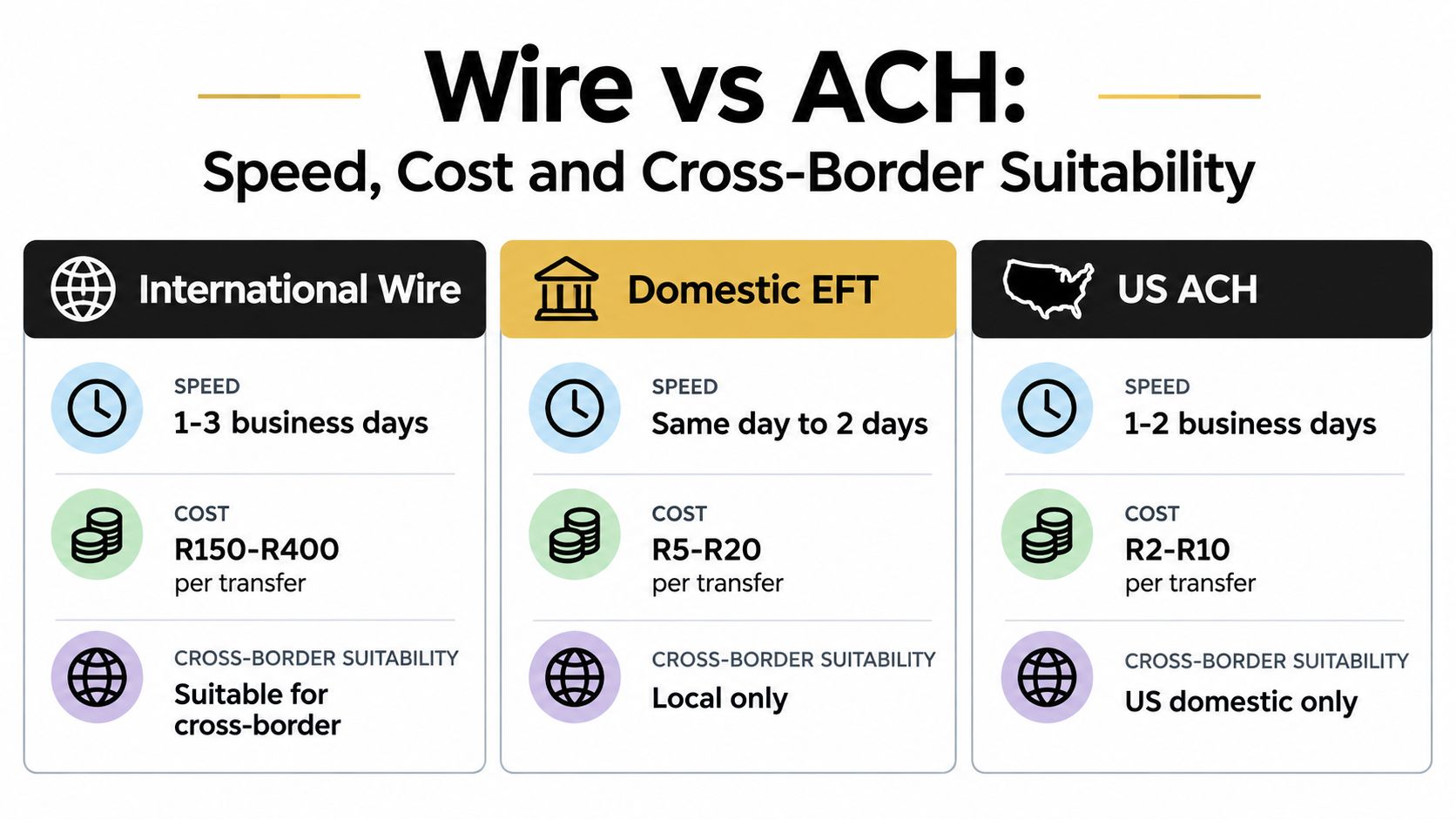
For a South African finance team, the practical comparison looks like this:
- Speed: Standard EFT is batch-based, so cut-offs and processing windows matter. RTGS is built for immediate final settlement. A wire may reach the beneficiary bank quickly, but compliance checks, currency conversion, correspondent coordination and the receiving bank's processing can still delay availability.
- Cost: Domestic EFT is generally the more economical choice for routine local payments. RTGS may be justified when finality and urgency matter. Cross-border wire charges are only part of the price: the exchange-rate spread and deductions along the payment chain can change the landed cost.
- Availability: US ACH is primarily useful when both sides can use supported US payment arrangements. A South African account isn't automatically reachable through a US ACH credit. Confirm routing and account compatibility before promising a payment method.
- Finality and corrections: RTGS settlement is immediate and irrevocable. Standard EFT is a batch credit-push instruction, so an online submission confirmation shouldn't be treated as proof of final settlement. For cross-border wires, verify recipient details before release and ask the bank what options exist if instructions are wrong.
- Cross-border fit: Use a wire or another confirmed cross-border service when funds need to reach a bank outside South Africa's domestic clearing arrangements. Use a domestic rail when the payment remains within that system.
Don't judge speed by the first notification in a banking app. Judge it by the point at which the beneficiary can use cleared funds.
Where the Money Actually Leaks in Cross-Border Payments
A bank's quoted transfer fee is not the total cost. For a South African business sending or receiving foreign currency, the landed amount can also reflect the exchange rate, charges taken by intermediary banks and fees applied by the receiving bank.
An IMF diagnostic on the South Africa–Zimbabwe remittance corridor reported costs as high as 12.7%, compared with a 6.3% global average and a 3% G20 affordability target. The report also gives a strong reason to scrutinise the whole payment chain, not just the headline fee. The IMF's South Africa–Zimbabwe cross-border payments diagnostic provides corridor-specific context. These figures describe remittances and shouldn't be treated as a guaranteed quote for a particular business transfer.
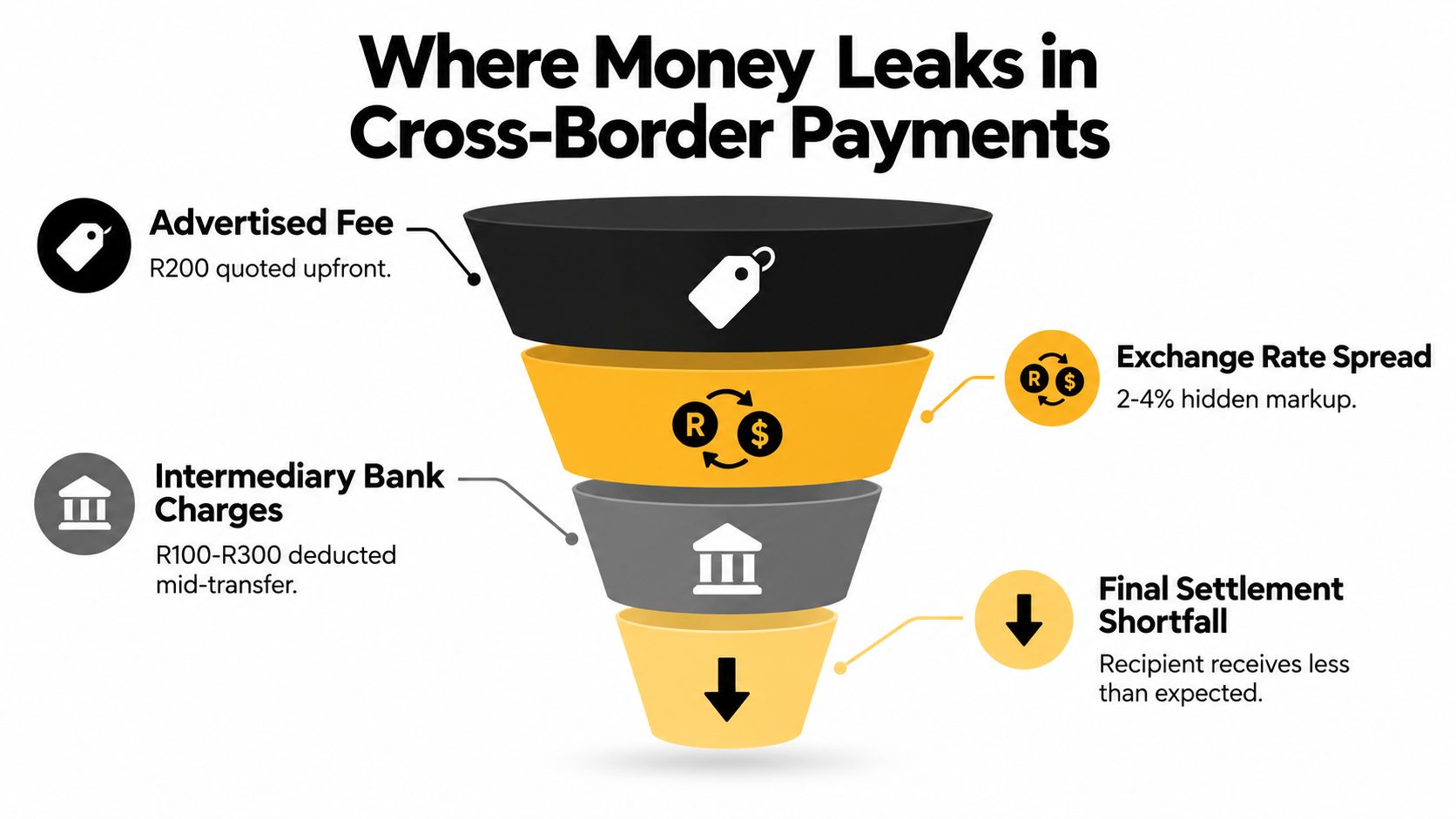
Follow the money through the payment chain
- Sender-bank fee: This is the visible charge quoted for initiating the transfer. Ask whether it's fixed, whether it's charged separately or deducted from the payment, and which party pays it.
- FX spread: If the bank converts the payment, compare its exchange rate with a transparent reference rate at the same time. The difference can be more consequential than the transfer fee, particularly when the amount is large or payments recur.
- Correspondent deductions: A cross-border payment may pass through intermediary banks. Those institutions can deduct charges before the funds reach the beneficiary bank, making the amount credited harder to predict.
- Receiving-bank charge: The beneficiary's bank may apply an incoming payment fee or process the payment under its own requirements. Confirm this with the recipient's bank, not only with the sending bank.
The claim that “ACH is cheaper” can fail for a South African business. A US ACH payment may not be supported as a direct deposit to the South African account. If it must be routed through an intermediary or converted through another service, the total cost and reconciliation outcome can differ from the US sender's advertised ACH fee.
Ask for the amount sent, exchange-rate basis, all known charges and expected amount credited. If the provider can't explain how those figures connect, you don't yet have a useful landed-cost quote.
Compare methods using the amount the beneficiary receives, not the sender's transaction charge in isolation. For a recurring payment, record the quoted rate, deductions and final credit each time. That gives finance a defensible basis for comparing providers without mistaking a low visible fee for a low total cost.
Matching the Rail to Real South African Use Cases
The right rail follows the payment's destination, currency and urgency. Four workflows cover most of what a South African finance team routes in a month.
Local ZAR supplier invoice
A Pretoria manufacturer paying a domestic supplier should start with standard EFT when the payment is planned and doesn't need same-day finality. The team needs accurate beneficiary banking details, an approved invoice and a clear payment reference for reconciliation. If the payment is high-value and time-critical, ask the bank which real-time route it supports. Confirm the recipient bank can accept an instant payment before paying for one.
US customer paying a South African SaaS company
A Johannesburg SaaS company collecting recurring USD subscriptions will hear "just use ACH" from US customers. ACH is a US domestic rail, and it doesn't terminate in a South African account. Ask the bank or payment provider which cross-border collection route it supports, what beneficiary and purpose information is required, whether funds arrive in USD or convert along the way, and which charges can be deducted before the credit lands. The expensive assumption is that a familiar US method deposits directly into the local account.
BPO paying overseas contractors
A Cape Town BPO paying contractors abroad needs a supported cross-border method; domestic EFT won't reach them. Collect verified beneficiary details and the payment information the provider requires, then confirm the receiving currency, the exchange-rate basis and the charges that may come off along the route. For recurring payments, consistent beneficiary records and references make reconciliation faster. Fraudulent change-of-account instructions cause more damage here than any fee does, so treat every update as suspect until independently confirmed.
Exporter collecting overseas revenue
A Western Cape exporter invoicing a UK distributor in GBP should settle upfront who carries the conversion cost and which currency the exporter expects to receive. Confirm the beneficiary details, any purpose disclosures the bank requires and the route the payment will take. A notification that funds have reached a correspondent bank still isn't a usable credit; the exporter's position is only real once the credited amount can be drawn on.
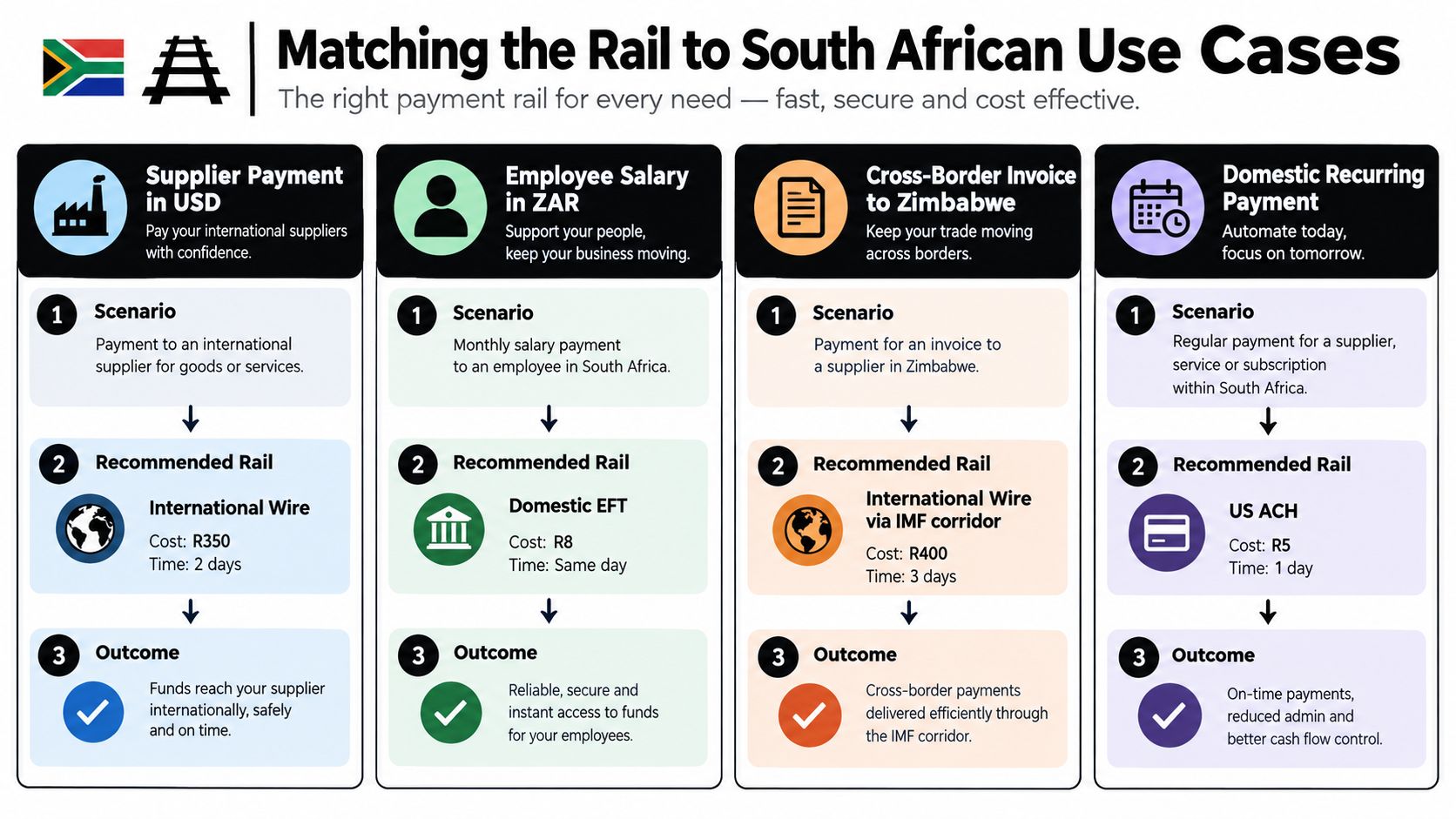
When a US customer insists on ACH, give them the cross-border collection details your provider supports rather than a local account number, and record the expected landed amount on each invoice. If a vendor or overseas customer treats "ACH" as a universal transfer rail, the SARB framework covered earlier is the reference point for explaining why South Africa's domestic stack behaves differently.
Setting Up the Banking Side So Either Rail Works Cleanly
Payment choice won't fix incomplete onboarding, incorrect beneficiary data or weak approval controls. Set up the operational basics before a payment becomes urgent.
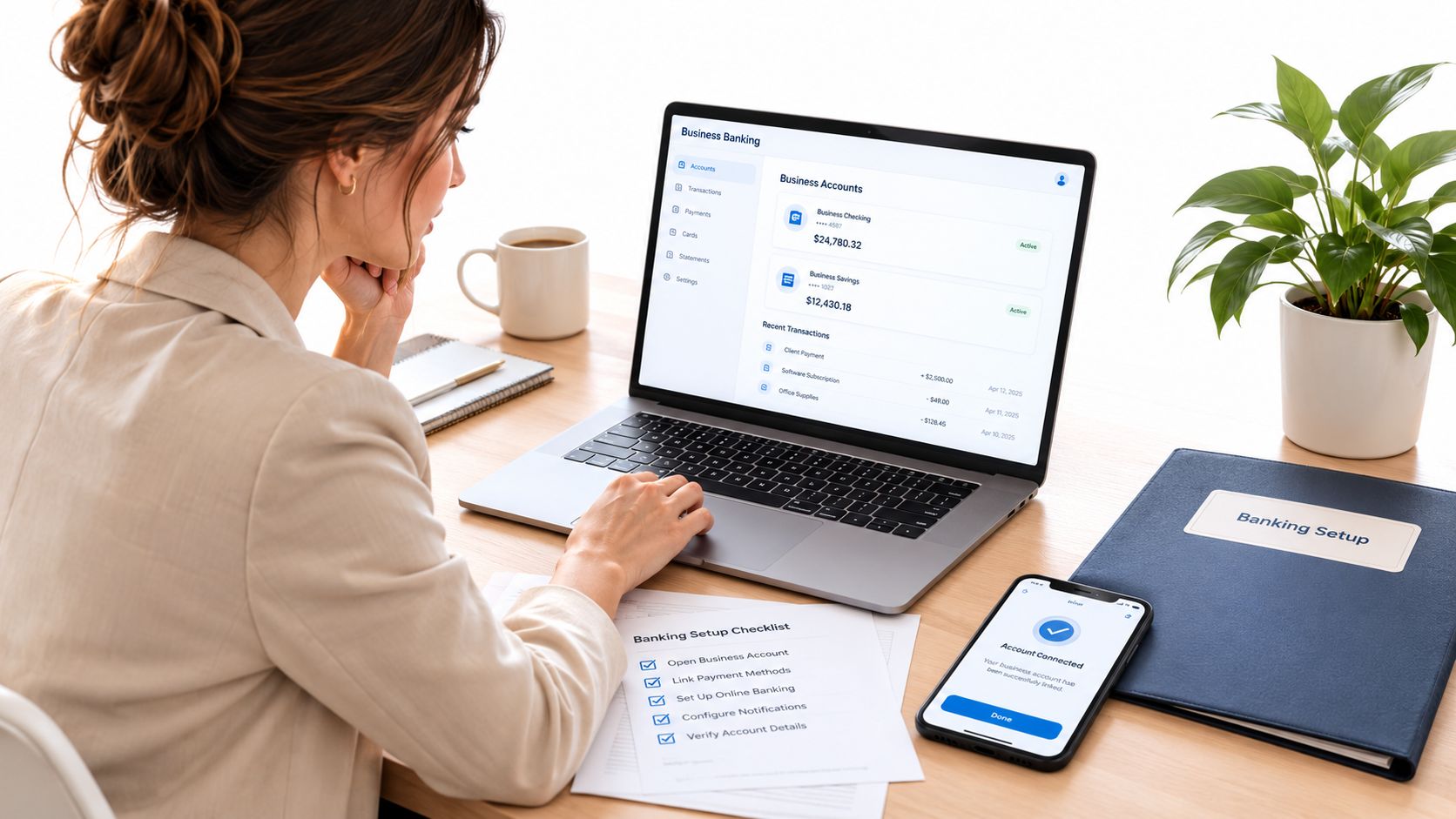
Build controls around the account and payment
Start with KYB verification and make sure the people who initiate and approve payments have the right access. If the business regularly handles foreign currency, ask its bank or provider whether it needs separate ZAR and foreign-currency accounts, and how funds move between them. Account structures and available currencies depend on the institution.
For each overseas beneficiary, collect the account name, account number, SWIFT/BIC where applicable, receiving-bank details, currency and payment purpose. Confirm new or changed instructions through a trusted channel independent of the message that supplied them. A correct-looking invoice isn't sufficient evidence that the banking details are genuine.
Configure local payment workflows around the relevant rail. Standard interbank EFT is processed in batch mode for transactions below R5 million per transaction. If a payment exceeds that threshold, route it for bank-specific review instead of assuming the standard EFT workflow applies. For high-value payments, define who can prepare, approve and release the instruction.
A clean control environment also separates three events that teams often blur: payment initiation, bank settlement and beneficiary availability. An online “submitted” message may only confirm that the instruction entered the bank's process. Ask your bank what confirmation indicates settlement, and ask the beneficiary when the funds are available for use.
Payment workflows should capture the invoice, approval trail, beneficiary details, payment purpose, FX quote and final amount credited. Teams building repeatable invoice approvals can refer to this accounts payable control system guide for ideas on structuring controls around payment operations.
A Practical Decision Matrix for Choosing the Right Rail
Use the destination first, then test transaction value and finality. Don't force every payment into a wire-versus-ACH comparison.
| Situation | Default decision |
|---|---|
| Beneficiary is in South Africa, routine ZAR payment | Use standard EFT if batch timing works |
| Beneficiary is in South Africa, payment must settle immediately and finally | Ask the bank about RTGS |
| Eligible domestic instant payment fits the transaction | Check whether RTC or PayShap is supported |
| Beneficiary is outside South Africa's domestic clearing environment | Use a confirmed cross-border route, commonly an international wire |
| US payer proposes ACH to a South African account | Confirm compatibility before accepting the instruction |
| Payment exceeds the standard EFT threshold | Route for bank-specific handling before release |
For a broader view of how businesses combine bank transfers with other options, this overview of B2B payment methods for CFOs can help place rail selection within the wider payment workflow.
Before release, confirm:
- The payment rail and destination are compatible.
- The responsible payment-system authority or provider is clear.
- Beneficiary details and payment purpose are verified.
- The FX quote basis and known charges are recorded.
- Expected settlement and recipient availability are not being treated as the same event.
Zaro provides South African businesses with ZAR and USD accounts, cross-border payment services, and FX at the spot rate without a spread or SWIFT fees. If you're comparing the full cost of international payments rather than the visible transfer fee, visit Zaro to see how its payment workflow fits your treasury needs.