
A zero spread cent account is a retail forex account that pairs cent-denominated balances and positions with a raw or near-zero quoted spread, not a business cross-border payment account. Its displayed spread can be close to zero without its total cost being close to zero.
If the spread is the number everyone compares, why can the wider-spread account sometimes be cheaper? The answer lies in commission minimums, position sizing and the difference between money used for trading and money owed to a supplier.
For South African traders and finance teams, the first decision isn't which account has the smallest advertised spread. It's whether you're choosing a tool for taking market risk or a service for moving business money.
What a Zero Spread Cent Account Really Means
The phrase combines two trading-account features, but it also gets confused with payment-account pricing. A retail forex account lets you open and close market positions. A business cross-border account helps you receive customer payments, convert currency and settle obligations.
Some payment providers describe conversions without an embedded FX markup as zero-spread pricing. That doesn't turn their accounts into cent accounts, nor does a trading platform become a payments service because it accepts deposits in foreign currency.
The distinction is easier to see when the money has a clear destination.
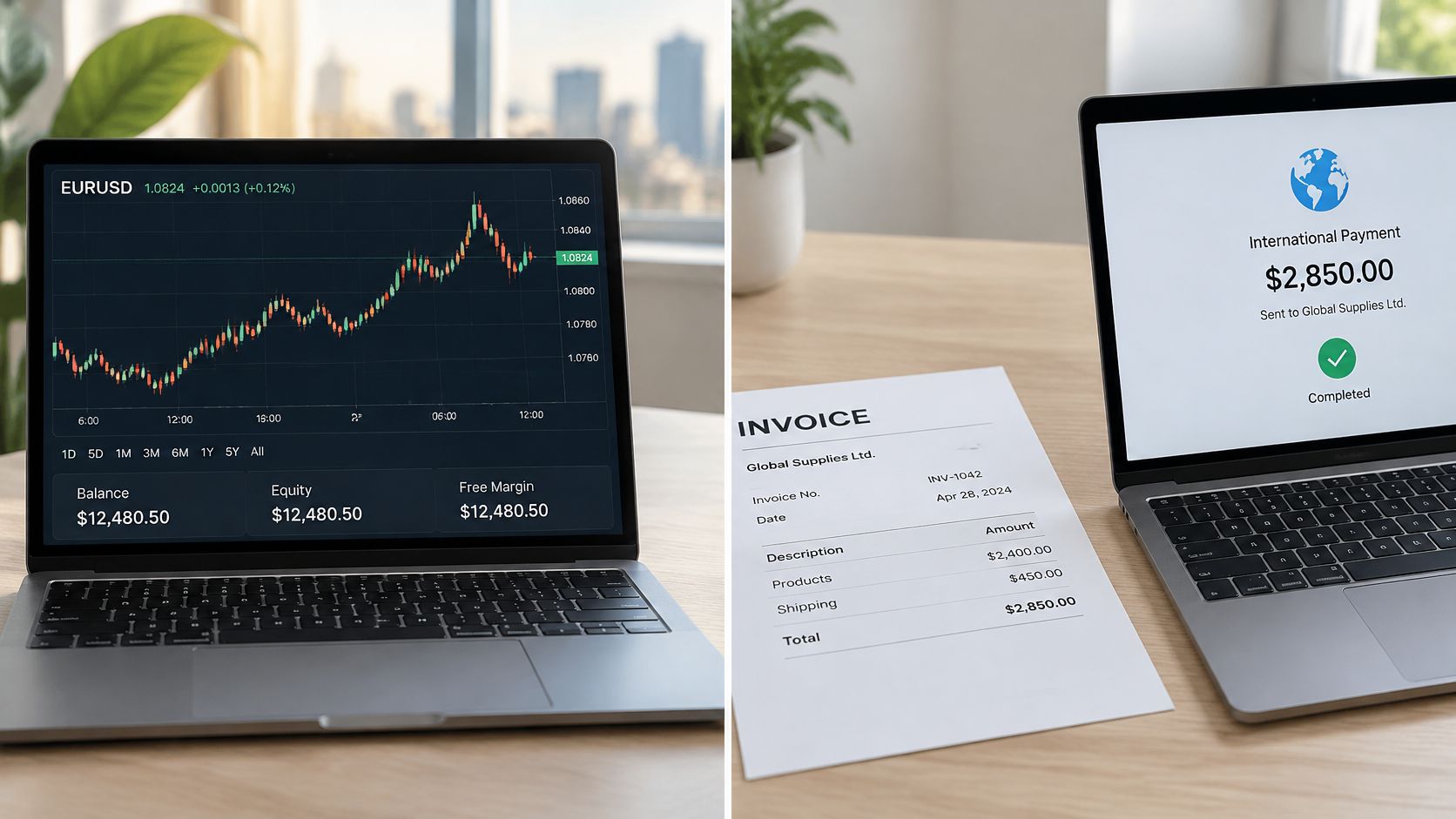
Two products behind one phrase
| Decision point | Zero-spread cent account in retail forex | Business cross-border account |
|---|---|---|
| Primary user | Retail trader testing a strategy with small capital | SA exporter, BPO or SME paying or receiving international invoices |
| What the balance is | Trading margin and profit or loss, often displayed in cents | Operating cash held in ZAR and foreign currency such as USD |
| What zero spread means | Quote at or near the raw bid-ask, usually with a commission | Claimed conversion at or near the live mid-market rate without hidden FX markup, subject to the actual quote |
| What cent means | Cent-denominated display and smaller position sizes | Not a standard feature; balances are shown in currency units |
| How money moves | Deposit, place trades and withdraw; not a supplier-payment workflow | Fund by bank transfer, convert, pay suppliers or receive export proceeds |
| Main safety question | Is the legal entity authorised, and are client funds segregated? | Is the provider appropriately authorised and FIC compliant, and can it document the transaction? |
| Main risk | Leverage, slippage, overnight financing and counterparty exposure | FX timing, compliance documentation, payment delay and bank fees |
Cent describes the account's units and, where the contract specification provides for it, smaller exposure per lot. It doesn't make the underlying currency worth more. Zero spread describes an aspect of the quote, not a promise that trading is free.
Neither label establishes what a particular provider offers. A broker might offer cent accounts and raw-spread accounts as separate products rather than combining them. A payments provider might disclose a spread openly instead of charging a separate conversion fee.
Start with the job the money must do
If you're experimenting with a trading strategy, the relevant questions concern contract size, execution and loss limits. You need to know what a position represents before deciding whether its entry price is attractive.
If you're paying a supplier or contractor, the relevant questions concern the recipient, delivery currency, payment documentation and total debit from your business account. Trading margin isn't a substitute for a documented payment instruction.
First filter: Money intended for an invoice belongs in a payments workflow, not a leveraged trading position.
Keep the distinction practical: identify the destination of the money before comparing account labels. That prevents an attractive trading quote from distracting you from the service your business needs.
How Cent Lots and Zero Spreads Work Together
A USD 10 balance may appear as 1,000 cents, while cent-lot sizing can reduce exposure to approximately 1/100 of a standard lot, according to the SA Shares comparison of cent accounts. The same comparison describes cent-account advertised spreads of roughly 0.3–1.6 pips, illustrating why cent denomination and zero-spread pricing aren't interchangeable features.
The display changes the accounting unit. It doesn't add money to the account, and it doesn't prove that every broker uses the same contract size.
A platform screen can show the balance, chart and order buttons together, but the contract specification determines what your order means.
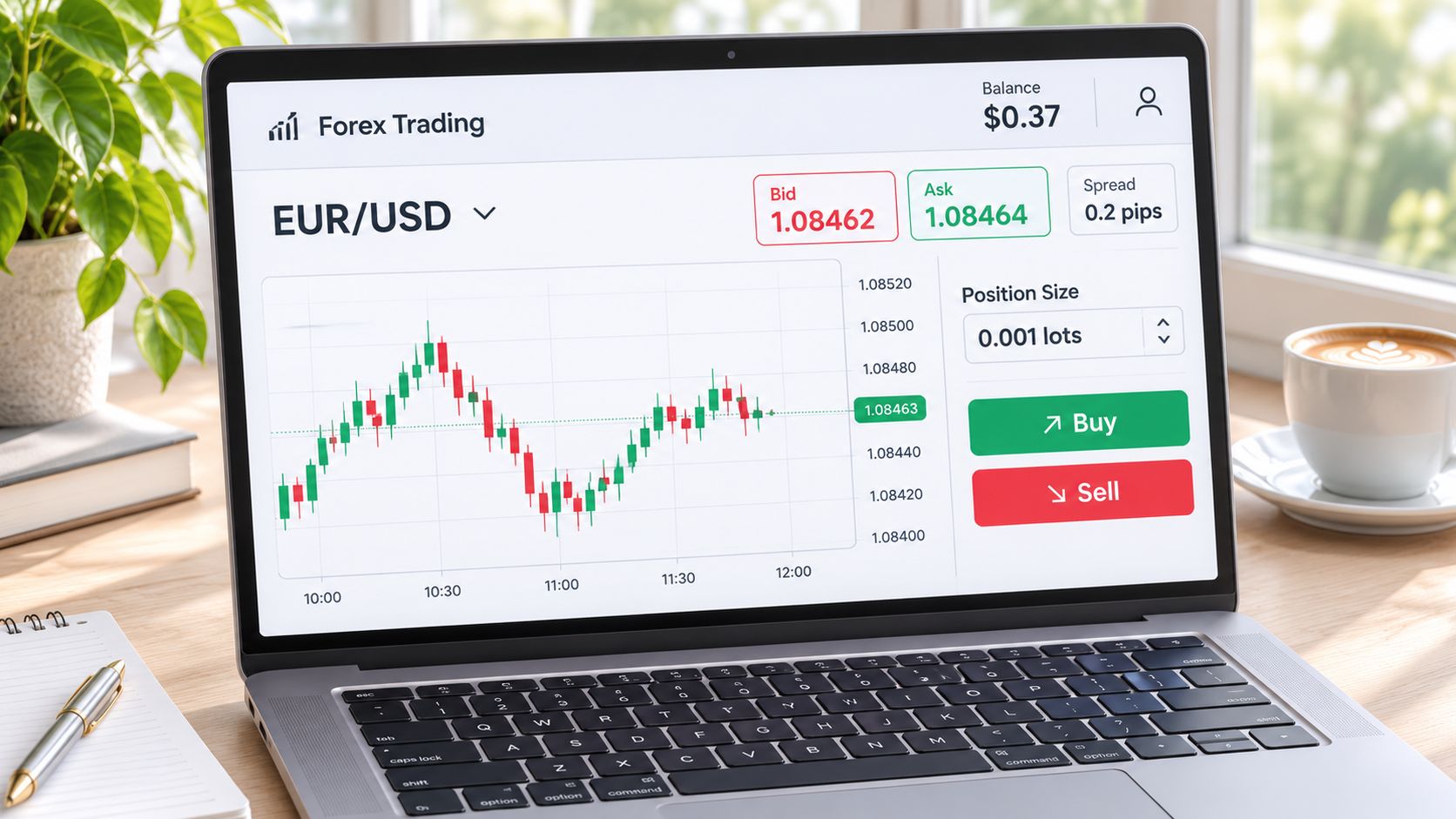
Separate the display from the contract
For terminology, the Thrive trading glossary is a useful companion when checking what lot size means. Your broker's instrument specification should then confirm the units represented by the order size you enter.
The numerical rows below are a hypothetical EUR/USD comparison using the cent-sizing relationship described above. They assume a standard lot represents 100,000 units, a cent lot represents 1,000 units, and a USD-quoted pip is worth USD 10 per standard lot. They're calculation assumptions, not universal broker terms.
What changes when a forex account is denominated in cents
| Item | Standard USD account | Cent account | What it means for the reader |
|---|---|---|---|
| Balance display | USD 10 shown as USD 10 | USD 10 shown as 1,000 cents | Same money, different unit |
| One lot exposure | Assumed 100,000 units | Assumed 1,000 units, 1/100 of a standard lot | Smaller notional per displayed lot |
| 10-pip move on one lot | About USD 100 under these assumptions | About USD 1 under these assumptions | Smaller absolute profit and loss |
| Margin requirement | Based on full notional and leverage | Based on smaller notional, with leverage still applicable | A low deposit can still carry large relative risk |
| Commission | May be charged per standard lot | May be per cent lot, spread-only or minimum-based | Check the minimum charge |
| Withdrawal | Paid in the withdrawal currency | Cent balance translated into currency units | Confirm conversion and withdrawal costs |
| Zero spread condition | Raw pricing may carry commission | Raw pricing only if expressly offered; otherwise spread-only terms may apply | The label doesn't establish the pricing model |
Read the quote separately
The bid is the price available to sell; the ask is the price available to buy. Their difference is the spread. Raw pricing generally means the broker isn't embedding its usual markup in that difference, but the underlying market can still have a bid-ask gap.
A cent account may instead bundle its trading charge into a wider spread. That's a different charging method, not evidence that the account is unsuitable.
Before depositing, request an order preview showing the instrument, underlying units, margin and commission in ordinary currency terms. If the broker can't explain the same trade in cents and standard-lot equivalents with a cost breakdown, treat the account label as marketing rather than a specification.
What a Zero Spread Cent Account Really Costs
The useful comparison is all-in cost, not the smallest number on an account page. The SA Shares South African broker comparison describes zero accounts advertising spreads from 0.0 pips with additional commission, while spread-only cent accounts may begin around 1.2 pips.
Use this calculation:
All-in cost = spread cost + commission + slippage + overnight financing + conversion and withdrawal fees.
Keep the calculation on a consistent basis. Compare a completed trade with a completed trade, and don't add a full spread separately to both entry and exit if your spread-cost calculation already captures the round-trip bid-ask difference.
A hypothetical minimum-commission test
Assume an EUR/USD zero-spread-labelled account quotes 0.1 pip, charges USD 7 per standard lot round trip, and imposes a USD 5 minimum round-trip commission. Compare it with a cent account charging a 1.2-pip spread and no separate commission, assuming USD 10 per pip per standard lot.
These are illustrative assumptions, not a provider quote. Initially exclude financing, slippage and funding costs so the effect of the commission minimum remains visible; the chart therefore shows the spread-and-commission subtotal, not a guaranteed final cost.
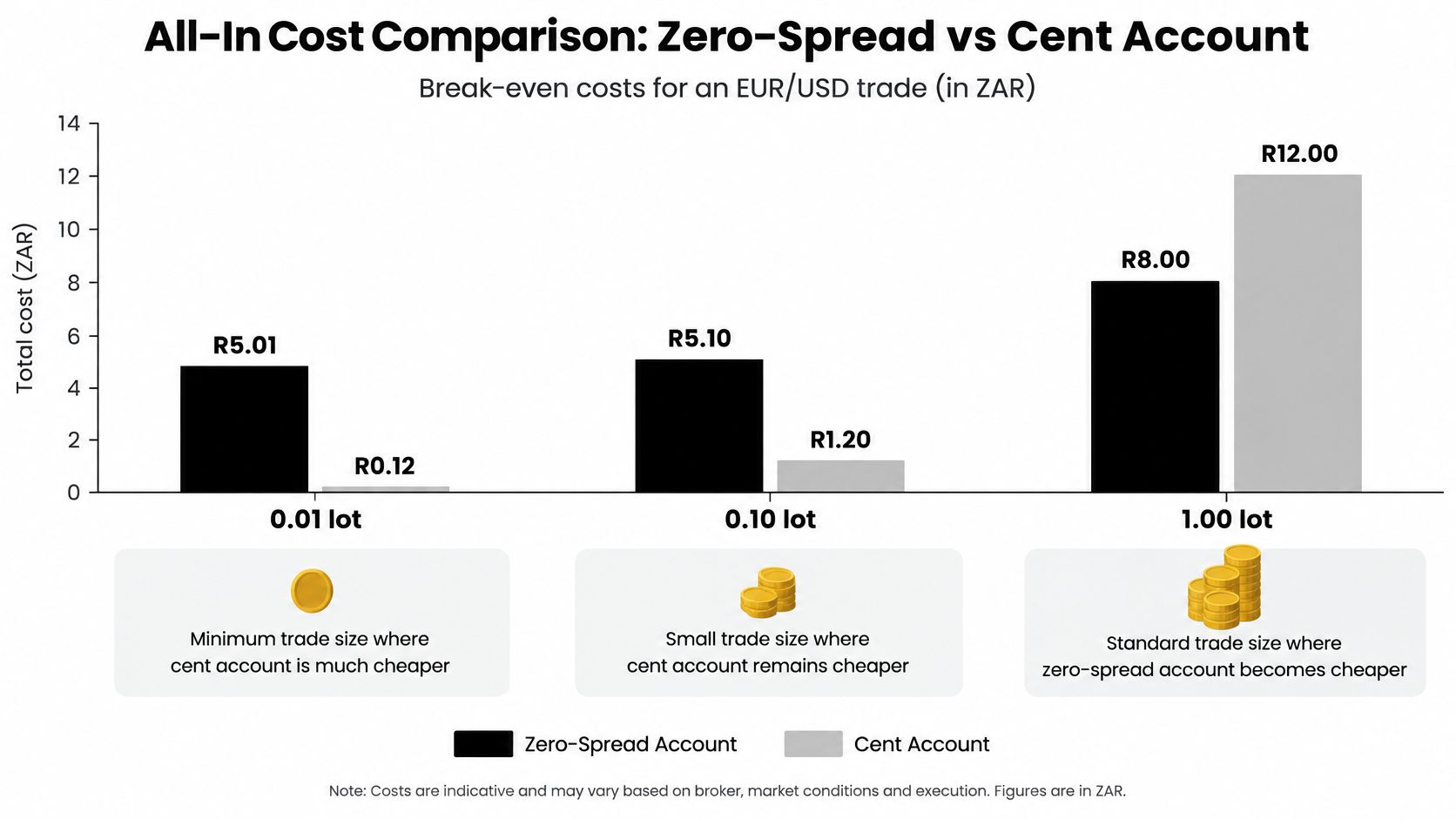
Worked all-in cost comparison for a zero-spread account and a cent account
| Trade size in standard-lot equivalents | Zero-spread account subtotal | Cent account subtotal | Lower cost |
|---|---|---|---|
| 0.01 lot | USD 5.01 | USD 0.12 | Cent account |
| 0.10 lot | USD 5.10 | USD 1.20 | Cent account |
| 1.00 lot | USD 8.00 | USD 12.00 | Zero-spread account |
Under these assumptions, the zero-spread subtotal is lot size × USD 1, plus the greater of USD 5 or lot size × USD 7. The cent-account subtotal is lot size × USD 12.
The minimum commission applies until approximately 0.71 standard lot. While it applies, break-even occurs at 5 ÷ 11, or approximately 0.45 standard lot; below that size, the wider-spread account is cheaper in this example.
Add the costs your strategy actually incurs
A short-lived position and an overnight position aren't the same purchase. Apply the instrument's financing terms to your intended holding period, then add expected execution costs and any funding or withdrawal charge.
For a South African budget, translate the resulting total into ZAR using the conversion rate you'll receive. Calculate at your normal order size, not at the larger size that makes an advertised commission look attractive.
Where Execution and Leverage Change the Risk
A quote is an offer under particular market conditions, not proof of the price every order will receive. The South African Reserve Bank analysis of the 2022 BIS Triennial Survey provides the local market context for understanding how liquidity, currency volatility and dealer intermediation affect executable FX prices.
For a USD/ZAR strategy, test the account during the conditions in which you intend to trade. Include session changes and economic announcements in your review rather than assuming an uneventful execution sample represents every trading period.
Measure the fill, not just the screen
Capture the quoted bid, ask and mid-market price when you submit an order. Then record the execution timestamp and actual fill, distinguishing the cost of crossing the spread from any additional slippage.
A spreadsheet is sufficient if its fields are consistent:
- Quote evidence: Save the bid, ask, timestamp and order direction.
- Execution evidence: Record the fill price, filled quantity and any partial fills.
- Cost evidence: Keep commission, financing and conversion charges in the same reporting currency.
- Market conditions: Note announcements, session changes or interrupted connectivity.
Express costs relative to notional exposure when comparing different trade sizes. Use a basis-point calculation with costs and notional converted into the same currency, and keep the calculation convention unchanged across accounts.
The video below offers an additional format for exploring the topic; your own order records remain the evidence for evaluating your account.
Margin isn't your maximum loss
Margin is collateral supporting a position. It isn't the position's full economic exposure, and the amount available to deposit isn't a sensible starting point for deciding how much exposure to take.
For a related explanation in another market, The Coin Course's crypto margin trading risks explained can help clarify how margin works. Crypto-specific rules aren't forex terms, so use your forex agreement for liquidation and account-protection details.
Set the maximum borrowing ratio, a loss limit per trade, and a daily loss cap in ZAR before opening positions. A stop-loss instruction helps implement that plan, but don't assume it guarantees the requested execution price during a price gap.
A small margin requirement tells you how little collateral the broker requires, not how little money you can lose.
Check whether the advertised spread applies continuously or only to selected instruments and liquidity conditions. Finish each test trade with a journal entry you can compare against the next one:
- Quoted spread: Instrument, bid-ask difference and submission time.
- Executed price: Actual fill, direction and slippage against the contemporaneous quote.
- All-in cost in basis points: Spread, execution difference, commission and financing, without double-counting.
Why a Business Cross-Border Account Is Not a Trading Account
A supplier invoice creates an obligation to deliver money to a beneficiary. Opening a currency position doesn't discharge that obligation, even if the position references the currencies on the invoice.
An exporter also needs more than a currency balance. The receipt must reach the correct business, carry the appropriate transaction information and remain traceable through conversion and reconciliation.
The operational difference starts with the invoice, not the exchange-rate chart.

Documentation is part of the payment
The South African Reserve Bank exchange-control fact sheet explains that SARB administers exchange controls on behalf of the finance minister and that the regulations govern transfers abroad by residents and companies. Transparent pricing doesn't remove those obligations.
A business payment workflow should accommodate the transaction's actual requirements:
- Company verification: KYB records, director information and evidence that the person instructing the payment can bind the company.
- Compliance checks: FIC and FICA-related verification and any additional information required for the transaction.
- Payment purpose: An appropriate balance-of-payments category supported by an invoice, contract or other relevant evidence.
- Beneficiary and audit records: Verified recipient details, approvals, payment confirmation and reconciliation information.
The precise documents follow the company and transaction circumstances. Prepare them before the payment deadline rather than treating a compliance request as an unexpected interruption.
Compare the amount delivered
In trading, spread transparency concerns the quote used to establish a position. In payments, price transparency concerns the total amount you surrender and the amount the recipient receives.
For a hypothetical simplified comparison, a rate disadvantage equivalent to 2% of a R500,000 conversion is R10,000, before separate charges. This isn't a quoted bank price; it demonstrates why a visible transfer fee alone doesn't describe the full cost.
Request competing quotes for the same source amount, destination currency and delivery requirement. Compare the total rand debit, recipient amount and any deductions that may occur along the route.
Using operating cash as trading collateral creates a mismatch between a business obligation and market exposure. A payments account won't remove every operational risk, but its workflow should be built around completing and documenting the payment.
What the Two Accounts Look Like in Practice
The following hypothetical situations show how the choice changes with the purpose of the money. The useful figure isn't always a spread: sometimes it's the maximum permitted loss, the recipient amount or the total invoice cost.
A Johannesburg trader tests a strategy
A trader sets aside a small ZAR budget to test USD/ZAR entries. A cent account may fit because it permits smaller position sizing, provided the instrument specification supports the intended experiment.
Check the planned loss in ZAR, including execution costs, rather than choosing an order size from the available margin. Avoid increasing exposure because the platform accepts a larger position.
A Cape Town exporter receives dollars
An exporter invoices a US customer in USD and wants to decide when to convert the receipt. The suitable tool is a business account that can receive the payment and provide a documented conversion.
The figure to compare is net ZAR received after disclosed charges. Don't place the receipt in a trading account merely to obtain access to a forex screen.
A BPO pays overseas contractors
A South African BPO owes contractors in the Philippines and India. Its finance team needs verified beneficiary details, payment approvals, appropriate payout capabilities and records that reconcile to contractor invoices.
Check the amount each contractor receives, not just the amount debited from the company. Avoid assuming every destination supports the same payment method or processing conditions.
An SME settles a UK supplier invoice
An SME has a GBP-denominated supplier obligation. A business cross-border service fits because the company needs to deliver the invoice amount, not profit from a view on sterling.
Compare the total rand cost of delivering the required GBP amount, including disclosed conversion and payment charges. Don't compare quotes taken at different times as though the underlying exchange rate hadn't moved.
Money deliberately exposed to market movements calls for a trading decision. Money owed to another party calls for a payments decision.
How to Choose the Right Account for Your Money
Choose the account by checking the legal relationship, the cost calculation and the route for resolving problems. A familiar brand name isn't enough if a different entity signs the agreement.
The SA Shares guide to micro accounts highlights both entity-level regulatory checks and the absence of a South African statutory investor-compensation scheme comparable to the UK's FSCS or Cyprus's ICF. Don't interpret an authorisation badge as a blanket promise of reimbursement.
For a retail trading account
- Verify the contracting party: Match the legal entity in the agreement to its FSCA register entry and relevant permissions, including whether it acts as an over-the-counter derivatives provider or intermediary.
- Read the money protections: Establish the client-fund segregation arrangements, negative-balance terms and governing jurisdiction.
- Identify the dispute route: Record the internal complaints process and applicable external escalation route before funding.
- Preserve evidence: Keep order confirmations, quote timestamps, statements, withdrawal requests and correspondence.
- Test the commercial terms: Confirm the commission minimum, instrument specifications and conditions attached to advertised spreads.
If a provider fails, delays a withdrawal or disputes execution, your available remedy follows the entity, agreement and applicable complaints or legal process. Don't assume another company within the same brand will meet the obligation.
For a business payment account
Check company verification, transaction documentation, disclosed conversion pricing and approval controls. Require a quote that makes the total debit and expected recipient amount clear.
At Zaro, we're operated by Capital (Pty) Ltd t/a Zaro, an authorised Financial Services Provider registered with the FSCA under FSP number 55133. We're FIC registered and meet FICA requirements; our onboarding process starts with KYB, followed by funding ZAR and USD accounts through bank transfers and making or receiving cross-border payments.
Our pricing uses a transparent spread and no SWIFT fees, with the quote based on volume and corridor. That makes us a business-payments option to assess on the disclosed quote, not a zero-spread cent trading account.
For trading, calculate costs at your intended position size and set your loss limits before depositing. For business payments, prepare the invoice and beneficiary information, then compare live quotes on the total rand cost of completing the obligation.
Zaro offers South African businesses cross-border payments with a transparent FX spread and no SWIFT fees, rather than cent-account trading. Visit Zaro to complete KYB and request a quote for your payment corridor, then compare the total rand cost before confirming your transfer.