The invoice is in dollars, the supplier wants it settled by Friday, and every provider you've pulled up advertises zero spread. One quote comes back at R17.82 to the dollar. Another says zero spread and shows R18.01. The rand has moved twice since you started comparing, and the cheaper-looking number isn't obviously the cheaper deal.
The confusion is worth clearing up, because the phrase "zero spread" carries more weight than it can bear. It describes where a price comes from, not what you end up paying. Once you separate the rate from the fees, the comparison stops being a marketing argument and becomes arithmetic.
What Zero Spread Forex Means in Plain Terms
A supplier invoice gives your business a choice between paying in rand or dollars, but the exchange quote can be hard to read. A provider advertising zero spread may still charge fees, so the phrase describes one part of the price, not the total amount your business pays.

The mid-market rate is the midpoint between the buy and sell prices in the foreign exchange market. It serves as a benchmark for comparing a customer's quote with the underlying market rate. A zero-spread provider says it will convert at or very near this benchmark, without adding a dealer markup to the rate.
Zero spread, defined: a conversion quote set at or very close to the mid-market rate, with no dealer markup layered between the underlying market rate and the rate you actually receive.
The definition is about the exchange rate, not every charge connected to a transaction. A provider may charge fees separately, so a zero-spread quote does not by itself establish the all-in cost.
Four terms help make the quote easier to read:
- Spread: the difference between the rate used to buy a currency and the rate used to sell it. A provider can earn money through this difference.
- Markup: an amount added to the mid-market rate before the customer receives a quote. It may appear only as a less favourable rate, rather than as a separate fee.
- Mid-market rate: a reference point for comparing an offered exchange rate with the underlying market rate.
- All-in cost: the combined effect of the exchange rate and any transaction fees.
A zero-spread quote is not a promise of a fixed rate. If the rand weakens before a payment is settled, the amount needed in rand can change. Nor does zero spread mean zero total cost: any applicable fees still matter. The quote is one piece of the price; fees are another.
For example, if the mid-market USD/ZAR rate is 18.00 and a provider quotes 17.82, the difference is 0.18. Dividing that gap by 18.00 gives 1.0%. In this example, the quoted rate is 1% below the benchmark, even if the provider does not call the difference a spread. The practical test is to compare the quoted rate with the benchmark, then account for any fees separately.
What a Spread Costs on Rand and Dollar Payments
A business sending ZAR 1,000,000 can see how a small percentage translates into rand. The calculation is straightforward: payment amount multiplied by the spread percentage gives the spread cost, before fixed charges. For a USD payment, the same arithmetic applies in dollars.
| Spread | Cost on ZAR 1,000,000 | Cost on USD 100,000 |
|---|---|---|
| 0% (zero spread, before fees) | ZAR 0 | USD 0 |
| 0.25% | ZAR 2,500 | USD 250 |
| 0.5% | ZAR 5,000 | USD 500 |
| 1% | ZAR 10,000 | USD 1,000 |
| 2% | ZAR 20,000 | USD 2,000 |
| 3% | ZAR 30,000 | USD 3,000 |
On a ZAR 1,000,000 payment, a 1% spread costs ZAR 10,000 before fixed charges. At 0.25%, it costs ZAR 2,500. The difference between those rates is ZAR 7,500 on that payment. Zero spread reduces the rate-based cost to zero, but it does not mean the full transaction has no fees.
An exporter receiving USD 100,000 faces the same percentage calculation in reverse. A 1% difference changes the rand proceeds by about 1% of the payment's rand value. The exact amount depends on the exchange rate used to convert the dollars.
For a business paying USD 100,000 each month, a 1% spread amounts to about USD 1,000 per payment, or roughly USD 12,000 over a year, before fixed charges. That turns a rate difference into a recurring budget item.
To use the table, match your payment amount to the relevant column, then find the row for the quoted spread. The result shows the approximate cost built into the exchange rate. Add any separate fees to compare the full payment cost. A zero in the spread row means only that this part of the cost is zero.
How They Differ
A quote can show a low spread and still leave your business paying more than expected. To compare providers fairly, separate the exchange rate from the charges added to it and the amounts deducted along the payment route.
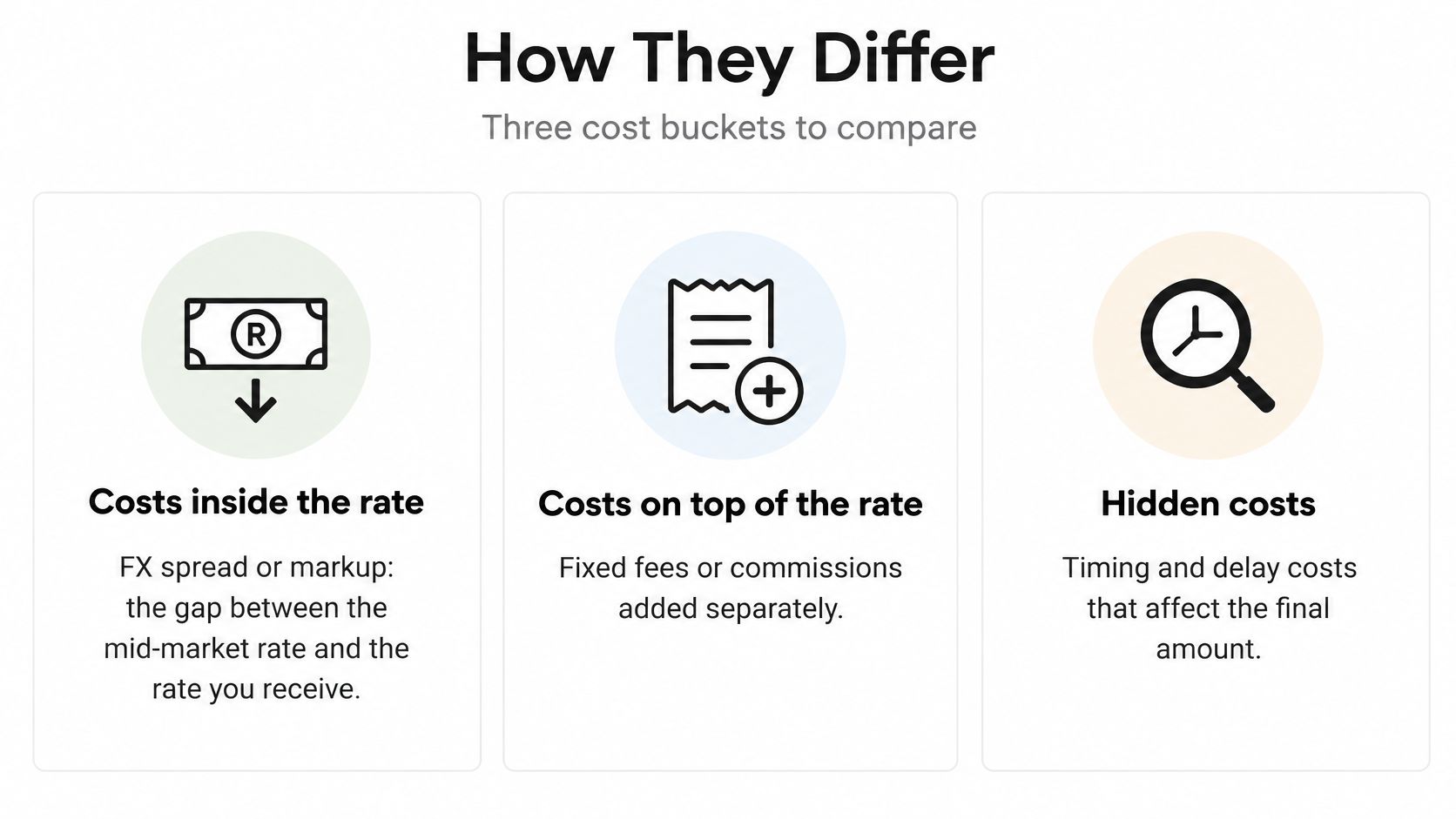
Costs inside the rate. The FX spread, also called a markup, is the difference between the mid-market rate and the rate offered to you. It is built into the exchange rate, so it may appear only as a less favourable number on your confirmation. Like a small amount shaved off each rand, the effect becomes more noticeable as the payment grows.
Costs on top of the rate. Transfer, SWIFT and administrative fees are separate charges. They are easier to spot on a quote, but still add to the total cost.
Costs taken along the route. Correspondent banks may deduct amounts as a payment passes through the banking network. The recipient gets less, and the deduction may not appear as a separate charge on your provider's quote.
| Cost type | What it covers | Where it appears |
|---|---|---|
| FX spread or markup | Gap between the mid-market rate and the rate you receive | Built into the rate on the confirmation |
| SWIFT or transfer fee | Fixed charge for sending the payment through the banking network | Stated separately; R500 to R1,000 on a R1 million transfer in one Moneyweb example |
| Intermediary deduction | Amount taken by banks along the payment route | Reduces the amount received, often without a line item |
| Commission per trade | Per-lot charge on some trading accounts | Listed separately on trading statements |
For context, Legal Clarity's guide to forex in South Africa summarises a Moneyweb report that South African banks may include roughly 2% to 3% in exchange-rate spreads and charge SWIFT and administrative fees separately. It gives the hidden FX cost on a R1 million US transfer as about R20,000, excluding SWIFT charges of R500 to R1,000. These are distinct parts of the cost, not interchangeable labels for the same charge.
Trading accounts use a different pricing structure from cross-border business payments. Retail zero-spread accounts usually replace the bid-ask markup with a per-lot commission. Swaps, funding costs and slippage can still apply, so a zero-spread label does not mean the trade is free. A 0.0-pip figure on a trading platform is not directly comparable with a business payment, where costs may sit in the exchange rate, separate fees or deductions along the route.
If you want to see how these pieces fit together, this walkthrough explains the mechanics:
Compare the full payment, not just the headline spread. Check how much leaves your account and how much reaches your supplier. The difference between those amounts shows the practical cost, including charges that a rate alone cannot reveal.
Why Zero Spread Does Not Protect Against Rand Moves
No. A zero-spread quote changes who carries what margin. It has no effect on which way the rand goes between the moment you accept a rate and the moment the money settles.
South Africa's currency history makes that plain. IMF research on the rand describes it as one of the more volatile currencies among advanced and emerging-market currencies when measured by nominal effective-rate movements and monthly changes. During the 1998 crisis, the rand depreciated 28% against the US dollar between the end of April and the end of August. A 1% saving on the spread is small consolation against a move of that size.
What moves the rate has nothing to do with your provider's pricing model. Commodity prices shift the terms of trade, global risk sentiment decides whether foreign capital stays or leaves, domestic policy uncertainty gets priced in within hours, and US conditions set the tide everything else floats on.
A quote is only as good as the moment it executes. Everything either side of that moment belongs to the market.
Timing is where operational exposure hides. Consider the four cases that catch South African businesses most often:
- A delayed export receipt. The buyer pays three days late and the rand has moved by the time the dollars arrive.
- An urgent supplier payment. You accept a quote on Friday afternoon, the treasury desk processes it Monday, and the rate has changed.
- A weekend or holiday conversion. Liquidity is thinner, so the price you're offered sits further from the mid-market rate.
- A payment made just before a major data release. The rate can reprice within seconds of the announcement.
A quote can also be re-priced before execution if it expires, which makes the validity window a commercial term, not a technicality. Ask your bank two direct questions. Would forward cover suit this exposure better than a spot conversion, and would adjusting the payment date reduce the risk more cheaply than hedging it?
How to Check a Zero Spread Quote Before You Pay
You don't need special software to test a quote. You need the discipline to record seven things and compare them after settlement.
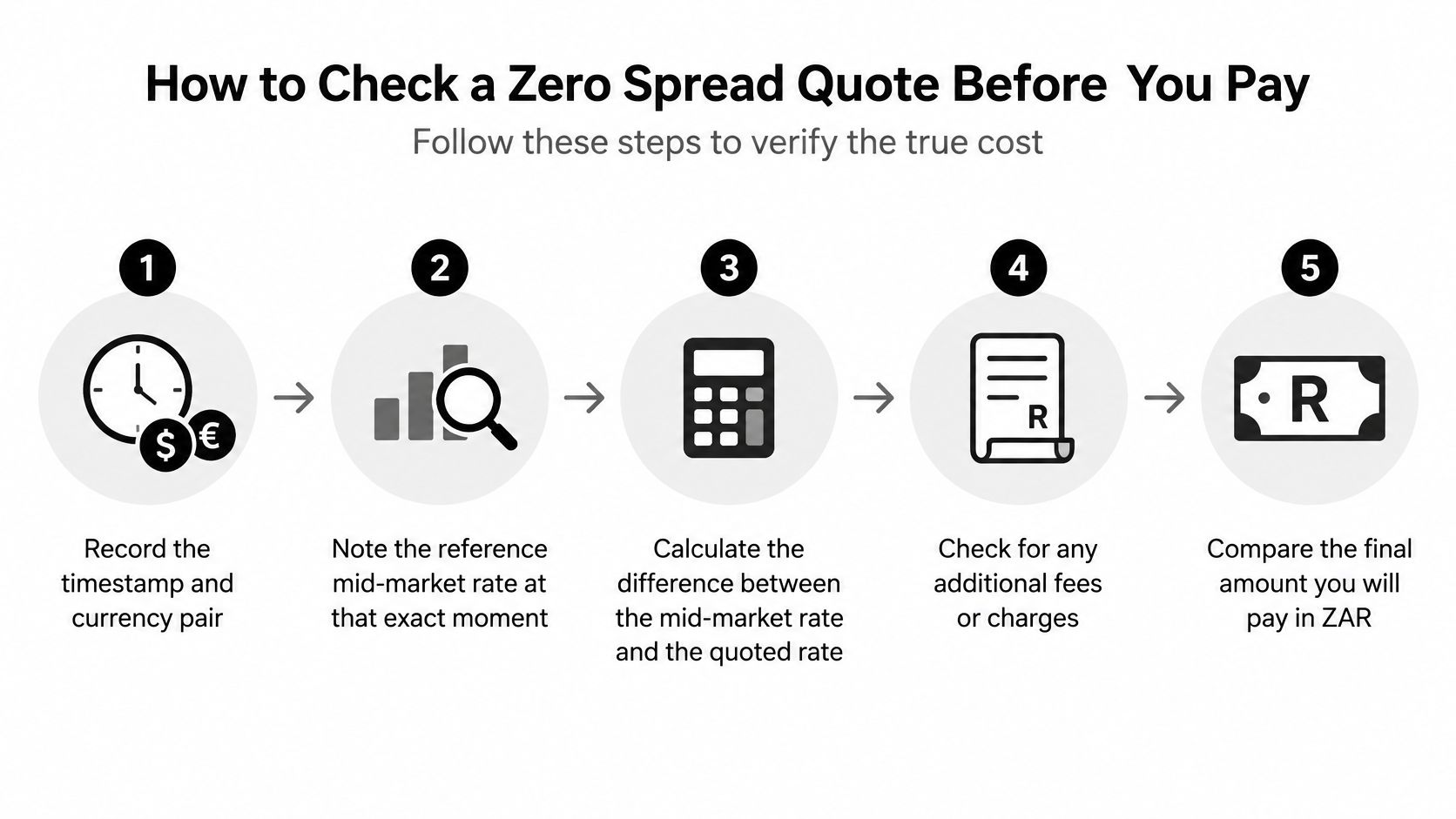
- Write down the timestamp and currency pair. The same USD/ZAR quote differs within minutes, so a rate without a time attached can't be checked later. The common slip is comparing your 09:15 quote with a mid-market rate you looked up at lunchtime.
- Note the mid-market rate from an independent source at that exact moment. Use a benchmark you don't buy from, otherwise you're grading a provider against itself. Pulling the rate from the provider's own screen defeats the test.
- Calculate the spread. Subtract the quoted rate from the mid-market rate, divide by the mid-market rate, and you have the percentage. On 18.00 against 17.82, that's 0.18 divided by 18.00, or 1.0%. The slip here is dividing by the quoted rate instead of the benchmark.
- Check the validity window. A quote that expires in ten minutes and one held for the day carry different risk. If the window is short, you'll transact at whatever the market gives you at execution, so plan the timing rather than accepting it.
- List every fixed charge. Ask explicitly about SWIFT fees, receiving fees, intermediary deductions and any monthly account charge. South African broker guidance on zero-spread accounts acknowledges that spreads widen in volatile conditions and that slippage can occur even on a zero-spread account, which is why the fee list has to be complete. The common slip is remembering the transfer fee and forgetting the deduction the correspondent bank takes.
- Calculate the expected recipient amount and the all-in percentage. Use the amount you will send, then express total cost as a percentage of it. A rand figure feels small until you see it as 1.8% of the payment.
- Reconcile after settlement. Compare what arrived with what the confirmation promised and record the gap. Do this once and you'll know whether your provider's quotes hold in practice.
Practical rule: keep the timestamp, the benchmark rate, the quoted rate, the fee breakdown and the settled amount for every payment. Three months of those records will tell you more about a provider than any comparison table.
That record set also gives you evidence. A provider whose settled rate consistently sits a fraction below the benchmark at the recorded timestamp is charging a spread whether it calls it one or not.
Confirm the All-In Cost Before You Choose a Provider
Compare providers using the total cost of a payment you make. The headline spread is only one part of that cost, and it may not be the deciding one.
Decision rule: zero spread means no added markup on the exchange rate. It does not mean the payment is free. Check the rate and every fee before comparing quotes.
Use three tests:
The rate test. Compare the quoted rate with an independently observable mid-market rate recorded at the same time. This shows whether the exchange rate includes a markup.
The fee test. Check that all applicable charges are disclosed before you confirm the transaction. A SWIFT fee can raise the cost even when the rate has no spread.
The deduction test. Ask whether intermediary charges are excluded or stated in writing. A deduction made by another institution can reduce the amount that arrives.
A provider may offer a competitive rate while still charging fees or leaving deductions unclear. The full cost matters more than the rate alone.
Use the checks from the previous section on a payment you expect to make. Record the quote, calculate the all-in cost as a share of the amount sent, then compare it with the amount received. Repeat the comparison for the currency pairs and payment types your business uses regularly. Our free USD to ZAR converter checks the live mid-market rate and compares what a bank may take in FX spread and SWIFT fees, helping you see those costs before committing.
A single payment gives you a practical comparison. Keep the quote and final amount together, so you can assess whether the quoted cost matched what arrived.
For South African businesses, Zaro charges a transparent spread on the exchange rate and no SWIFT fees. Pricing depends on volume and corridor, and a clear quote is available upon sign-up or by speaking with the Zaro team. That quote lets you assess the exchange-rate spread alongside the disclosed fees before confirming a transaction.