
Plenty of South African businesses have been told that a zero volatility spread means they're paying the exchange rate, so there's nothing left to negotiate. That advice is tidy, popular and incomplete. It describes one line of a quote and says nothing about the rest of the money that leaves your account, or about what your supplier can confirm on the other side.
The phrase itself is the problem. Zero volatility spread names a measurement in bond pricing and a marketing description in currency conversion. Both uses are legitimate. Neither one, on its own, tells you what a payment costs.
The number that does tell you is simpler than either: rand debited against rand received, on the same invoice, at the same timestamp. Get that comparison right and the vocabulary stops mattering.
What a Zero Volatility Spread Means
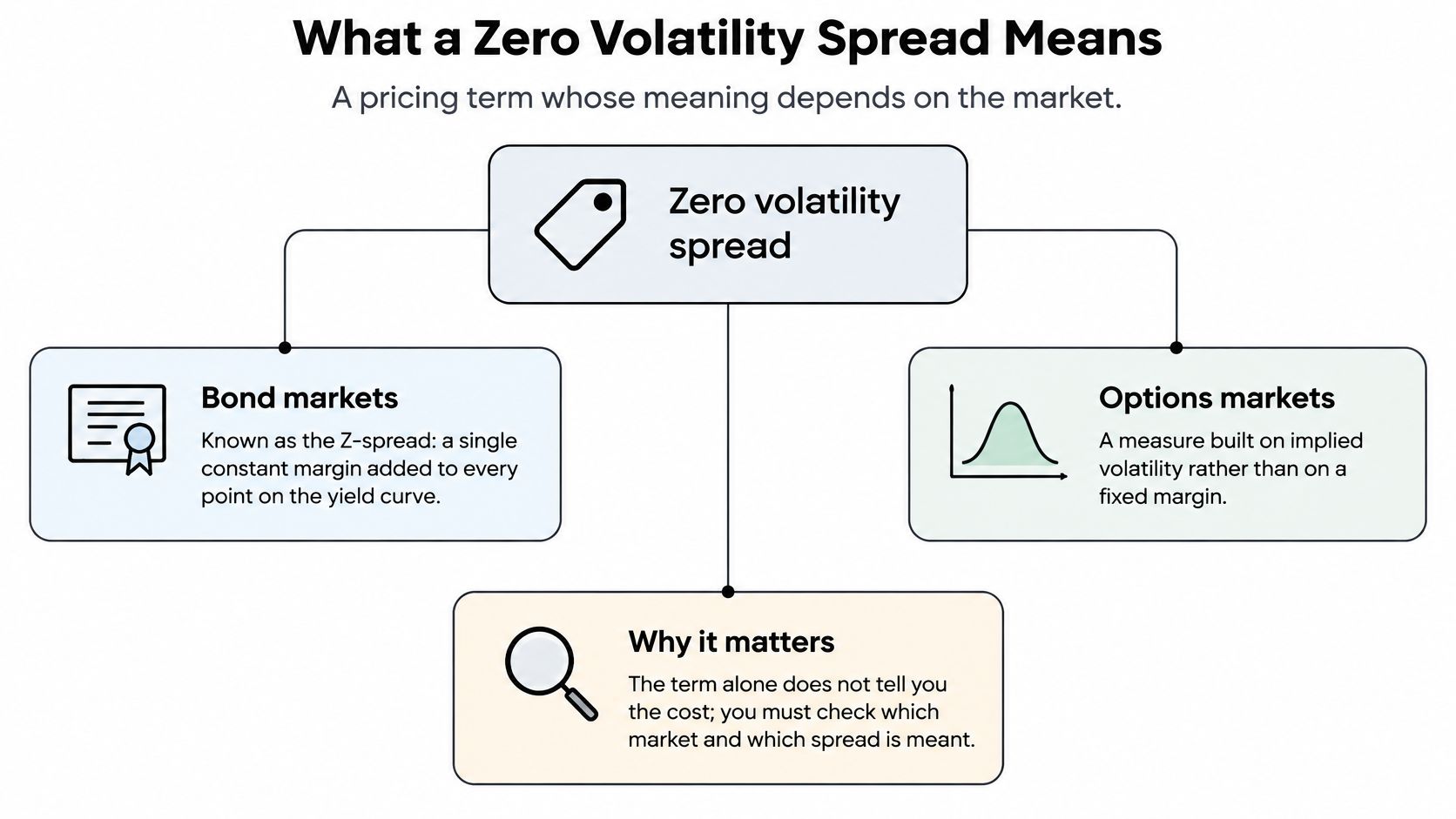
Ask two finance people what a zero volatility spread is and you'll get answers that don't meet. That isn't confusion. The phrase names two different measurements, and the only way to use it well is to know which one is in front of you.
The bond market meaning
In fixed income, a zero volatility spread, usually written Z-spread, is the single constant margin you add to every point on a zero-coupon yield curve so that discounting a bond's cash flows returns exactly its traded price. The Prudential Authority's government bond curve review sets out how that curve is bootstrapped from observed instruments to produce a risk-free term structure that reprices its own inputs. Work at the University of Johannesburg built such a curve from local money-market, FRA and swap rates and used the Z-spread as an evaluative measure to compare bonds with similar duration, convexity and price value of a basis point. Because every coupon keeps its own date, the measure doesn't treat a 2031 maturity as if it were a 2027 one.
Local conventions sit inside that calculation. South African fixed-rate bonds are typically valued on semi-annual cash flows, an Actual/365 day-count basis, T+3 settlement and the South African holiday calendar, so a local Z-spread carries technical pricing as well as credit and liquidity compensation.
The curve you discount from is part of the definition, not a detail. South Africa's move from JIBAR to ZARONIA means the same bond can throw off two different spreads, and the Reserve Bank's historical ZARONIA overnight-indexed-swap curve work shows the two reference frameworks aren't interchangeable. A spread quoted against the wrong basis looks like issuer risk when it's really benchmark basis.
The payment meaning
In a currency quote, the same phrase means the provider adds no margin to the mid-market rate, the midpoint between the live buy and sell prices for a pair. Picture a market stall. The mid-market rate is the wholesale price the stallholder paid. The spread is the margin added on top. A zero spread claim says the stallholder is passing goods through at cost, which can be a genuine offer, but the stall still has rent to cover somewhere.
| Context | What is measured | What it means for a payer |
|---|---|---|
| Bond markets (Z-spread) | Constant spread added to the zero-coupon curve so discounted cash flows equal price | Extra yield over the risk-free curve, not a payment fee |
| FX payments (advertised zero spread) | Gap between the mid-market rate and the rate applied to your payment | Markup only; provider or bank fees may still apply separately |
| Typical bank FX quote | Rate applied minus mid-market rate, plus separate sending charges | Compare the rate you receive with the live mid-market rate on the same timestamp |
How to tell which meaning you're being sold: ask what the quoted number is measured against. A Z-spread is measured against a zero-coupon curve. A payment spread is measured against the mid-market rate at a stated time. Then ask whether any fees sit on top of it. If the answer drifts, you've learned something useful.
How Market Volatility Moves the Spread
Insurers raise premiums in storm season and relax them when the weather settles. The house did not change. The probability of a claim did, and the price followed. FX desks work the same way.
A provider quoting you a rate at nine in the morning and settling in the afternoon carries the currency in between. If the rand moves against that position, the desk absorbs the loss, so the margin includes a buffer sized to expected movement. When volatility falls, buffers compress and quotes tighten. When it rises, the buffer widens and the same invoice costs more in rand, even though nothing about your supplier changed.
The calm and turbulent settings look like this side by side.
| Measure | Calm market | Turbulent market |
|---|---|---|
| Implied USD/ZAR volatility | Drifts toward multi-year lows | Reprices sharply higher when the rand sells off |
| Realised one-month volatility | Hovers near what the options market priced in | Runs well above earlier implied readings |
| Buffer inside your quote | Thins out, so quotes tighten | Widens, so the same invoice costs more rand |
Implied volatility is what the options market charges for. Realised volatility is what the rand delivered. They are different quantities, and treating a soft implied reading as proof the currency has turned tame is how calm periods produce expensive decisions. A narrower margin means the desk is pricing less risk over the next few hours. It says nothing about where the rate sits when your committed payment settles next week, which is why a quiet chart is not a hedging decision already made.
The test that settles it: ask whether the spread on your quote is fixed or moves with market conditions, then ask for that answer in writing before you send the invoice.
South African evidence complicates the idea that a spread over the risk-free curve is purely a volatility charge. A study of South African Treasury instrument returns analysed monthly yields and compounded returns over 2000 to 2013 and found Treasury bills carried a statistically significant volatility risk premium, while long-dated government securities showed high return variance without one. The same work examined bid-ask spreads as a sign of secondary-market liquidity and trading cost.
Two practical takeaways follow. Maturity matters, so match your zero curve to the cash flow you are pricing. And a positive spread on a corporate or structured instrument bundles expected credit loss, liquidity compensation, market segmentation, tax and technical effects. Attribute a wider spread to the issuer's fundamentals only after you have checked the liquidity conditions in the market you are quoting from.
Why a Zero Spread Is Not Zero Cost
Start with the measurement that ends every argument about pricing: ZAR debited minus the beneficiary's confirmed amount received, divided by the invoice value. Express it as a percentage and you have the only cost figure that survives scrutiny. Everything a provider tells you about its spread is a claim about one component of that number.
The gap between the debit and the receipt has five places to hide.
| Cost line | Where it shows up | What to record |
|---|---|---|
| FX difference | Gap between the mid-market rate and the rate applied | Rand cost against mid-market value at the same timestamp |
| Sending fees | SWIFT or outgoing charge on the bank statement | Visible amount per transfer, roughly R500 to R1,000 at conventional banks |
| Intermediary deductions | Correspondent bank takes a share in transit | Difference between the amount sent and the amount reaching the account |
| Receiving-bank charges | Beneficiary's bank deducts on arrival | Confirmed amount received, from the beneficiary's statement |
| Payment-date timing | Rate and value date differ from initiation to settlement | Quote date, settlement date and the rate on each |
Conventional banks make part of this visible and leave the rest in the rate. Reporting on SME international transfers puts visible SWIFT charges at roughly R500 to R1,000 per transfer, while hidden spread costs can accumulate to thousands of rand for businesses making frequent or large payments. That second figure is the one finance teams miss, because it never appears as a line item.
The beneficiary's statement is the only proof
Your bank can show what it debited. Only the receiving side proves what arrived. Correspondent banks take a share in transit and receiving banks deduct on arrival, and neither sends you an invoice. Ask your supplier for the credit advice or remittance confirmation, and keep it with the payment record.
The rate you were quoted is a promise. The credit advice is evidence.
This matters more than the amount suggests. When a supplier's bank nets off a charge, the invoice can land short, which triggers a follow-up payment, another set of fees and a delay in releasing goods. Chasing the shortfall costs more admin than the deduction itself.
Add one line to your month-end close
Pull every cross-border payment for the month, fill in the five lines above, and divide the total by invoice value. Do it provider by provider rather than payment by payment, because one transfer tells you nothing and three months tells you a pattern. Label each line separately in the ledger so an auditor can trace the difference between what was authorised and what was received. If your FX difference line is bigger than your sending fees line, the rate is where the money is going, and that's a conversation to have with the pricing team rather than the bank's call centre.
How a Supplier Payment Plays Out in ZAR
Say a Johannesburg exporter has a USD 10,000 supplier invoice to settle and the mid-market rate on the day is R18.00 to the dollar. Two quotes land on the same desk within an hour of each other.
The first is a zero-spread quote: the rate applied is the mid-market rate, so the conversion adds R0 before any fixed fee, and the invoice converts at R180,000. The second is a bank quote with a 2% markup, applied at R18.36, which delivers R183,600 against the same invoice. The payer is R3,600 worse off before any SWIFT charge is added, and that number only exists because both quotes were stamped at the same time on the same day.
What the supplier actually receives
Now follow the money to the other end. The supplier's bank deducts R400 on arrival, so the beneficiary receives less than the amount sent. That deduction doesn't appear on the exporter's statement, and it doesn't appear in either quote. The finance team has to log it as its own line, from the supplier's confirmation, or the reconciliation will never close.
A short receipt also creates work. The supplier's system marks the invoice as partly paid, the account goes on hold, and someone re-sends the balance with another set of charges attached. Two payments where one was planned.
Every rate and fee in this walkthrough is illustrative, not a market quote. Replace them with live rates from the same timestamp before you draw any conclusion from the comparison.
The habit the example builds
Compare totals in rand at the same timestamp, never headline rates from different days. A quote taken at Tuesday's close against one taken on Wednesday morning is a comparison of two markets, not two providers.
Watch the validity window too. A quote is a price for a period, and settlement doesn't happen the moment you deal. If the window lapses before the beneficiary is credited, the number you approved isn't the number that cleared.
Replace every rate here with your own same-day quotes. The structure of the comparison is what travels; the numbers don't.
The lesson survives the arithmetic. A zero spread quote and a marked-up bank quote differ by a calculable amount in rand, and a receiving-bank deduction differs by an amount you can only learn from the beneficiary. Capture both, or you're managing half of the cost.
Zero Spread Versus Hedging Currency Risk
Removing a markup makes the conversion price transparent. It does not protect an exporter's future ZAR revenue, an importer's landed cost or a BPO's USD payroll from the rand moving. Those are separate problems, and the industry habit of treating a clean rate as a complete risk answer is the expensive one.
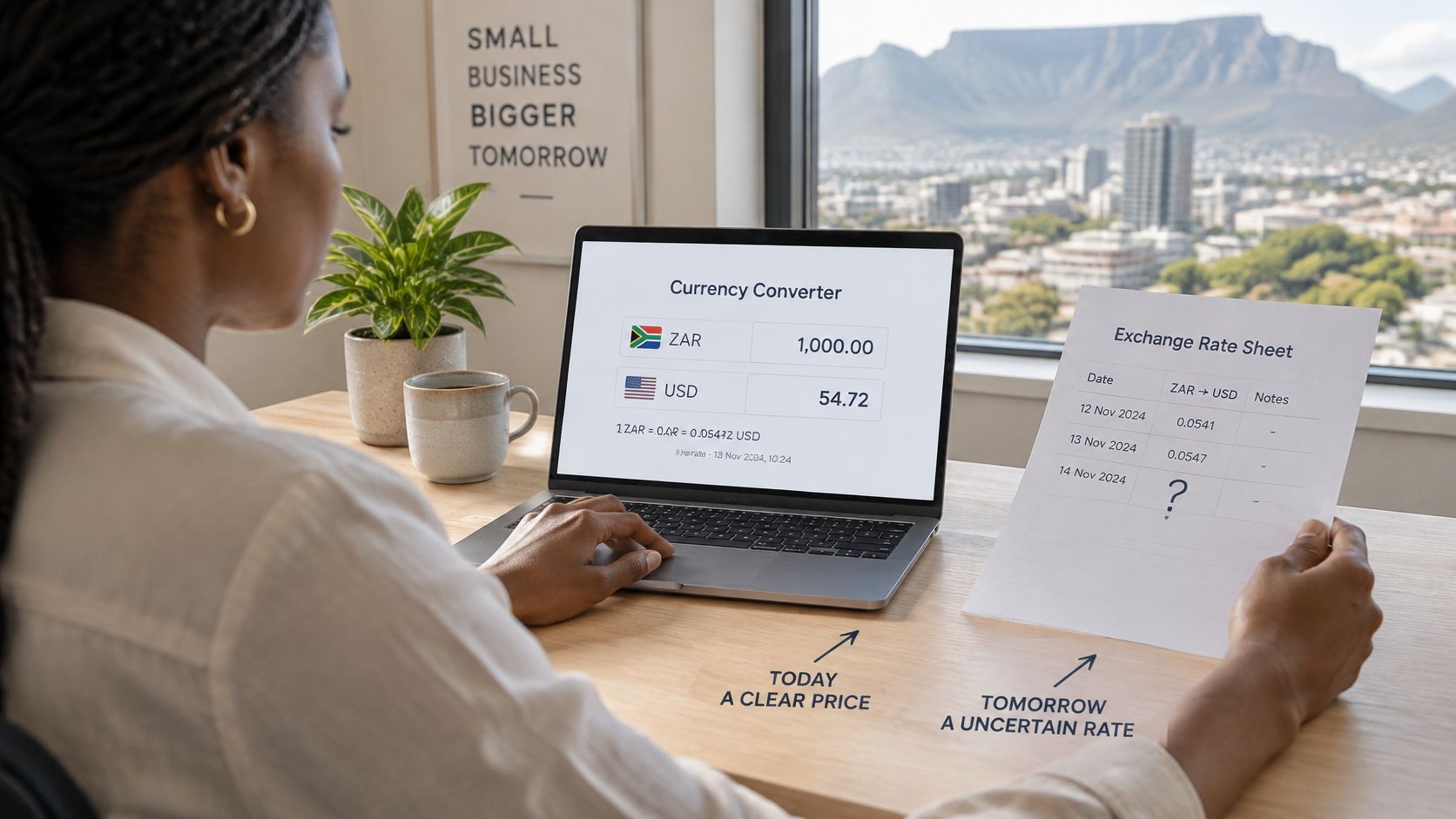
The rand stays an emerging-market currency exposed to abrupt repricing. Moneyweb's reporting on the rand's lost reputation for wild swings captures the trap: one-month implied USD/ZAR volatility fell to 7.9% in late 2025, the lowest since February 2000, while the five-year average realised one-month figure was 13.1%. A market that prices calm and delivers more than calm is precisely where complacency gets paid for.
So separate the two decisions. Converting an invoice that's already due is a pricing question. Protecting cash flow you haven't received yet is a risk question.
| Option | Best when | Protects against | Leaves exposed to |
|---|---|---|---|
| Spot conversion at a transparent rate | Invoice already due and payable | Hidden markup on the conversion | Rand movement if you wait before converting |
| Forward contract | Committed future payment or receipt on a known date | Rate movement up to the agreed date | Gains if the rand moves in your favour |
| Option hedge | Timing or volume is uncertain | Adverse moves, with the upside kept | Premium paid up front |
| Natural hedge | Receipts and payments share a currency | Net currency exposure | Mismatched timing or amounts |
Three questions before you convert instead of hedge
Is the cash flow committed? A signed purchase order or a supplier invoice you've already accepted is committed. A pipeline conversation isn't, and hedging it locks in a rate for revenue that may never arrive.
Is the date fixed? A forward with a known maturity fits a contractual payment run. If delivery could slip a quarter, an option costs more but doesn't punish you for a delay.
Do receipts and payments share a currency? A South African business billing in dollars and paying a Filipino contractor in dollars already holds a partial natural hedge. Net the two before you buy anything.
Build a landed-cost model with two columns: a calm rand, and a shock you choose and can defend to your board. Put the conversion spread in one column and the exposure in the other. That way the spread sits beside the risk instead of standing in for it.
Exchange control is a separate gate. A cheap conversion still stalls when the payment purpose, the Balance of Payments code or the supporting documents don't match, and the delay can outlast the rate advantage that prompted the payment. Check documentation before you compare prices, not after.
Convert what's already due at the cleanest rate you can verify. Hedge what's committed and dated. Don't let the first decision stand in for the second.
Checking Provider Pricing Before Your Next Payment
A short check before you confirm beats reconstructing a payment after the fact. A transparent quote has a specific shape, and you can test for it without a spreadsheet.
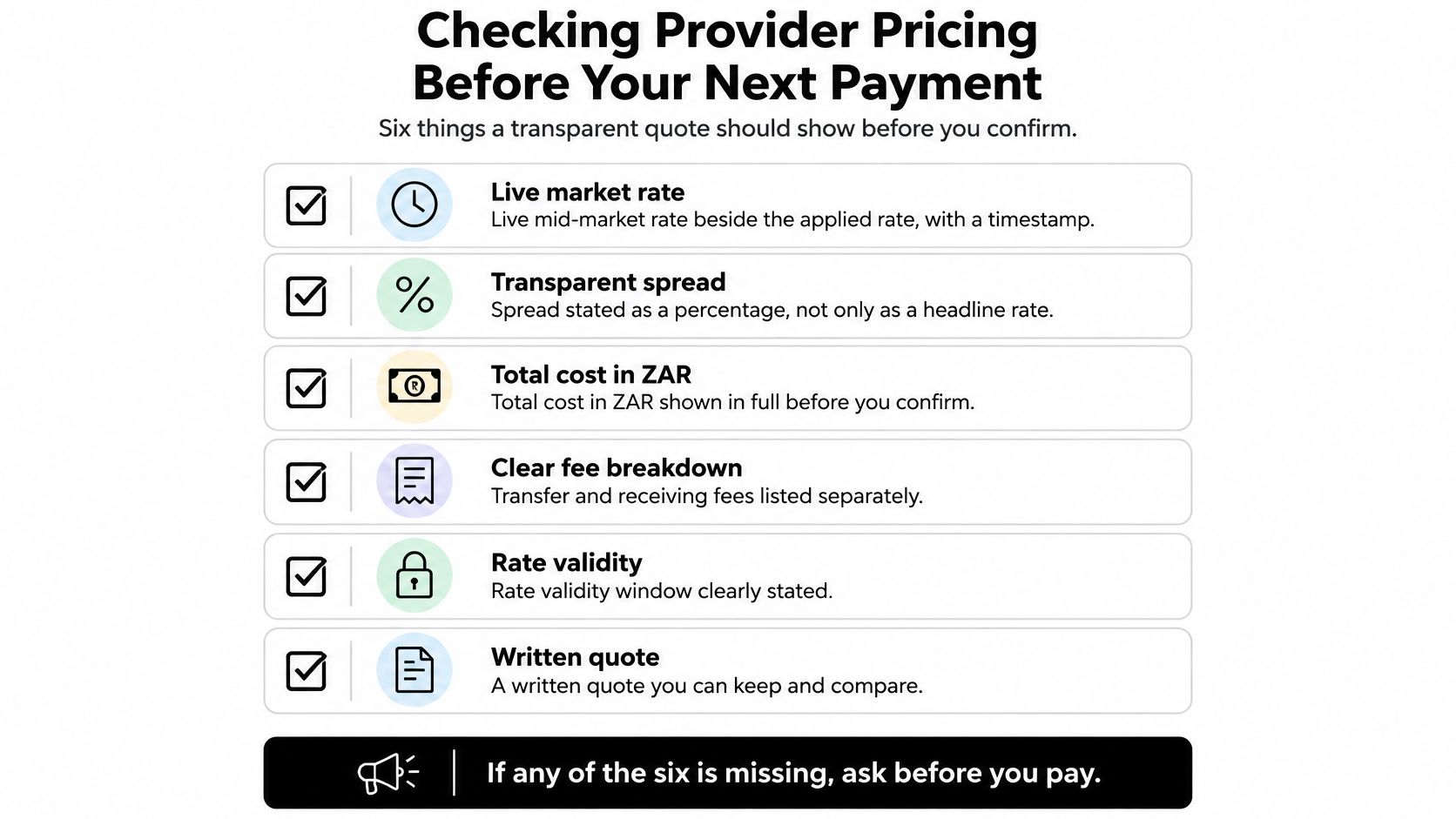
Six things a transparent quote shows
- The live mid-market rate beside the rate applied, with a timestamp. Both numbers, same moment. Without the timestamp, the comparison is theatre.
- The spread stated as a percentage. A percentage can be checked against the interbank rate you look up yourself; a headline claim cannot.
- Every fee, listed before confirmation. Sending, intermediary and receiving charges belong on the quote, not on a statement that arrives after the money has moved.
- How long the quote holds, and what moves it afterwards. A rate with no validity window is a rate you can't plan around.
- The pricing basis. Whether the rate depends on volume or on the currency corridor you're paying into tells you whether the quote you got will repeat next month.
- The provider's regulatory status. Check the FSP number against the FSCA register, then ask how client funds are safeguarded before they are sent on. Reading up on how electronic money safeguarding works gives you the questions to press on: which account holds the balance, whether it is segregated from the provider's own money, and what happens to it if the provider fails.
A zero spread paired with heavy fees elsewhere is the same cost, moved to a line you weren't watching.
What to do with your next payment
- Reconcile your recent payments. Run each one through the debit-minus-received formula and see which line dominates. This is usually the moment a business discovers its real cost sits in the FX difference rather than in the visible charge.
- Benchmark against the mid-market. Run the same invoice through a free USD to ZAR converter that shows the live mid-market rate, so you can see what a bank may be taking in spread on top of its SWIFT fee. We publish pricing based on volume and corridor, with a clear quote at sign-up or from our team, and we disclose applicable fees before a transaction is confirmed. Zaro is an authorised Financial Services Provider registered with the FSCA, FSP number 55133.
- Ask for the beneficiary amount in writing. The figure your supplier receives after every fee, in the currency they invoice in. The quoted rate alone tells you nothing about that number.
- Decide the hedge separately. Committed future cash flow gets a hedging decision of its own, and spot pricing doesn't answer it. A calm rand on payment day says nothing about where the rand sits when the next invoice falls due.
For a walkthrough of how quoting and settlement interact once a payment is in flight, this video is worth watching before your next run:
Recheck the live rate before settlement, because a quote is a snapshot and markets keep moving after the snapshot is taken.
Put one question to every provider in writing: what will the beneficiary receive after every fee? The answer is either a number or it isn't an answer.
Zaro gives South African businesses a way to convert and pay at the live mid-market rate with a transparent spread and no SWIFT fees, so the quote you approve is the number you can reconcile against your supplier's confirmation. If your last international payment left a rand gap you couldn't explain, run the same invoice through Zaro and compare the all-in cost before you commit to the next one.